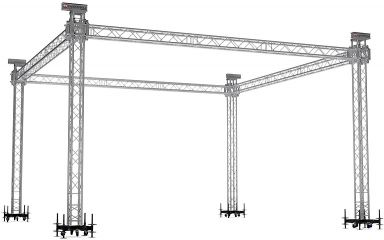
Truss constructions
Truss Constructions at LTT – Your Specialist for Event Technology
Truss constructions are the backbone of every stage, exhibition stand and show set-up — and at LTT you get them straight from the specialist. Whether you plan a ground support, a stage roof, a sign gantry or a radio mast, our modular aluminium truss systems combine low weight with impressive load capacity and let you create genuine wow-effects.
As a manufacturer with our own production in Germany and 25 years of experience, we know exactly what professionals need. Explore our range of high-quality branded products and build your next project on a solid, TÜV-tested foundation.
From compact 2-point ladder trusses to heavy-duty GS94 towers — here you find the optimal solution for stages, trade fairs, clubs, theatres and road applications.
What Exactly Is a Truss Construction? Fundamentals
A truss construction — called truss in English — is a modular lattice girder (Fachwerkträger) used in event technology to carry payloads such as spotlights, moving heads and loudspeakers, and to build decorative structures. Trusses are assembled from straight lengths, corner blocks and connectors into free-standing, suspended or ground-supported frameworks.
Unlike a simple aluminium tube or a lighting stand, a truss distributes loads across several chord tubes and diagonal braces. This lattice principle gives it a far higher stability-to-weight ratio, which is why truss constructions dominate both mobile and fixed stage technology, trade fair and shop fitting.
How a truss differs from adjacent products
Many users confuse trusses with rigid support beams or telescopic stands. The key difference lies in the modular, standardised connector system: a truss can be extended, angled and combined almost infinitely, while a stand or beam is a fixed single element.
Besides carrying weight, a truss also serves a decorative function — coloured or shaped truss circles set exhibition stands and stage designs in scene. Typical materials are aluminium alloy EN AW 6082 T6 for standard systems and steel for heavy-load or special components. This combination of light weight, high load capacity, many mounting options, multifunctional use and easy transport is what makes truss constructions indispensable for events.
Types and Variants of Truss Constructions (1, 2, 3 and 4-Point)
The primary way to classify truss constructions is by the number of chord tubes: the more chords, the higher the stability and load capacity of the overall structure. LTT offers all common variants for every application.
1-point truss
The 1-point truss consists of a single chord and resembles an aluminium tube with truss connectors at both ends. It is used as an extension to hang a mirror ball or a single spotlight, or to stabilise open-air roofs between larger structures.
2-point truss
The 2-point truss (ladder truss) has two chord tubes and is popular as a curtain rail or for mounting lighter fixtures, molton fabric or drapes. Its compact form even fits into a smaller car — but note the mechanical limit: with wider spans a 2-point truss can buckle sideways, so keep loads modest and decorative.
3-point truss
The 3-point truss serves mainly as deco truss at trade fairs, often with a thinner wall thickness, and enables special constructions such as truss circles for projections and moving-head effects.
4-point truss
The 4-point truss is the most common variant and offers the highest mechanical stability of all four types. Ground supports and stage roofs are built from 4-point truss because it carries the greatest loads. Beyond the number of chords, length, tube diameter and wall thickness determine the maximum payload — always match them to your individual application.
Material and Technical Buying Criteria: The Naxpro-Truss FD/HD/GS Series
The material and precise dimensions decide whether a truss construction is right for your project. Standard trusses are manufactured from aluminium alloy EN AW 6082 T6; steel is reserved for heavy-load or special components. Trusses differ in length, outer dimensions, number of chord tubes and — crucially — wall thickness. Coloured trusses are available for trade fair use as an alternative to standard aluminium grey.
As a manufacturer, LTT gives you the concrete technical specifications of the Naxpro-Truss series so you can plan precisely instead of guessing:
Naxpro-Truss series overview
- FD21 / FD24 — 35 mm diameter chord tubes with 2 mm wall thickness; the lightweight deco and light-duty series.
- FD31 / FD44 — 50 mm diameter chord tubes with 2 mm wall thickness; the versatile standard for most stage and exhibition work.
- HD31 / HD44 — 50 mm diameter chord tubes with 3 mm wall thickness; the heavy-duty series for higher loads and larger spans.
- GS94 — 60 mm diameter chord tubes with 5 mm wall thickness and 40 x 3 mm diagonal tubes; the heavy-load system for ground supports and stage roofs.
What to check before buying
Always compare chord diameter (35/50/60 mm), wall thickness (2/3/5 mm) and diagonal tube dimensions against your required working load limit and span. A larger diameter and thicker wall mean more payload — but also more weight per metre. For decorative set-ups the FD series is ideal; for heavy rigging with moving heads and loudspeakers choose HD or GS94 to achieve safe, impressive results.
Applications and Use: Ground Support, Stage Roofs, Exhibition Stands and Sign Gantries
Truss constructions are used wherever loads have to be carried safely and flexibly — in mobile and fixed stage technology, trade fair and shop fitting, and even in road and construction environments. Their fast assembly and dismantling make them ideal for temporary set-ups at festivals, concerts and exhibitions.
Ground support
The ground support is the best-known construction form. It is built from towers acting as vertical supports plus a horizontal head element that is often raised with motors through sleeve blocks. Ground supports can be erected almost anywhere and allow additional suspended features such as truss circles or extra load bars.
Stage roofs
A stage-roofed construction is essentially a ground support with a roof. Because rain or snow can rapidly increase the roof load, stage roofs require heavy-load truss such as the GS94 series and proper static planning.
Exhibition stands and shop fitting
At trade fairs and in retail, trusses form the frame for banners, lighting and branding — often as deco truss in shapes and colours that set the stand in scene.
Road and construction use
Beyond the event world, truss constructions serve as sign gantries for variable traffic signs, as cable bridges and as radio masts for temporary road and construction applications. To complete these set-ups you will also need suitable lifting and mounting hardware — round it off with matching rigging accessories and lighting technology from the LTT range.
Comparison: Naxpro-Truss vs. Global Truss vs. Prolyte vs. Alutruss
A frequent buyer question concerns the comparison and cross-brand compatibility of truss systems. Because connector geometries and tube dimensions vary, systems from different manufacturers are generally not freely interchangeable — always check compatibility before combining brands. The comparison table below summarises the key differences.
As a rule, connectors, corner blocks and base plates should always be sourced from the same system as the straight lengths. If you mix systems on one project, keep them mechanically separate rather than joined at a single load point. Our team helps you pick a consistent, TÜV-tested system as your reliable partner.
Load Capacity, WLL and Safety Norms (DGUV V17, EN 1090, TÜV)
Safe truss construction stands or falls with the load capacity and the applicable norms. The decisive figure for planning is the working load limit (WLL) — the maximum permissible load for a given truss type and span. As a rough principle, the WLL drops sharply as the span increases: a 4-point HD truss carries considerably more over 2 m than over 8 m. Always take the exact WLL and load tables from the manufacturer documentation of the specific series before you rig anything.
Relevant norms and certifications
- DGUV Vorschrift 17 (formerly BGV C1) — the binding accident-prevention regulation for event and production venues.
- EN 1090 — the standard for the execution of steel and aluminium structures, relevant for certified truss production.
- DIN EN 1999 — design and construction of aluminium structures.
- TÜV Süd / TÜV Nord — independent certification of production and static calculations.
- VStättVO — venue regulation; scene areas under 200 m² are subject to specific rules.
Static documentation
Every serious truss set-up needs static documentation of the standing and hanging points to determine the permissible loads. LTT trusses are manufactured with certified production and static testing, giving you a solid, safety-compliant basis for professional applications and beautiful, safe results.
Who Is Allowed to Build a Truss and How to Assemble It Safely
A common safety question is who may build a truss construction. In principle, smaller trusses standing on feet may be erected without a qualified specialist as long as the truss statics are respected, the assembly follows the manufacturer's instructions and the scene area stays under 200 m² (and not in multi-purpose halls with more than 5,000 seats).
As soon as trusses are flown, motorised or exceed these limits, a Verantwortlicher für Veranstaltungstechnik (VfV) and qualified personnel are required. The relevant qualifications include the three-year training as Fachkraft für Veranstaltungstechnik and, for suspended structures, the igvw SQ Q2 rigging qualification standard.
Safe assembly step by step
- Check every truss element and connector for damage and valid inspection labels before use.
- Assemble straight lengths and corner blocks with the correct conical connectors, bolts and R-clips — insert the bolt from the correct side to avoid irreparable damage.
- Secure each bolt from the outside and lock it with an R-clip on the inside.
- Verify the standing surface, base plates and static documentation before applying any load.
- Never exceed the WLL, and always secure flown constructions with steel safety wires.
When in doubt, get competent advice — our specialists support you as a reliable partner.
Buying Guide: Choosing the Right Truss System and Accessories
This buying guide helps you select the right truss construction by span, load and application. Start with three questions: What do you want to hang, how far do you need to span, and is the set-up indoor or outdoor?
Beginner vs. professional decision helper
- Light decoration, small DJ set-up, banners: an FD-series deco truss (35–50 mm, 2 mm wall) on stands or feet is sufficient.
- Regular stage lighting, moving heads, medium spans: choose an FD31/FD44 4-point truss for reliable stability.
- Heavy rigging, loudspeakers, ground supports, stage roofs: invest in HD or GS94 heavy-load truss with 3–5 mm wall thickness.
- Outdoor use: always factor in wind and weather loads and use heavy-duty systems with proper ballast.
Essential accessories
A truss construction is only complete with the right hardware. Plan for couplers (clamps), corner blocks, base plates, spigots, conical connectors, bolts and R-clips, plus chain hoists or motors for flown set-ups. Match your fixtures with lighting technology and effect equipment to bring the whole rig to life.
Buy the whole system from one range to guarantee compatibility — that is the safest route to impressive, professional results.
Accessories and Rigging Components for Truss Constructions
The right accessories turn loose truss lengths into a safe, functional construction. LTT offers all the rigging components you need from its own product world and leading brands.
Core rigging accessories
- Couplers / clamps — attach spotlights, loudspeakers and fixtures to the chord tubes.
- Corner blocks and connectors — join straight lengths into angles, circles and boxes; a corner block plus a short 21 cm length typically adds up to a clean 50 cm module.
- Base plates — provide a stable, weighted footing for free-standing towers and ground supports.
- Chain hoists and motors — raise flown truss lines safely and evenly.
- Spigots, bolts and R-clips — the small parts that guarantee a secure connection.
Cable management and dressing on trusses
Tidy cable management ('Traversen Kabelführung') is often overlooked but essential. Route power and signal cables along the chord tubes, secure them with cable ties or velcro straps at regular intervals and use strain relief at every connector. Never let cables carry mechanical load, and keep them clear of moving or motorised sections. Riggatec accessories and matching rigging hardware complete your set-up for a clean, professional finish.
Brands and Manufacturers of Truss Constructions
For truss constructions LTT relies primarily on its own premium brand Naxpro-Truss — high-quality aluminium trusses manufactured in Germany by trained specialists, with production and statics verified by independent testing bodies such as TÜV Nord. This manufacturer status lets us guarantee consistent quality and give you exact technical data.
Alongside Naxpro-Truss you will find leading manufacturers in our range, including:
- Global Truss — with its widely used F32, F33 and F34 systems.
- Prolyte — premium touring and heavy-duty structures.
- Alutruss — budget-friendly deco and light-duty trusses.
- Litec and Milos — established professional systems.
- Riggatec — rigging accessories that round off any construction.
Whatever the project, our high-quality branded products let you build safe, durable and impressive truss constructions — from a single deco frame to a full stage roof.
Care and Maintenance of Truss Constructions
Regular care and maintenance keep your truss construction safe and extend its service life. Aluminium trusses are robust, but connectors, bolts and load points need consistent attention.
Practical care and maintenance tips
- Cleaning: wipe trusses with a soft cloth and mild cleaner after outdoor or dusty use; avoid aggressive solvents that could attack coatings on coloured trusses.
- Inspection: before every job, check chord tubes and diagonals for dents, cracks or deformation — a bent tube significantly reduces the load capacity.
- Connectors: keep conical connectors, bolts and R-clips clean and lightly serviced so they seat correctly; replace worn or damaged parts immediately.
- Storage: store truss lengths dry and supported at several points to prevent bending, ideally in flight cases or on shelving.
- Documentation: log periodic inspections; documented checks are also required as legal proof under the applicable safety regulations.
Well-maintained trusses stay TÜV-compliant and reliable, so you can achieve consistently professional results job after job.
Related Categories and LTT – Your Specialist for Event Technology
Truss constructions rarely stand alone — combine them with matching lighting technology, loudspeakers, chain hoists and stage podiums to complete your set-up. As a specialist, we stock the full ecosystem around your truss: from rigging accessories and clamps to effect equipment such as haze and fog machines that give your rig the finishing wow-effect.
As a manufacturer with our own production in Germany and 25 years of experience, LTT is more than a dealer — we are your reliable partner for professional event technology. You benefit from our 3-year LTT warranty, free shipping from €69, fast delivery and express options straight from Germany, plus a worldwide dispatch network and wholesale conditions for resellers.
With over 100,000 positive customer reviews, we know how to help you set your projects in scene safely and cost-effectively. Explore our truss range and build your next stage, exhibition stand or show on a foundation you can trust — L, your specialist for event technology.
FAQ – Questions & Answers
A truss (German: Traverse) is a modular lattice girder used in event technology to carry payloads such as spotlights, moving heads and loudspeakers, and to build decorative structures. A truss is assembled from straight aluminium lengths, corner blocks and connectors into free-standing, suspended or ground-supported frameworks. Thanks to its lattice principle with several chord tubes and diagonal braces, a truss offers a very high stability-to-weight ratio. Trusses are used in mobile and fixed stage technology, trade fair and shop fitting, and even as sign gantries or radio masts for temporary road applications.
Trusses are classified by the number of chord tubes: 1-point, 2-point, 3-point and 4-point trusses. A 1-point truss has one chord and serves as an extension for a mirror ball or single spotlight. A 2-point (ladder) truss carries curtains, molton or lighter fixtures. A 3-point truss is popular as deco truss for trade fairs and special shapes such as circles. The 4-point truss is the most common variant with the highest mechanical stability and is used for ground supports and stage roofs. The more chords a truss has, the higher its stability and load capacity.
Trusses are usually made of aluminium, most often from the alloy EN AW 6082 T6, which combines low weight with high strength. For very large systems or heavy-load and special components, steel in various grades is used instead. Trusses differ in length, outer dimensions, number of chord tubes and wall thickness. At LTT, the Naxpro-Truss series ranges from 35 mm chord tubes with 2 mm wall thickness (FD21–24) up to 60 mm chord tubes with 5 mm wall thickness and 40 x 3 mm diagonal tubes (GS94). For trade fairs, coloured trusses are also available as an alternative to standard aluminium grey.
Trusses are used wherever loads must be carried safely and flexibly. Typical applications include concert stages, stage roofs, exhibition stands, shop fitting, clubs, theatres and festival set-ups. Ground supports built from towers and a head element form the frame for lighting and sound, while heavy-load trusses carry roofs that must resist rain and snow. Beyond the event world, truss constructions serve as sign gantries for variable traffic signs, as cable bridges and as radio masts for temporary road and construction use. Their fast assembly and dismantling make trusses ideal for both temporary and permanent installations.
You assemble a truss by connecting straight lengths and corner blocks with conical connectors, bolts and R-clips. First check every element and connector for damage and valid inspection labels. Insert each connector bolt from the correct side — forcing it the wrong way usually damages the connector irreparably. Secure the bolt from the outside and lock it on the inside with an R-clip inserted to the first notch. Before applying any load, verify the standing surface, base plates and static documentation, and never exceed the working load limit. Flown constructions must always be secured with steel safety wires.
Smaller truss constructions standing on feet may be built without a qualified specialist as long as the truss statics are respected, assembly follows the manufacturer's instructions and the scene area stays under 200 m² (and not in multi-purpose halls with over 5,000 seats). As soon as trusses are flown, motorised or exceed these limits, a Verantwortlicher für Veranstaltungstechnik (VfV) and qualified personnel are required. Relevant qualifications include the three-year training as Fachkraft für Veranstaltungstechnik and, for rigging, the igvw SQ Q2 qualification standard. When in doubt, seek competent advice before building any load-bearing truss construction.
The main difference between a 2-point and a 4-point truss lies in the number of chord tubes and the resulting stability. A 2-point (ladder) truss has two chord tubes, is compact and light, and suits curtain rails, molton and lighter fixtures — but it can buckle sideways under load, so it is more decorative than load-bearing. A 4-point truss has four chord tubes and offers the highest mechanical stability of all four types. It carries the greatest loads and is the standard choice for ground supports, stage roofs and heavy rigging with moving heads and loudspeakers.
Which truss you should buy depends on span, load and environment. For light decoration or a small DJ set-up, an FD-series deco truss (35–50 mm chord, 2 mm wall) on stands is sufficient. For regular stage lighting and medium spans, a 4-point FD31 or FD44 truss provides reliable stability. For heavy rigging, loudspeakers, ground supports or stage roofs, choose HD or GS94 heavy-load truss with 3–5 mm wall thickness. Outdoor set-ups additionally require wind and weather load planning plus proper ballast. At LTT you also get all matching accessories such as couplers, corner blocks and base plates to complete the system.