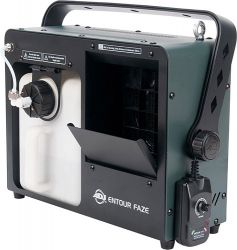
Fazer
Fazer – Continuous Fine Haze for Stunning Lighting Effects
A fazer is a specialised haze machine that produces continuous fine mist to enhance lighting effects at professional events. Unlike traditional fog machines that create dense bursts of fog, fazers generate a subtle, even atmospheric haze that makes light beams visible without obscuring the stage or venue. Whether you're lighting a concert stage, theatre production or corporate event, a fazer delivers the perfect atmospheric foundation to truly showcase your lighting design and create impressive visual moments.
What is a Fazer Machine?
A fazer is a continuous-output haze machine designed specifically for professional event and stage applications. The term "fazer" combines the words "fog" and "hazer," reflecting the machine's hybrid nature: it produces atmospheric effects similar to traditional fog machines but with the fine particle size and continuous operation characteristic of dedicated haze generators.
Technical Operating Principle
Fazers work by heating a specialised haze fluid—typically oil-based or water-based glycol formulations—to create an ultra-fine aerosol mist. The key difference from standard fog machines lies in the particle size and output method. Fazers produce particles typically between 0.2 and 1.0 microns in diameter, compared to 2–5 microns for conventional fog machines. This finer particle size creates a translucent atmospheric effect that hangs evenly in the air for extended periods, making light beams visible without creating the dense, obscuring clouds associated with traditional fog effects.
The continuous output mechanism means fazers maintain a steady flow of haze rather than producing intermittent bursts. Most professional models feature adjustable output controls, allowing operators to dial in precisely the right atmospheric density for any venue size or lighting design. Advanced units incorporate DMX control for remote operation and integration into lighting control systems, enabling synchronised atmospheric effects that respond to music, lighting cues or programmed sequences.
Fazer vs Traditional Fog Machines
While both fazers and traditional fog machines create atmospheric effects, they serve fundamentally different purposes in professional event production. Traditional fog machines excel at creating dramatic, visible fog effects—dense clouds that roll across stages or fill dance floors. Fazers, by contrast, produce a subtle atmospheric enhancement that remains nearly invisible to the naked eye until illuminated by stage lighting.
The warm-up time differs significantly: conventional fog machines typically require 3–8 minutes to reach operating temperature, while many professional fazers are ready within 2–4 minutes. Output duration also varies—fog machines produce timed bursts that dissipate relatively quickly, whereas fazers maintain continuous output for hours, making them ideal for events requiring consistent atmospheric conditions throughout long performances or conferences.
Professional Applications for Fazer Machines
Fazers have become indispensable tools across the professional event technology sector, valued for their ability to enhance lighting effects without interfering with visibility or audience comfort.
Concert and Festival Stages
In live music production, fazers create the atmospheric foundation that makes moving head fixtures, beam lights and laser effects truly spectacular. The continuous fine mist reveals light beams in three-dimensional space, transforming simple lighting into immersive visual experiences. Tour-grade fazers typically feature output volumes of 3,000–10,000 cubic feet per minute, sufficient to maintain consistent atmospheric density even in large outdoor festival environments with wind and air movement.
Theatre and Broadcast Studios
Theatrical productions rely on fazers to add depth and dimension to stage lighting without creating the heavy fog that would obscure actors or set pieces. The fine, even haze enhances gobo projections and creates subtle atmospheric moods that support storytelling. Broadcast and television studios use low-output fazers to add visual interest to lighting designs while maintaining the crystal-clear visibility required for camera work. Many studio-grade units operate virtually silently, with noise levels below 35 dB, ensuring they don't interfere with audio recording.
Corporate Events and Exhibitions
Corporate event producers use fazers to add production value to product launches, keynote presentations and gala dinners. The subtle atmospheric enhancement elevates standard conference lighting into professional-grade visual experiences that engage audiences and reinforce brand messaging. Exhibition stands and trade show booths benefit from localised haze effects that draw attention to displays and create memorable visual moments without affecting neighbouring exhibitors.
Quality Standards and Buying Criteria for Professional Fazers
Selecting the right fazer requires careful consideration of technical specifications, build quality and operational requirements. Professional-grade units from manufacturers such as Antari, Eurolite and Showtec offer the reliability and performance demanded by touring productions and permanent installations.
Output Volume and Coverage
Output volume, measured in cubic feet per minute (CFM) or cubic metres per minute, determines how quickly a fazer can fill a space with atmospheric haze. Entry-level units typically produce 1,000–3,000 CFM, suitable for small to medium venues up to 200 square metres. Professional touring fazers deliver 5,000–10,000 CFM or more, capable of maintaining consistent atmospheric density in large concert halls, arenas and outdoor festival stages. Consider venue size, ceiling height and air exchange rates when specifying output requirements—venues with high ceilings or significant air movement require proportionally higher output to maintain effective atmospheric levels.
Fluid Consumption and Operating Costs
Fluid consumption directly impacts operational costs and determines how long a fazer can run between refills. Professional units typically consume 10–40 millilitres of haze fluid per minute at maximum output, with adjustable settings allowing operators to balance atmospheric density against fluid economy. A 5-litre fluid reservoir running at 20 ml/min provides approximately 4 hours of continuous operation—sufficient for most events without mid-show refilling. Calculate fluid costs based on your expected usage: professional haze fluids range from €15–35 per litre, with oil-based formulations typically costing more than water-based alternatives but often producing longer-hanging, finer particle haze.
Power Requirements and Warm-Up Time
Power consumption for professional fazers ranges from 800W for compact units to 1,500W or more for high-output touring models. Warm-up time—the period from power-on to full operational readiness—varies from 2 minutes for quick-heat designs to 8 minutes for larger-capacity units. For applications requiring rapid deployment or frequent on/off cycling, prioritise models with fast warm-up times and efficient thermal management.
DMX Control and Integration
DMX512 control capability is essential for professional applications, allowing fazers to integrate seamlessly into lighting control systems. Most professional units offer 1–3 DMX channels controlling output volume, fan speed and sometimes fluid selection for dual-fluid models. Advanced units provide RDM (Remote Device Management) for remote monitoring of fluid levels, operating temperature and maintenance alerts—invaluable features for permanent installations and touring productions where accessibility may be limited.
Fazer Fluids: Oil-Based vs Water-Based Formulations
The choice between oil-based and water-based haze fluids significantly impacts atmospheric quality, hang time and operational considerations. Understanding the characteristics of each formulation enables informed decisions matched to specific application requirements.
Oil-Based Haze Fluids
Oil-based formulations, typically refined mineral oils or synthetic alternatives, produce exceptionally fine particle sizes (0.2–0.5 microns) that create nearly invisible atmospheric haze with exceptional hang time. The microscopic particles remain suspended in air for extended periods—often 1–3 hours in still-air environments—making oil-based fluids ideal for applications requiring consistent atmospheric density throughout long events without continuous machine operation.
The ultra-fine particle size creates minimal visible haze under normal lighting, becoming apparent only when illuminated by focused light beams—perfect for theatrical applications where atmospheric enhancement must remain subtle. Oil-based haze produces minimal residue on surfaces and equipment compared to traditional fog fluids, though some formulations may leave a slight oily film on sensitive surfaces over extended periods. Ventilation requirements are moderate; most venues with standard HVAC systems handle oil-based haze without difficulty.
Water-Based Haze Fluids
Water-based formulations, typically glycol or glycerine solutions, produce slightly larger particles (0.5–1.0 microns) that create more visible atmospheric haze with shorter hang times than oil-based alternatives. The particles typically remain suspended for 30–90 minutes in still air, requiring more frequent machine operation to maintain consistent atmospheric levels.
Water-based fluids offer several operational advantages: they produce virtually no residue, making them suitable for venues with sensitive equipment or strict cleanliness requirements. The formulations are generally odourless and produce no irritation for performers or audiences, even in enclosed spaces with limited ventilation. Water-based fluids typically cost 20–40% less than oil-based alternatives, reducing operational expenses for high-volume applications.
Fluid Compatibility and Machine Requirements
Not all fazers accept both fluid types—always verify manufacturer specifications before selecting fluids. Some professional units feature dual-fluid capability with separate tanks and heating elements optimised for each formulation. Using incompatible fluids can damage heating elements, clog nozzles or produce poor-quality haze with excessive visible residue. Reputable manufacturers including Antari, Eurolite and Look clearly specify compatible fluid types and often offer proprietary formulations optimised for their equipment.
Fluid quality matters significantly: premium formulations from established manufacturers produce consistent particle sizes, minimal residue and reliable performance. Budget fluids may save initial costs but often result in inconsistent output, increased maintenance requirements and shorter equipment lifespan. For professional applications, the modest additional cost of quality fluids represents sound investment in reliable performance and equipment longevity.
Installation, Safety and Maintenance Requirements
Proper installation, operation and maintenance ensure fazer machines deliver reliable performance while meeting safety standards for professional event environments.
Mounting and Positioning
Fazers may be floor-mounted, truss-mounted or rigged overhead depending on application requirements and venue constraints. Overhead mounting typically produces the most even atmospheric distribution, allowing haze to settle naturally throughout the venue. When rigging fazers on truss systems, ensure mounting hardware meets or exceeds the manufacturer's specified working load limit (WLL) and complies with DGUV Vorschrift 17 rigging safety standards. Most professional fazers include mounting brackets or omega clamps compatible with standard 48–51mm truss tubes.
Position fazers with adequate clearance from flammable materials—manufacturers typically specify minimum distances of 0.5–1.0 metres from curtains, scenery and other combustible surfaces. Ensure the output nozzle has unobstructed airflow; positioning too close to walls or set pieces creates uneven atmospheric distribution and may cause fluid condensation on nearby surfaces.
Electrical Safety and Power Distribution
Fazers draw significant current—1,500W units require approximately 6.5 amperes at 230V. When connecting multiple units, calculate total current draw carefully to avoid overloading circuits. Use appropriately rated power distribution equipment and ensure all connections comply with local electrical codes. Professional installations should incorporate RCD (residual current device) protection to safeguard against earth faults.
For touring applications, verify power availability at each venue and carry appropriate adaptors for regional power standards. Some professional fazers offer switchable voltage (110V/230V) for international touring, eliminating the need for heavy transformers.
Routine Maintenance and Cleaning
Regular maintenance extends fazer lifespan and ensures consistent performance. After every 40–50 hours of operation, flush the fluid system with manufacturer-recommended cleaning solution to prevent residue build-up in heating elements and fluid lines. This simple procedure—typically requiring 15–20 minutes—prevents the majority of performance issues and costly repairs.
Inspect and clean the output nozzle monthly, removing any accumulated residue that may affect particle size or output pattern. Check fluid filters (if fitted) and replace according to manufacturer schedules—clogged filters reduce output volume and may cause pump damage. For units in regular professional use, schedule annual professional servicing including heating element inspection, pump testing and electrical safety verification.
Fluid Handling and Storage
Store haze fluids in sealed containers away from direct sunlight and temperature extremes. Most formulations remain stable for 12–24 months when properly stored, though always check manufacturer expiry dates. When refilling fazer tanks, use clean funnels or pumps to prevent contamination—even small particles can clog nozzles and affect output quality. Never mix different fluid types or brands within the same tank; residual incompatible fluids may cause chemical reactions or poor performance.
LTT – Your Specialist for Event Technology
At LTT, you'll find an extensive range of professional fazer machines from leading manufacturers, backed by expert advice and comprehensive service. With over 25 years of experience in event technology, we understand the specific requirements of touring productions, permanent installations and rental operations. Our team helps you select the right fazer for your application, considering factors such as venue size, output requirements, fluid preferences and budget constraints.
We stock fazer machines across all performance categories—from compact units for small venues and mobile DJs to high-output touring models for festival main stages and arena productions. Every fazer we supply comes with a 3-year LTT warranty, giving you confidence in long-term reliability. Orders over €69 ship free throughout Germany, and express delivery options ensure you receive equipment when you need it, even for last-minute productions.
Our international shipping network serves customers across more than 40 countries, and we offer wholesale terms for resellers and rental companies. As manufacturers of our own Naxpro-Truss, Riggatec and Bullstage product lines, we bring manufacturing expertise and technical understanding to every customer interaction. Whether you're building a permanent installation, equipping a touring production or expanding a rental inventory, LTT delivers the products, expertise and service that professional event technology demands.
FAQ – Questions & Answers
In event technology, a fazer is a specialised haze machine that produces continuous fine mist to enhance lighting effects at professional events. The term combines "fog" and "hazer," reflecting the machine's ability to create atmospheric effects with ultra-fine particles (0.2–1.0 microns) that remain nearly invisible until illuminated by stage lighting. Unlike traditional fog machines that produce dense bursts, fazers generate subtle, even atmospheric haze that makes light beams visible without obscuring stages or venues. Professional fazers feature adjustable output controls and DMX integration, making them essential tools for concerts, theatre productions, corporate events and broadcast studios where atmospheric enhancement must support rather than dominate the visual experience.
Fazers and traditional fog machines differ fundamentally in particle size, output method and application purpose. Fazers produce ultra-fine particles (0.2–1.0 microns) in continuous output, creating subtle atmospheric haze that enhances lighting without obscuring visibility. Traditional fog machines generate larger particles (2–5 microns) in timed bursts, producing dense, visible clouds ideal for dramatic effects. Fazers maintain steady output for hours with hang times of 1–3 hours for oil-based fluids, while fog machines create intermittent bursts that dissipate relatively quickly. Warm-up time also differs: fazers typically ready in 2–4 minutes versus 3–8 minutes for fog machines. For professional lighting enhancement and consistent atmospheric conditions, fazers are the preferred choice; for dramatic visible fog effects, traditional fog machines excel.
Selecting the right fazer depends on venue size, ceiling height, air exchange rates and application requirements. For small venues up to 200 square metres, entry-level units producing 1,000–3,000 CFM (cubic feet per minute) provide adequate coverage. Medium venues (200–500 square metres) require 3,000–5,000 CFM output, while large concert halls, arenas and outdoor stages demand professional touring fazers delivering 5,000–10,000 CFM or more. Consider fluid type preferences: oil-based formulations offer longer hang time (1–3 hours) and finer particles, ideal for theatrical applications; water-based fluids provide shorter hang time (30–90 minutes) with no residue, suitable for venues with sensitive equipment. DMX control capability is essential for integration with lighting systems. Reputable manufacturers including Antari, Eurolite and Showtec offer reliable options across all performance categories and price points.
Professional fazer machines range from approximately €300 for entry-level units suitable for small venues and mobile applications, to €2,500 or more for high-output touring models with advanced features. Mid-range professional fazers with 3,000–5,000 CFM output and DMX control typically cost €600–1,200, offering excellent value for permanent installations and rental operations. High-end touring units featuring 8,000+ CFM output, dual-fluid capability, RDM monitoring and road-case construction command €1,500–2,500 or more. Beyond initial purchase price, consider operational costs: professional haze fluids range from €15–35 per litre, with consumption rates of 10–40 ml per minute depending on output settings. A fazer consuming 20 ml/min costs approximately €0.30–0.70 per hour in fluid, making operational economics an important consideration for high-volume applications.
Fazer fluid choice depends on application requirements, venue constraints and desired atmospheric characteristics. Oil-based fluids produce ultra-fine particles (0.2–0.5 microns) with exceptional hang time (1–3 hours), creating nearly invisible atmospheric haze ideal for theatrical productions and applications requiring consistent density without continuous machine operation. Water-based glycol or glycerine formulations generate slightly larger particles (0.5–1.0 microns) with shorter hang time (30–90 minutes) but produce virtually no residue, making them suitable for venues with sensitive equipment or strict cleanliness requirements. Always verify manufacturer specifications—not all fazers accept both fluid types, and using incompatible fluids can damage heating elements or produce poor-quality haze. Premium formulations from established manufacturers including Antari, Eurolite and Look ensure consistent particle sizes, minimal residue and reliable performance, representing sound investment despite modest additional cost over budget alternatives.
Proper fazer maintenance ensures reliable performance and extends equipment lifespan significantly. After every 40–50 hours of operation, flush the fluid system with manufacturer-recommended cleaning solution to prevent residue build-up in heating elements and fluid lines—this 15–20 minute procedure prevents the majority of performance issues. Inspect and clean the output nozzle monthly, removing accumulated residue that affects particle size or output pattern. Check fluid filters (if fitted) and replace according to manufacturer schedules; clogged filters reduce output volume and may damage pumps. For units in regular professional use, schedule annual professional servicing including heating element inspection, pump testing and electrical safety verification. Always use quality haze fluids from reputable manufacturers and never mix different fluid types within the same tank. Store the fazer in a clean, dry environment and drain fluid tanks if the unit will remain unused for extended periods.
Fazers can be used effectively outdoors for festival stages, though wind and air movement present challenges requiring careful consideration. High-output touring fazers delivering 8,000–10,000 CFM or more are essential for maintaining consistent atmospheric density in outdoor environments where wind disperses haze rapidly. Position multiple fazers strategically around the stage perimeter rather than relying on a single central unit, ensuring even atmospheric distribution despite air movement. Oil-based haze fluids offer advantages for outdoor use due to their finer particle size and longer hang time compared to water-based alternatives. Protect fazers from direct exposure to rain and moisture using weather-resistant road cases or temporary shelters; most professional units are not IP-rated for outdoor use without protection. Monitor atmospheric conditions continuously and adjust output settings to compensate for changing wind patterns. For large outdoor festivals, budget significantly higher fluid consumption than equivalent indoor venues—outdoor applications may consume 2–3 times more fluid to maintain effective atmospheric levels.
Most professional fazers operate on standard single-phase electrical supplies (230V in Europe, 110V in North America) and do not require special three-phase connections. However, power consumption is significant—1,500W units draw approximately 6.5 amperes at 230V, requiring appropriately rated circuits and power distribution equipment. When connecting multiple fazers, calculate total current draw carefully to avoid overloading circuits; three 1,500W units on a single 16A circuit would exceed safe capacity. Professional installations should incorporate RCD (residual current device) protection to safeguard against earth faults. Use power cables with adequate current rating—most manufacturers specify minimum cable gauges in technical documentation. For touring applications, verify power availability at each venue and carry appropriate adaptors for regional power standards. Some professional fazers offer switchable voltage (110V/230V) for international touring, eliminating the need for heavy transformers and simplifying power requirements across different regions.