TV brackets
TV Mounts – Professional Display Mounting for Events & Installations
Whether you're setting up a stage monitor, mounting digital signage at a trade show or installing displays in a conference venue, professional TV mounts are essential for secure, flexible positioning. LTT offers a comprehensive range of TV wall brackets, ceiling mounts and truss-compatible mounting systems designed for the demands of live events, touring productions and permanent installations. From ultra-flat fixed brackets to full-motion articulating arms with extension distances up to 100 cm, our selection covers screen sizes from 32 to 85 inches and load capacities up to 60 kg. Every mount is VESA-compatible, rigorously tested and built to deliver the stability and precision your professional application requires.
What Is a TV Mount? Types and Functions Explained
A TV mount is a mechanical bracket system that secures flat-panel displays—LED, OLED or QLED screens—to walls, ceilings or structural supports such as aluminium truss. Unlike domestic TV stands or furniture-based solutions, professional TV mounts are engineered for load-bearing reliability, VESA compliance and flexible positioning in dynamic environments.
Fixed (Flat) Mounts hold the screen parallel to the wall at a minimal distance—typically 2.5 to 4 cm. They deliver a clean, low-profile appearance and are ideal when the viewing angle is fixed and the screen faces the audience directly. Fixed mounts are the lightest and most cost-effective option, suitable for permanent installations in conference rooms, control centres or backstage monitor walls.
Tilt Mounts add a vertical adjustment range of 15 to 20 degrees, allowing you to angle the screen downward or upward. This function is essential when the display is mounted above eye level—common in exhibition booths, foyers or stage wings—to eliminate glare and optimise the viewing angle for standing or seated audiences.
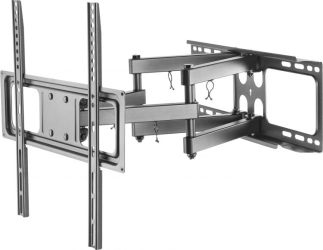
Full-Motion (Articulating) Mounts feature one or two extension arms that enable horizontal swivel (up to 180 degrees) and vertical tilt. These mounts pull the screen away from the wall by 40 to 100 cm, making them indispensable for corner installations, multi-zone event spaces or touring setups where the display must serve different audience positions. The articulating mechanism uses precision ball-bearing joints to ensure smooth, wobble-free adjustment even with heavy 65- or 75-inch screens.
Motorised Mounts integrate electric actuators controlled via remote, app or DMX protocol. They automate screen positioning, enabling choreographed reveals, automated stowage after use or dynamic angle changes during a presentation. Motorised solutions are premium options for high-end corporate events, broadcast studios and permanent theatre installations.
Unlike consumer-grade brackets, professional TV mounts for event technology are tested to three times their stated load limit, comply with EN safety standards and feature cable-management channels to keep power and signal lines concealed and protected.
Applications – Where Professional TV Mounts Are Essential
Professional TV mounts are deployed wherever displays must be positioned securely, adjusted flexibly and integrated into technical infrastructure.
Stage and Touring Productions use TV mounts to position confidence monitors, lyric displays or video playback screens on truss grids, side fills or upstage walls. Articulating and truss-compatible mounts allow crew to angle screens precisely for performers' sightlines and stow them safely during transport. Flight-case-ready mounting plates and quick-release VESA adapters reduce setup time at multi-venue tours.
Trade Shows and Exhibitions rely on swivel and tilt mounts to present product videos, branding loops or interactive content on booth walls and freestanding structures. Full-motion brackets let exhibitors reposition screens throughout the day to address different visitor flows, while ceiling mounts free up valuable floor space in compact booth layouts.
Corporate Events and Conferences install TV mounts in breakout rooms, foyers and main auditoriums for presentation displays, digital signage and live-stream feeds. Fixed and tilt mounts provide clean, professional aesthetics, while motorised options enable automated screen deployment at the start of sessions and concealment during breaks.
Permanent Installations in museums, visitor centres, houses of worship and educational institutions use heavy-duty wall and ceiling mounts to secure large-format displays for wayfinding, interpretation content or live service broadcasts. Load capacities up to 60 kg and VESA 600×400 compatibility ensure long-term reliability with minimal maintenance.
Broadcast and Studio Environments mount reference monitors, teleprompters and preview screens on articulating arms that can be repositioned quickly between takes. Cable-management features and vibration-damped construction prevent interference with sensitive audio and video equipment.
Professional TV mounts bridge the gap between static furniture solutions and the dynamic, load-bearing requirements of live event technology, offering the flexibility and safety standards that touring crews and installation technicians demand.
Quality and Professional Standards – Choosing the Right TV Mount
Selecting a professional TV mount requires attention to load capacity, VESA compatibility, material quality and compliance with safety standards—factors that separate reliable event-grade hardware from consumer products.
VESA Standards and Compatibility define the mounting-hole pattern on the rear of the display. Common VESA sizes include 200×200 mm (small screens up to 43 inches), 400×400 mm (55- to 65-inch displays) and 600×400 mm (75- to 85-inch screens). Universal mounts accommodate multiple VESA patterns within a stated range, but always verify that your specific screen's hole spacing matches the bracket's adjustment slots. Manufacturers such as Manfrotto, Vogel's and Riggatec publish detailed VESA compatibility charts with their professional mounting systems.
Load Capacity and Safety Margins are critical. A 55-inch LED screen typically weighs 15 to 20 kg; a 75-inch OLED can exceed 35 kg. Professional mounts are tested to three times their maximum rated load to ensure a safety margin during dynamic use—vibration from bass-heavy audio, accidental impacts during setup or thermal expansion in outdoor summer events. Look for mounts certified to EN 1090 (structural metalwork) or equivalent standards, and always cross-reference the mount's maximum weight with your display's actual mass (found in the manufacturer's datasheet, not the shipping weight).
Material and Construction Quality distinguish touring-grade mounts from residential brackets. Cold-rolled steel arms with powder-coated finishes resist corrosion and mechanical wear; aluminium alloy components reduce weight without sacrificing strength, essential for ceiling and truss installations. Ball-bearing pivot joints provide smooth, play-free adjustment over thousands of cycles, while plastic bushings in budget mounts wear out quickly under professional use.
Extension Distance and Clearance matter when mounting screens on uneven walls, around obstacles or in corners. Standard articulating mounts extend 40 to 60 cm; long-arm models reach 100 cm or more, allowing a 75-inch screen to swing 90 degrees without hitting the wall. Calculate the required extension by measuring half the screen width plus 10 cm clearance—this ensures full swivel range without obstruction.
Cable Management and Integration separate professional mounts from basic brackets. Integrated cable channels, snap-on covers and pass-through grommets keep HDMI, power and control cables concealed and protected, reducing trip hazards and maintaining a clean aesthetic. Some mounts include built-in spirit levels, laser-etched alignment guides and quick-release mechanisms for tool-free screen removal—features that save valuable setup time on multi-day events.
Brands such as Manfrotto, Vogel's, Riggatec and Global Truss supply mounts engineered for the event-technology sector, with load ratings from 20 kg (small confidence monitors) to 60 kg (large-format digital signage), VESA compatibility up to 800×600 mm and modular accessories for truss integration, floor stands and mobile flight cases. Investing in certified, over-engineered mounting hardware protects both your display investment and your audience's safety.
Truss-Compatible and Mobile TV Mounting Solutions
Professional event production demands mounting solutions that integrate seamlessly with aluminium truss systems, flight cases and mobile rigging infrastructure—capabilities that standard wall brackets cannot provide.
Truss-Compatible TV Mounts use spigot adapters, half-couplers or bolt-on clamps to attach VESA-compatible display brackets directly to 50 mm diameter truss tubes (common in Naxpro-Truss FD31 and Global Truss F34 systems). This allows screens to be rigged on overhead grids, vertical towers or ground-support structures without requiring wall access. Truss mounts are essential for outdoor festivals, temporary stages and touring productions where permanent walls are unavailable. Load ratings must account for dynamic forces—vibration from PA systems, wind load outdoors and the additional leverage of an extended arm—so always specify mounts tested to DGUV Vorschrift 17 (formerly BGV C1) standards for suspended loads.
Mobile TV Flight Cases combine protective transport with integrated mounting hardware. A typical flight-case TV mount features a foam-lined interior for the display, a hinged front panel that converts into a tilt or swivel bracket, and recessed handles and castors for easy movement. These cases are indispensable for touring bands, mobile DJ setups and rental companies that transport screens between venues weekly. Look for cases with reinforced corners, spring-loaded latches and cable pass-throughs; premium models include built-in power distribution and HDMI loop-through panels.
Ceiling and Pole Mounts extend the versatility of TV mounting beyond walls. Ceiling mounts use threaded rods or telescopic columns to suspend displays from structural beams or truss grids, ideal for foyers, exhibition halls and houses of worship where wall space is limited or sightlines require overhead positioning. Adjustable drop lengths (30 to 150 cm) and 360-degree rotation enable precise alignment. Pole mounts clamp onto vertical scaffolding tubes or lighting stands, providing a freestanding solution for outdoor events, car shows or retail pop-ups.
Quick-Release VESA Plates are a game-changer for multi-screen touring rigs. The display carries a lightweight VESA adapter plate that locks into a matching bracket on the truss or wall mount via a spring-loaded latch or quarter-turn mechanism. Crew can mount or remove a 55-inch screen in under 30 seconds without tools, reducing setup time and minimising the risk of dropped fasteners or cross-threaded bolts during high-pressure load-ins.
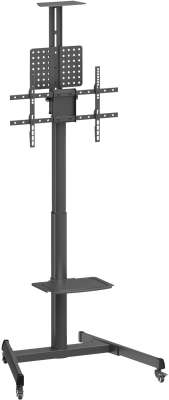
Heavy-Duty Mobile Stands combine a weighted base, height-adjustable column and VESA bracket into a portable floor stand suitable for conference centres, training rooms and temporary installations. Lockable castors allow repositioning during events; cable hooks and equipment shelves (for media players or laptops) integrate the entire display system into a single mobile unit. Models rated for 75- to 85-inch screens typically feature counterweighted bases or sandbag hooks to prevent tipping.
Manufacturers such as Riggatec, Global Truss, Doughty and Manfrotto offer modular mounting ecosystems where wall brackets, truss adapters, flight cases and mobile stands share common VESA interfaces and load ratings, enabling rental companies and production crews to standardise inventory and interchange components across different event formats. This modularity reduces capital expenditure, simplifies training and ensures that every screen—whether on a trade-show wall, a festival truss or a touring flight case—benefits from the same professional-grade safety and adjustability.
LTT – Your Specialist for Professional Event Technology
LTT is your trusted partner for professional TV mounts and display mounting solutions, backed by over 25 years of experience in event technology, staging and rigging. As both a specialist retailer and a manufacturer with our own production facility in Germany, we understand the demands of touring productions, permanent installations and high-stakes live events.
Our range includes fixed, tilt and full-motion TV mounts from leading brands such as Manfrotto, Vogel's, Riggatec and Global Truss, covering screen sizes from 32 to 85 inches and load capacities up to 60 kg. Every mount is VESA-compatible, tested to professional safety standards and available with truss adapters, flight-case integration and quick-release mechanisms for fast, tool-free deployment.
When you order from LTT, you benefit from free shipping on orders over €69, express delivery options for urgent projects and our 3-year LTT warranty on all mounting hardware. Our team provides expert advice on VESA compatibility, load calculations and truss integration, ensuring you select the optimal solution for your application. With over 100,000 positive customer reviews and a global network of trade partners, LTT is the reliable choice for professionals who demand quality, safety and performance.
Discover our full selection of professional TV mounts, truss systems and event technology at LTT—where expertise meets innovation.
FAQ – Questions & Answers
To select the correct TV mount, you need three pieces of information: the screen size (measured diagonally in inches, e.g. 55 or 65 inches), the VESA pattern (the horizontal and vertical distance in millimetres between the four mounting holes on the rear of the display, such as 400×400 mm) and the weight of the screen (found in the manufacturer's technical datasheet). Match these specifications to the mount's rated capacity—ensure the VESA pattern falls within the bracket's adjustment range, the screen weight is well below the maximum load limit (ideally 50 per cent or less for a safety margin) and the screen size is listed as compatible. For professional event applications, also verify that the mount is tested to EN or DGUV standards and includes cable-management features.
A tilt mount allows vertical angle adjustment—typically 15 to 20 degrees downward—so you can angle the screen to reduce glare or improve the viewing angle when the display is mounted above eye level, common in exhibition booths or stage wings. A swivel (or articulating) mount adds horizontal rotation, enabling the screen to pivot left or right by up to 180 degrees, which is essential when the display must serve multiple audience zones, corner installations or touring setups where the screen position changes between venues. Full-motion mounts combine both tilt and swivel functions, offering maximum flexibility. Tilt-only mounts are simpler, lighter and more affordable; swivel mounts are heavier, require stronger wall anchors and cost more, but they provide the positioning freedom that professional event production demands.
The VESA pattern is the standardised spacing (in millimetres) between the four threaded mounting holes on the rear of your display. To measure it, locate the holes (they may be hidden beneath a removable cover or the factory stand), then measure the horizontal distance between the left and right holes and the vertical distance between the top and bottom holes. For example, if the horizontal spacing is 400 mm and the vertical spacing is 400 mm, your VESA pattern is 400×400 mm. Alternatively, consult the display's technical datasheet or user manual, where the VESA standard is usually listed under "mounting" or "physical specifications." Common VESA sizes for professional displays are 200×200 mm (32–43 inches), 400×400 mm (55–65 inches) and 600×400 mm (75–85 inches). Always verify that your chosen mount explicitly supports your screen's VESA pattern.
Mounting a 65-inch TV on a standard wall is possible, but the wall must have sufficient load-bearing capacity and you must use appropriate anchors. A 65-inch LED or OLED screen typically weighs 20 to 30 kg; with the mount and dynamic forces (vibration, adjustment), the total load can exceed 40 kg. Solid masonry, concrete or brick walls provide adequate strength when you use expansion anchors or through-bolts rated for the combined weight. Stud walls (timber frame with plasterboard) require that the mount is fixed directly into the vertical studs using wood screws or heavy-duty toggle anchors; mounting only into plasterboard will fail. For professional event installations, always verify wall construction, use anchors rated to at least three times the total load and consult a structural engineer if in doubt. Pre-reinforced mounting plates or truss-based solutions are safer alternatives in temporary or uncertain wall conditions.
A truss-compatible TV mount is a bracket system designed to attach a flat-panel display directly to aluminium truss tubes—typically 50 mm diameter—using spigot adapters, half-couplers or bolt-on clamps. These mounts enable screens to be rigged on overhead grids, vertical towers or ground-support structures without requiring wall access, making them essential for outdoor festivals, temporary stages, touring productions and exhibition stands. Truss-compatible mounts must meet DGUV Vorschrift 17 (formerly BGV C1) standards for suspended loads and are tested to withstand dynamic forces such as vibration, wind load and the leverage of extended articulating arms. They typically feature VESA-compatible mounting plates, integrated cable management and quick-release mechanisms for fast setup and teardown. Brands such as Riggatec, Global Truss and Doughty manufacture truss-compatible TV mounting systems rated for professional event use.
Articulating TV mounts extend the display away from the wall using one or two hinged arms. Standard models extend 40 to 60 cm, suitable for most corner installations and multi-angle viewing. Long-arm mounts can extend 80 to 100 cm or more, allowing large 75- or 85-inch screens to swing 90 degrees without hitting the wall. The required extension depends on the screen width: as a rule of thumb, the arm length should be at least half the screen width plus 10 cm clearance to achieve a full 90-degree swivel. For example, a 65-inch screen (approximately 145 cm wide) requires an arm of at least 82 cm to clear the wall when rotated perpendicular. Longer arms increase leverage and wall load, so always verify that your wall anchors and mount are rated for the additional stress, especially with heavy OLED or QLED panels.
Professional TV mounts for event technology range from approximately €50 for basic fixed brackets suitable for small 32- to 43-inch screens, to €150–€300 for heavy-duty articulating mounts rated for 65- to 85-inch displays with load capacities up to 60 kg. Truss-compatible mounts with spigot adapters and quick-release VESA plates typically cost €200–€400, while motorised mounts with remote or DMX control start at €500 and can exceed €1,000 for high-load, long-arm models. Flight-case TV mounts with integrated brackets and protective transport cases range from €300 to €800 depending on screen size and case quality. Prices reflect material quality (cold-rolled steel versus aluminium alloy), load-bearing certification (EN 1090, DGUV 17), adjustment range and brand reputation. Investing in certified, over-engineered mounting hardware protects your display investment, ensures audience safety and reduces long-term maintenance costs in professional touring and installation environments.
TV mounts can be used for outdoor events, but they must be specified and installed to withstand environmental conditions such as wind load, temperature fluctuations and moisture exposure. Outdoor TV mounts should be constructed from corrosion-resistant materials—stainless steel or powder-coated aluminium—and rated for higher dynamic loads to account for wind pressure on large screen surfaces. The display itself must be rated for outdoor use (IP54 or higher ingress protection) or housed in a weatherproof enclosure. Mounting structures—whether truss grids, scaffolding poles or temporary walls—must be engineered and anchored to resist wind forces, often requiring ballast weights, ground anchors or guy-wire stabilisation. For touring festivals and outdoor exhibitions, truss-compatible mounts with quick-release VESA plates enable rapid deployment and weatherproof stowage between events. Always consult a structural engineer and comply with local safety regulations (DGUV 17, EN 1090) when rigging displays in outdoor environments.