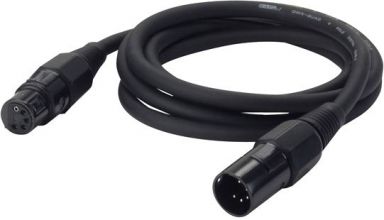
XLR cables
XLR Cables at LTT – Your Specialist for Event Technology
XLR cables are the backbone of every professional audio chain on stage, in the studio and at large events. Whether You connect microphones to a mixing console, route line signals to active speakers or build a road-ready signal path for touring, the right XLR cable delivers clean, noise-free sound over long distances. At LTT You find balanced XLR cables in every length, with quality connectors and durable jackets built for daily professional use. Browse pro brands, find Your optimal solution and bring Your sound to life with reliable, robust connections.
What Is an XLR Cable? Fundamentals for Stage and Event Use
An XLR cable is a balanced connection cable used to transmit analogue audio signals between professional equipment such as microphones, mixing consoles, active speakers and stage gear. The XLR connector is cylindrical and typically carries three to seven pins, with the 3-pin version being by far the most common in audio applications. XLR connectors are also called Cannon plugs, named after the Cannon Electric company that originally developed them, and they conform to the international dimension standard IEC 61076-2-103.
The abbreviation XLR refers to the connector design: the X comes from the original Cannon X series, the L from the latching mechanism that locks the plug securely in place, and the R from the resilient rubber insulation surrounding the female contacts. This locking latch is one reason XLR cables are so popular for live events — the connection cannot be pulled apart accidentally during a show.
How XLR differs from other audio cables
Unlike unbalanced cables such as RCA or standard instrument jacks, an XLR cable carries a balanced signal with two signal wires plus a ground. This construction makes XLR cables far more resistant to interference and ideal for long cable runs. While a Speakon connector is now the standard for high-power loudspeaker connections, XLR remains the universal choice for microphone-level and line-level signal transmission in professional audio.
How XLR Cables Work: Balanced Signal Explained
The key advantage of an XLR cable lies in its balanced signal transmission. A balanced XLR cable carries two signal conductors plus a ground conductor, whereas an unbalanced cable only has a single signal wire and a ground. This small difference makes a huge practical impact on Your sound quality, especially over long stage runs.
Why balanced transmission cancels noise
In a balanced XLR connection the original audio signal travels along one conductor (hot, pin 2), while an inverted copy of the same signal travels along the second conductor (cold, pin 3). As both wires run side by side through the cable, they pick up identical electromagnetic interference from lighting rigs, dimmers, power lines and radio sources. At the receiving end — for example a mixing console or active speaker — the inverted signal is flipped back into phase. In that moment the wanted signal adds up, while the picked-up noise becomes inverted and cancels itself out. The result is a clean, noise-free signal even in electrically noisy event environments.
Reliable over long distances
Thanks to this principle, XLR cables transmit reliable audio over runs of up to around 200 metres without audible degradation. That makes balanced XLR cables the standard for festivals, concerts, theatres and trade-show stands where the mixing position can be far from the stage. The robust, locking XLR connector adds mechanical reliability, so the connection stays solid even when cables are coiled, stepped on and re-rigged night after night.
XLR Pin Configuration: 3-Pin and Multi-Pin Variants
The pin configuration of an XLR connector determines how the signal travels through the cable. Understanding the standard 3-pin layout helps You wire, troubleshoot and combine Your equipment correctly.
Standard 3-pin layout
The most common XLR cable uses a 3-pin configuration:
- Pin 1 = ground / screen — the shield and earth reference
- Pin 2 = hot / positive (Live) — carries the in-phase signal
- Pin 3 = cold / negative (Return) — carries the inverted signal
This standardised assignment ensures that microphones, mixers and speakers from different manufacturers work together reliably and that phantom power (typically 48 V) reaches condenser microphones safely.
Multi-pin variants
Beyond the 3-pin standard, XLR connectors are available with four, five, six and seven pins, and mini XLR versions reach up to eight pins. A 5-pin XLR connector is the official standard for DMX512 lighting control, where the additional pins can carry a second data pair. Four-pin XLR connectors are common on intercom headsets and some DC power applications, while higher pin counts serve specialised stereo, intercom and stage-lighting tasks. When You order an XLR cable, always confirm the pin count required by Your device — a 3-pin microphone cable will not fit a 5-pin DMX socket.
XLR Connector Types and Adapter Cables (Jack, RCA, DMX)
XLR cables come in several connector combinations so You can integrate them into almost any signal chain. Knowing the available types and variants helps You pick the right cable the first time.
Common XLR types and combinations
- XLR male to XLR female — the most common variant, used to connect microphones to mixers or to link mixers with active speakers and stage boxes
- XLR to 6.3 mm jack — connects active speakers, DI boxes or DJ gear with balanced or unbalanced jack inputs
- XLR to 3.5 mm jack — routes signals from mobile devices or laptops into an XLR input
- XLR to RCA — links DJ mixers or studio sources to monitor speakers with phono inputs
XLR cables are available in lengths from roughly 0.5 m up to 30 m and beyond, so You can match the run exactly to Your setup. The male connector carries pins and is typically used as a signal output, while the female connector carries receptacles and acts as a signal input.
Adapter cables in practice
Adapter cables and connector combinations let You bridge equipment with different sockets without rebuilding Your whole rig. When You combine balanced XLR with balanced jack You preserve the noise-rejecting benefit of the balanced design. When You adapt to unbalanced RCA, keep the cable run as short as possible to avoid picking up hum and interference. Quality adapter cables with proper shielding protect Your signal integrity across the entire chain.
XLR vs. DMX Cable: Which One for Lighting and Effects?
A frequent question among event technicians is whether a 3-pin XLR audio cable can be used for lighting and effect devices. Because many budget moving heads, fog and haze machines and DJ lighting effects use 3-pin connectors that look identical to audio XLR, the two cables are easily confused — but they are not the same.
The crucial difference: impedance
A proper DMX cable is built to an impedance of 110–120 Ohm, while a standard XLR microphone cable typically sits around 75 Ohm. For data signals controlling several fixtures this difference matters: DMX cable maintains signal integrity and reduces the risk of flickering, dropouts or fixtures behaving erratically. An audio XLR cable may work with one or two effects over a short run, but in a larger lighting chain it can cause unstable DMX control.
Safety note
The DMX512 standard explicitly recommends 5-pin connectors and prohibits 3-pin XLR for DMX, partly because an audio cable carrying 48 V phantom power could accidentally be plugged into lighting equipment and damage it. For reliable control of effect devices such as fog machines and moving heads, always use a dedicated DMX cable rather than an audio XLR cable.
Buying Guide: Choosing the Right XLR Cable for Your Setup
This buying guide focuses on what matters for stage and event use — guidance most competitors skip entirely. Picking the right XLR cable comes down to length, conductor cross-section, shielding and connector quality.
Choose the right length
Select a length that matches Your distance without excessive surplus. A 30 m cable to bridge a 10 m mic-to-mixer run only adds weight, coiling effort and clutter. For large events and trade-show stands, plan generously and use stage boxes to keep individual runs sensible. Thanks to balanced transmission, XLR runs of up to around 200 metres remain practical for live applications.
Mind the conductor cross-section and shielding
A larger conductor cross-section and oxygen-free copper conductors reduce signal loss over long distances and improve durability. Look for dense braided or spiral shielding to reject interference from dimmers and power lines — essential for clean signal transmission on busy stages.
Road-ready durability for touring
For touring use, prioritise flexible, abrasion-resistant jackets, proper strain relief at the connector and gold-plated contacts that resist corrosion through repeated coiling and uncoiling. Robust connectors with secure locking latches survive years of load-in and load-out.
XLR in the complete signal chain
Think in terms of the whole PA chain: microphones feed into the mixing console via XLR, the console sends line-level signals to active speakers or amplifiers, and stage boxes consolidate multiple XLR lines into a clean multicore run. Choosing matching connectors and consistent quality across the chain helps You achieve impressive, reliable results every time.
Do expensive cables make a difference?
Up to a point, yes. Better connectors, purer copper and stronger shielding mean fewer failures and cleaner sound under demanding conditions — exactly what professional and touring use requires. For a permanent install or studio, investing in solid quality pays off in long-term reliability.
Brands and Manufacturers: Recommended XLR Cables and Quality Tiers
At LTT You find XLR cables across clear quality tiers from established brands trusted across the event industry. A curated overview of brands and manufacturers helps You match cable quality to Your application.
Pro brands at LTT
- Adam Hall Cables — well-known for reliable everyday series built with high-purity oxygen-free copper, robust PVC jackets and spiral shielding, ideal for stage, rehearsal and studio use
- Neutrik — the benchmark for XLR connectors, with its X-series design valued for durability and secure locking; the connector of choice for road-ready cables
- Cameo and LD Systems — pro audio and lighting brands offering dependable signal cables that integrate cleanly with their wider event-tech ranges
- Sommer Cable and Hicon — respected for high-quality bulk cable and precision connectors used in custom and demanding installations
Choosing the right quality tier
For occasional use a solid mid-range XLR cable delivers clean, balanced signal at an attractive price. For heavy touring, rental stock and large events, invest in higher tiers with reinforced jackets, gold-plated contacts and premium connectors. As Your reliable partner for event technology, LTT carries hochwertige Markenprodukte across every tier so You can build a dependable signal chain for any project.
Accessories for XLR Cables
The right accessories keep Your XLR cables organised, protected and ready to deploy. For touring and rental use, cable drums and reels make winding and transport fast and tidy, while cable bags and cases protect connectors during transport. Cable ties, hook-and-loop straps and coiling tools speed up load-out and prevent kinks that shorten cable life.
Further useful accessories include XLR adapters (for example XLR to jack or XLR to RCA), connector caps to protect unused contacts, and replacement Neutrik connectors for in-house repairs. Stage boxes and multicore systems help You consolidate many XLR lines into clean, manageable runs for larger productions. Pairing Your cables with the matching accessories ensures a professional, road-ready setup.
Care, Maintenance and Cleaning of XLR Cables
Proper care extends the lifespan of Your XLR cables and keeps the signal clean. Always coil cables using the over-under technique rather than wrapping them around the elbow — this prevents internal twist, conductor fatigue and premature failure. Avoid sharp bends directly at the connector, where strain relief is most stressed.
Keeping contacts clean
Dirt, dust and oxidation on the pins can cause crackle, intermittent dropouts or noise. Wipe the contacts occasionally with a dry, lint-free cloth, and for stubborn oxidation use a dedicated contact cleaner sparingly. Gold-plated contacts resist corrosion better and need less maintenance, which is why they are favoured for touring.
Storage and inspection
Store cables loosely coiled in a dry case, not under heavy weight. Before big events, inspect each cable for jacket damage, loose connectors and bent pins. Catching a faulty cable in the workshop is far better than chasing a noise problem during a live show.
Problems and Solutions: Common XLR Cable Issues
Even with quality XLR cables, occasional issues arise on busy stages. Knowing the typical problems and their solutions saves valuable time during setup and shows.
Hum, buzz and noise
If You hear hum or buzz, first check for ground loops and confirm You are using a properly balanced XLR connection throughout the chain. Swap a suspect cable for a known-good one to isolate the fault. Keep XLR runs away from power and dimmer cables, crossing them at right angles rather than running them in parallel.
Signal dropouts
Intermittent dropouts usually point to a damaged cable, a loose connector or a bent pin. Inspect the connectors, re-seat them and check the locking latch. For repeated offenders, re-terminate the connector or replace the cable.
Signal loss on long runs
On very long runs, a thicker conductor cross-section and high-quality shielding minimise signal loss. For extreme distances at large events, use stage boxes and multicore systems to keep individual XLR runs efficient and to avoid signal degradation. Choosing the correct length from the start also reduces excess cable and potential interference.
Related Categories
To complete Your event-tech setup, explore categories closely related to XLR cables. Pro audio chains benefit from matching DMX cables for controlling stage lighting and effect devices, while power distribution and mains cabling keep Your rig safely supplied. For touring and rental use, suitable cases and cable management gear protect Your investment. Combining the right cables, lighting control and protective accessories ensures a reliable, professional setup from microphone to mixer to speaker.
LTT – Your Specialist for Event Technology
With more than 25 years of experience in event technology, LTT is Your reliable partner for professional audio, lighting and stage gear. From a single microphone cable to a complete PA signal chain, You get hochwertige Markenprodukte from trusted manufacturers, expert know-how and the optimal solution for Your application.
As a specialist — not a generalist — LTT understands the demands of stage, studio, touring and trade-show work. You benefit from fast shipping out of Bocholt, Germany, a 3-year LTT warranty and free shipping from €69, with express delivery and worldwide shipping available. Whether You equip a club, a touring rig or a permanent install, LTT helps You bring Your sound and show to life and achieve impressive results. Order Your XLR cables today and rely on a partner that knows event technology inside out.
FAQ – Questions & Answers
An XLR cable uses a balanced two-conductor design plus a ground/screen. Inside a standard 3-pin XLR cable there are two insulated signal wires — pin 2 (hot) and pin 3 (cold) — surrounded by a shield connected to pin 1 (ground). Quality XLR cables use oxygen-free copper conductors and dense braided or spiral shielding to reduce signal loss and reject interference. The flexible outer jacket protects the cable during coiling and transport. This construction is what lets an XLR cable carry a clean, balanced audio signal over long stage runs without picking up noise.
The point of an XLR cable is to transmit professional audio signals cleanly and reliably, even over long distances and in electrically noisy environments. Because an XLR cable carries a balanced signal — the original plus an inverted copy — interference picked up along the run cancels itself out at the receiving device. This noise-free transmission is essential for microphones, mixing consoles and active speakers at concerts, festivals, theatres and trade shows. The robust, locking XLR connector also stays securely in place during a show, making the XLR cable the standard choice for professional and touring audio.
No, not all XLR cables are 3-pin, although the 3-pin version is by far the most common for audio. XLR connectors are also available with four, five, six and seven pins, and mini XLR variants reach up to eight pins. A 5-pin XLR connector is the official standard for DMX512 lighting control, while 4-pin XLR is common on intercom headsets and some DC power applications. When choosing an XLR cable, always confirm the pin count Your equipment requires, because a 3-pin microphone cable will not physically fit a 5-pin DMX socket.
Expensive XLR cables can make a real difference, particularly for professional and touring use. Higher-priced XLR cables typically use purer oxygen-free copper, denser shielding and better connectors such as Neutrik with gold-plated contacts. These features reduce signal loss, reject interference more effectively and survive years of repeated coiling and load-outs. For occasional home use, a solid mid-range XLR cable is perfectly adequate. But for stage, studio and rental applications where reliability and clean signal transmission are critical, investing in better-built XLR cables pays off through fewer failures and longer service life.
The main difference between an XLR cable and a DMX cable is the impedance and intended signal. An XLR audio cable typically has an impedance around 75 Ohm and carries balanced analogue audio for microphones, mixers and speakers. A DMX cable is built to 110–120 Ohm and carries digital DMX512 control data for stage lighting and effect devices. Although some 3-pin connectors look identical, using an audio XLR cable in a larger lighting chain can cause flicker and dropouts. For reliable control of fog machines, moving heads and other effects, always use a dedicated DMX cable.
A male XLR connector has protruding pins and is typically used as a signal output, while a female XLR connector has matching receptacles and acts as a signal input. The female connector also features a longer sleeve that connects the ground pin first, so You can plug and unplug live equipment without a loud pop. In a standard microphone cable, the female end connects to the microphone output and the male end plugs into the mixer input. By convention, signals flow from male pins on the source to female receptacles on the receiving device.
Thanks to balanced signal transmission, an XLR cable can carry audio reliably over runs of up to around 200 metres, which is why XLR is the standard for festivals and large events. The balanced design cancels out interference picked up along the run, so even long cables stay clean. To minimise signal loss over long distances, choose a larger conductor cross-section, high-quality shielding and quality connectors. For very large productions, stage boxes and multicore systems help keep individual XLR runs efficient and manageable while preserving signal integrity across the whole chain.
For a stage setup, choose an XLR cable that matches Your run length without excessive surplus and offers oxygen-free copper conductors, dense shielding and a robust, flexible jacket. For microphones and line connections, a quality 3-pin XLR cable with Neutrik connectors and gold-plated contacts gives reliable, road-ready performance. For touring and rental use, prioritise strain relief and durability. For controlling lighting and effect devices, buy a dedicated DMX cable instead. At LTT You find XLR cables across clear quality tiers from brands like Adam Hall, Neutrik and Cameo to suit Your specific application and budget.