CEE cables
CEE Cables – Reliable Power Distribution for Professional Events
When it comes to powering professional stage setups, lighting rigs and sound systems, CEE cables are the industry standard. These robust power cables deliver reliable electricity distribution for concerts, festivals, trade shows and theatre productions. Unlike standard household cables, CEE cables are built to withstand the demanding conditions of event technology – from outdoor festivals to multi-day touring productions. At LTT, you'll find a comprehensive range of CEE cables engineered for professional applications, available in lengths from 10 metres to 50 metres and rated for both single-phase 230V/16A and three-phase 400V/32A configurations.
What Are CEE Cables and How Do They Differ from Standard Power Cables?
CEE cables are standardised power cables conforming to the IEC 60309 international standard, designed specifically for industrial and professional applications. The name "CEE" derives from the Commission on the Rules for the Approval of Electrical Equipment, which established these European norms.
Key technical specifications that define professional CEE cables include:
- Cable construction: H07RN-F rubber sheathed flexible cable with minimum 2.5 mm² cross-section for 16A variants, 4 mm² or higher for 32A applications
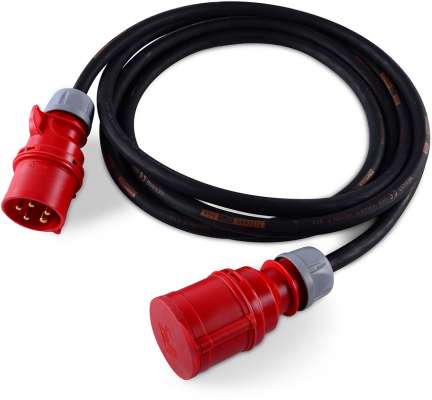
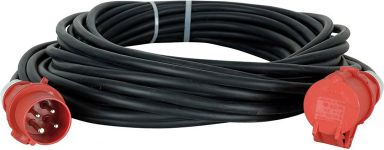
- Connector coding: Blue 3-pin connectors for 230V single-phase (16A), red 5-pin connectors for 400V three-phase (16A/32A)
- Protection rating: Minimum IP44 – dust resistant and splash-proof for outdoor use
- Temperature range: Typically -25°C to +60°C for professional rubber cables
- Maximum recommended length: 25 metres per cable run to minimise voltage drop
CEE vs. Schuko: Critical Differences
While household Schuko plugs are rated for 230V/16A, they lack the robust construction and safety features required for professional event technology. CEE connectors feature a keyed design that prevents incorrect phase connections, a crucial safety element when distributing three-phase power to lighting desks, dimmer racks and motor hoists. The twist-lock mechanism on many professional CEE connectors ensures cables cannot be accidentally disconnected during performances.
For stage applications involving truss systems, moving lights and high-power audio equipment, CEE cables provide the load capacity and mechanical durability that standard extension leads simply cannot match. The rubber H07RN-F construction resists abrasion from constant coiling and uncoiling, whilst maintaining flexibility even in cold outdoor conditions.
Applications in Professional Event and Stage Technology
CEE cables form the backbone of power distribution in virtually every professional event scenario. Understanding where and how to deploy them ensures safe, efficient electrical infrastructure for your productions.
Concert and festival staging relies heavily on CEE power distribution. Main power feeds from generators or building supplies connect to distribution boxes via 32A three-phase CEE cables, which then branch out to individual zones through 16A single-phase cables. This tiered approach allows technical crews to isolate lighting, sound and backline power independently.
Theatre and permanent installations benefit from the standardised nature of CEE connections. Touring productions can confidently specify CEE power requirements knowing that venues across Europe will provide compatible infrastructure. Fixed installations in theatres often feature floor pockets and overhead grid connections with CEE sockets, enabling flexible rigging configurations.
Trade show and exhibition stands require temporary power distribution that's both safe and professional in appearance. CEE cables rated IP44 can run across floors and through cable protectors without degradation, whilst the colour-coded connectors (blue for 230V, red for 400V) prevent potentially dangerous misconnections when multiple contractors work simultaneously.
Mobile DJ and band setups increasingly specify CEE connections for their reliability. A 25-metre CEE cable from a venue's distribution box to a stage-mounted power strip eliminates the need for multiple household extension leads, reducing trip hazards and ensuring adequate current capacity for powered speakers, lighting effects and mixing consoles.
Outdoor events and festivals demand the weatherproof characteristics of professional CEE cables. The IP44 rating ensures connectors resist rain ingress during setup and breakdown, whilst the robust rubber construction withstands the mechanical stress of being laid across grass, gravel and temporary roadways.
Quality Standards and Professional-Grade Specifications
Selecting the correct CEE cable for professional event applications requires understanding both electrical ratings and mechanical construction standards. Inferior cables pose genuine safety risks and can fail mid-event, making quality specification essential.
Cable Construction and Load Capacity
Professional-grade CEE cables use H07RN-F rubber-sheathed construction as standard. This designation indicates heavy-duty rubber insulation suitable for outdoor use, with flexible stranded conductors that resist work-hardening from repeated coiling. For 16A single-phase applications, a minimum 2.5 mm² cross-section is specified; 32A three-phase cables require 4 mm² or 6 mm² depending on cable length and load characteristics.
When calculating power distribution requirements, consider that a 16A CEE connection at 230V provides approximately 3.7 kW continuous power – sufficient for most small-to-medium lighting rigs or a modest PA system. Three-phase 32A connections at 400V deliver up to 22 kW, adequate for substantial dimmer racks, motor hoists or large-format LED walls.
Manufacturer Quality and Certification
Leading manufacturers in the professional event sector include Neutrik, Sommer Cable, Titanex and PCE, all of which maintain rigorous testing protocols. Look for cables bearing CE marking and conformity to IEC 60309, DIN VDE 0282 and EN 60309 standards. For applications subject to DGUV Vorschrift 17 (the German accident prevention regulation for event technology), cables must undergo regular PAT testing – typically annually for rental stock.
Price points for professional CEE cables range from approximately €2.50 per metre for basic 16A variants to €6–8 per metre for heavy-duty 32A three-phase cables with premium connectors. Whilst budget alternatives exist, the cost difference is negligible when weighed against the consequences of cable failure during a live event.
Connector Quality Matters
The connectors themselves warrant careful attention. Professional-grade CEE plugs and sockets feature brass contact pins (not plated steel), strain relief that genuinely grips the cable sheath, and robust polycarbonate housings. Brands such as Mennekes and Walther set the industry standard, with their connectors often outlasting the cables they're fitted to.
Understanding Single-Phase vs. Three-Phase CEE Configurations
The distinction between single-phase and three-phase CEE cables is fundamental to professional power distribution, yet frequently misunderstood by those new to event technology.
Single-Phase 230V/16A (Blue Connectors)
Blue 3-pin CEE connectors deliver standard 230V single-phase power, identical to household supplies but with industrial-grade connectors. The three pins comprise live, neutral and earth, with the connector keyed to prevent incorrect insertion. These cables are ideal for:
- Individual lighting fixtures and moving heads drawing up to 3.5 kW
- Powered loudspeakers and monitor systems
- DJ equipment and small mixing consoles
- Hazer and atmospheric effect machines
- Individual power distribution to backline equipment
Maximum continuous load should not exceed 13A (approximately 3 kW) to maintain a safety margin and account for inrush current when devices power on.
Three-Phase 400V/16A and 32A (Red Connectors)
Red 5-pin CEE connectors provide three-phase power, with the five pins comprising three live phases (L1, L2, L3), neutral and earth. This configuration is essential for:
- Dimmer racks and large lighting control systems
- Motor hoists and chain motors for truss and rigging
- High-power LED walls and video processors
- Large-format audio power amplifiers
- Distribution boxes that split three-phase into multiple single-phase outputs
The key advantage of three-phase distribution is load balancing. A 32A three-phase connection can theoretically supply 22 kW, but in practice this is distributed across three phases, with each phase carrying approximately 7.3 kW. Proper load balancing prevents phase imbalance, which can trip protective devices and damage equipment.
Phase Rotation and Compatibility
Professional technicians must be aware of phase rotation (the sequence L1-L2-L3) when connecting motor hoists. Incorrect phase rotation causes motors to run in reverse, potentially creating dangerous rigging situations. Phase rotation testers and phase inverter adapters are essential tools for touring productions working across multiple venues.
For international touring, note that whilst IEC 60309 is a global standard, some regions use different voltage and frequency combinations. The UK, Ireland and most of Europe operate on 230V/50Hz, but equipment rated for 240V/60Hz (common in some older installations) may require voltage converters.
Cable Management, Safety and Maintenance for Event Applications
Professional deployment of CEE cables extends beyond simply connecting plug to socket. Proper cable management ensures both safety compliance and operational reliability throughout an event's duration.
Deployment Best Practices
When running CEE cables across public areas or backstage zones, always use cable protectors or cable ramps rated for vehicular traffic where appropriate. Even IP44-rated cables can suffer sheath damage from repeated vehicle crossings, potentially exposing live conductors. For overhead cable runs, use appropriate cable ties or Velcro straps – never gaffer tape directly on rubber sheathing, as adhesive residue attracts dirt and degrades the rubber over time.
Coiling technique significantly impacts cable lifespan. Always use the over-under method for rubber cables to prevent twisting and kinking. Cables stored on reels should be unwound completely during use, as coiled cables carrying high current can overheat due to inductive heating effects.
Inspection and Testing Requirements
Under DGUV Vorschrift 17 (formerly BGV C1), all electrical equipment used in German event productions must undergo regular inspection by a qualified person. For CEE cables in rental stock, this typically means:
- Visual inspection before each use: check for cuts, abrasions, crushed sections or damaged connectors
- PAT testing annually or after 200 uses (whichever comes first): insulation resistance, earth continuity and polarity verification
- Immediate withdrawal of any cable showing signs of damage, with repair or disposal as appropriate
Maintain a log of cable testing dates and results. Many professional hire companies now use RFID tags embedded in cable connectors to track usage cycles and testing history automatically.
Common Failure Modes and Prevention
The most frequent CEE cable failures in event environments are:
- Connector strain relief failure – caused by pulling cables by the plug rather than the cable body. Always grasp the connector housing when disconnecting.
- Sheath cuts near connectors – occurs when cables are coiled too tightly or kinked during storage. Maintain minimum bend radius of 10× cable diameter.
- Pin corrosion – results from storing cables whilst damp. Always dry connectors thoroughly before storage, and consider silicone grease on pins for long-term outdoor installations.
- Internal conductor breakage – caused by repeatedly driving over cables without protection. Use cable ramps without exception in vehicle traffic areas.
Quality cables from manufacturers such as Sommer Cable, Titanex and Riggatec incorporate reinforced strain relief and thicker sheathing specifically to resist these failure modes, making them worthwhile investments for professional applications.
LTT – Your Specialist for Professional Event Technology
At LTT, we understand that reliable power distribution is non-negotiable in professional event production. Our CEE cable range encompasses everything from compact 10-metre single-phase leads for mobile DJ setups to heavy-duty 50-metre three-phase cables for festival main power distribution.
Every CEE cable we supply meets or exceeds IEC 60309 standards, with H07RN-F rubber construction as standard across our professional range. We stock trusted brands including Neutrik, Sommer Cable and PCE, alongside our own Riggatec range – all backed by our comprehensive 3-year LTT warranty.
Shipping from our Bocholt facility in Germany, we offer free delivery on orders over €69 with express options available for urgent production requirements. Our international shipping network ensures that whether you're rigging a theatre in Dublin, setting up a festival stage in Edinburgh or installing a permanent venue system anywhere across Europe, your CEE cables arrive on schedule.
With over 25 years of experience in professional event technology and more than 100,000 positive customer reviews, LTT combines manufacturer expertise with specialist knowledge. We're not just suppliers – we're your partner in creating safe, reliable power infrastructure that lets you focus on delivering impressive results for your clients.
FAQ – Questions & Answers
For professional event applications, CEE cable length depends on your power distribution strategy. Most stage setups use 10–25 metre cables from distribution boxes to individual zones, as this minimises voltage drop whilst maintaining flexibility. The IEC 60309 standard recommends maximum 25-metre runs for 16A cables to prevent excessive voltage loss. For festival main power feeds using 32A three-phase cables, 50-metre lengths are common but require 6 mm² cross-section to maintain voltage regulation. Always calculate total cable length in your distribution chain – multiple 25-metre cables daisy-chained can exceed safe voltage drop limits. For permanent installations, consider fixed cabling with CEE outlet boxes rather than extended temporary cable runs.
CEE connectors differ fundamentally from household Schuko plugs in construction, safety features and load capacity. CEE connectors conform to IEC 60309 international standards with IP44 weatherproof rating, making them suitable for outdoor events where Schuko plugs would fail. The keyed design of CEE connectors prevents incorrect phase connections – critical when distributing three-phase power to lighting dimmer racks and motor hoists. CEE connectors also feature superior strain relief and often incorporate twist-lock mechanisms that prevent accidental disconnection during performances. Whilst both 16A CEE and Schuko are rated for similar current, CEE cables use H07RN-F rubber construction that withstands the mechanical abuse of touring production environments. For professional event technology, CEE is the industry standard specified by DGUV Vorschrift 17 safety regulations.
For 16A single-phase CEE cables at 230V, the minimum specified cross-section is 2.5 mm² for cables up to 25 metres length. This provides adequate current-carrying capacity whilst limiting voltage drop to acceptable levels for lighting and audio equipment. For 32A three-phase CEE cables at 400V, cross-section requirements increase: 4 mm² is standard for cables up to 25 metres, whilst 6 mm² is recommended for 50-metre runs or applications involving motor loads with high inrush current. Professional-grade cables often exceed these minimums – premium 32A cables may use 10 mm² conductors for maximum voltage stability in long distribution runs. Always verify that cable cross-section matches both the current rating of protective devices and the total circuit length to ensure compliance with electrical safety standards and prevent overheating during sustained high-load operation.
Yes, three-phase CEE cables with red 5-pin connectors (400V/32A configuration) are specifically designed for professional lighting power distribution. These cables deliver three separate phases plus neutral and earth, allowing dimmer racks and distribution boxes to balance loads across all three phases. A 32A three-phase CEE connection provides up to 22 kW total capacity, which can be split into multiple single-phase circuits for individual lighting fixtures. This configuration is standard in professional theatre, concert and festival applications. Ensure your three-phase CEE cables use minimum 4 mm² cross-section (6 mm² for runs exceeding 25 metres) and verify correct phase rotation when connecting motor hoists or phase-sensitive equipment. Always engage a qualified electrician familiar with DGUV Vorschrift 17 requirements for initial installation and load balancing calculations.
IP44 protection rating on CEE cables indicates the connectors are protected against solid objects larger than 1 mm (dust resistant) and water splashing from any direction (splash-proof). For outdoor event applications, this means CEE cables can withstand rain during setup and breakdown, temporary exposure to ground moisture, and incidental water contact from cleaning or weather. However, IP44 is not submersion-proof – connectors should not be placed in standing water or subjected to pressure washing. The rating applies specifically to the connector assemblies when properly mated; unmated connectors should be protected with dust caps. For permanent outdoor installations or marine environments, consider IP67-rated alternatives. Professional H07RN-F rubber cable sheathing complements IP44 connectors by resisting UV degradation and maintaining flexibility in temperature extremes from -25°C to +60°C, making the combination suitable for year-round festival and touring applications.
Under DGUV Vorschrift 17 (German accident prevention regulations for event technology), CEE cables in professional rental stock must undergo portable appliance testing (PAT) at least annually or after every 200 uses, whichever occurs first. Testing must be performed by a qualified electrical person and should include insulation resistance measurement (minimum 1 MΩ at 500V DC), earth continuity verification (maximum 0.1Ω resistance), and polarity checking for three-phase cables. Visual inspection before each deployment is mandatory, checking for sheath damage, connector cracks, bent pins or strain relief failure. Many professional hire companies implement more frequent testing schedules – quarterly PAT testing is common for high-utilisation stock. Maintain detailed records of test dates, results and any repairs performed. Cables failing PAT testing must be immediately withdrawn from service and either repaired by qualified personnel or destroyed to prevent accidental reuse.
A 16A single-phase CEE cable at 230V has a theoretical maximum capacity of 3,680 watts (16A × 230V), but professional practice limits continuous load to approximately 3,000 watts (13A) to maintain safety margins and account for inrush current when equipment powers on. This capacity is adequate for most mobile DJ setups, small lighting rigs with 4–6 LED moving heads, or a modest PA system with powered speakers totalling under 3 kW. For three-phase 16A CEE cables at 400V, total capacity increases to approximately 11 kW distributed across three phases, though individual phase loading should not exceed 3.5 kW. Always calculate total connected load including startup surge current for motors and transformer-based equipment. If your application approaches these limits, specify 32A cables instead – attempting to run sustained loads above 80% of cable rating risks connector overheating and potential fire hazards, particularly with budget-grade cables or damaged connectors.
For touring production work, specify a modular CEE cable system based on 25-metre lengths in both single-phase (230V/16A blue connectors) and three-phase (400V/32A red connectors) configurations. This length provides optimal flexibility whilst staying within voltage drop limits and remaining manageable for two-person cable runs. Stock a 3:1 ratio of single-phase to three-phase cables, as most equipment connects via single-phase even when fed from three-phase distribution boxes. Invest in professional-grade cables from manufacturers such as Sommer Cable or Titanex with reinforced strain relief and premium Mennekes or Walther connectors – the marginal cost increase is negligible compared to mid-show cable failures. Include phase rotation testers and a selection of CEE adapters (16A to 32A, single-phase to three-phase converters) to handle venue variations across different countries. Implement RFID tracking for cable inventory management and PAT testing schedules, ensuring compliance with DGUV Vorschrift 17 wherever you tour.