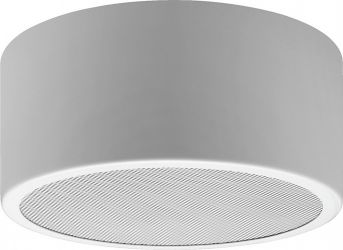
ELA 100V speakers

ELA 100V Speakers – Professional Constant Voltage Systems for Events and Installations: ELA 100V speakers are the professional solution for distributed audio in events, hospitality and permanent installations. These constant voltage systems allow you to connect multiple speakers in parallel over long cable runs without signal loss, making them ideal for restaurants, conference venues, trade show stands and outdoor events. At LTT you will find a comprehensive range of ELA 100V speakers from leading...
Read more »
ELA 100V speakers
Close window
ELA 100V speakers

ELA 100V Speakers – Professional Constant Voltage Systems for Events and Installations

ELA 100V speakers are the professional solution for distributed audio in events, hospitality and permanent installations. These constant voltage systems allow you to connect multiple speakers in parallel over long cable runs without signal loss, making them ideal for restaurants, conference venues, trade show stands and outdoor events. At LTT you will find a comprehensive range of ELA 100V speakers from leading manufacturers – from compact ceiling speakers to powerful horn speakers for outdoor use. Whether you are planning background music for a corporate event or a voice alarm system for a large venue, our ELA speaker systems deliver reliable performance and excellent speech intelligibility.

What Are ELA 100V Speakers?

ELA 100V speakers are loudspeakers designed for constant voltage distribution systems, commonly known as 100 volt line systems. The term "ELA" stands for "elektroakustische Anlage" (electroacoustic system) and describes professional public address and background music installations.

Unlike conventional low-impedance speakers (typically 4 or 8 ohms), ELA speakers contain an integrated line matching transformer that steps the audio signal up to 100 volts. This high voltage, low current transmission offers several key advantages: you can connect dozens of speakers in parallel without complex impedance calculations, use smaller cable cross-sections even over distances exceeding 100 metres, and add or remove speakers without recalculating the entire system.

Each ELA speaker has a power tap selector on its transformer, typically offering settings such as 1.5W, 3W, 6W, 12W or more. You simply set the desired power level for each speaker location, and the transformer automatically matches the impedance. The total connected power must not exceed the amplifier's rated output, but otherwise the system is highly flexible.

This technology was originally developed for large commercial installations – department stores, airports, railway stations – but has become indispensable in event technology. Mobile PA systems for trade shows, corporate events and outdoor festivals benefit from the same advantages: fast setup, long cable runs without signal degradation, and the ability to distribute audio across multiple zones without complex wiring.

Compared to traditional PA speaker systems with low-impedance connections, 100V systems are less suited to high-fidelity music reproduction at concert SPL levels, but they excel at speech intelligibility, background music and distributed coverage in acoustically challenging environments.

Applications in Events, Hospitality and Installations

ELA 100V speakers are the backbone of professional audio distribution in countless event and hospitality scenarios. In the events industry, they are used extensively for trade show stands, conference venues, product launches and corporate events where clear speech reproduction and background music are required across large areas. A typical trade show booth might use a combination of compact ceiling speakers for uniform coverage and directional sound projectors to focus audio on specific zones without spilling into neighbouring stands.

In hospitality – restaurants, bars, hotels, beer gardens – 100V systems provide discreet background music and paging announcements. Ceiling speakers blend into the interior design, while outdoor horn speakers withstand weather exposure (IP55 or IP65 rated) and deliver intelligible announcements across large terraces or garden areas. The ability to run long cable distances without dedicated amplifier racks in every zone makes installation straightforward and cost-effective.

Permanent installations in schools, sports facilities, places of worship and retail spaces also rely on ELA technology. In these environments, voice alarm systems certified to EN 54-24 are often mandatory, and 100V speakers with A/B wiring (dual redundant circuits) ensure that emergency announcements reach every zone even if one cable is damaged.

For event technicians, the flexibility of 100V systems is a major advantage: you can quickly scale a system up or down by adding or removing speakers, and the parallel wiring topology means a single cable fault does not bring down the entire installation. Whether you are setting up a temporary outdoor festival site or a multi-room conference centre, ELA 100V speakers deliver reliable, intelligible audio with minimal setup time.

Types of ELA 100V Speakers and Their Technical Characteristics

The ELA 100V speaker family encompasses a wide range of form factors, each optimised for specific installation scenarios and acoustic requirements. Understanding the technical characteristics of each type helps you select the optimal solution for your event or installation.

Ceiling Speakers

Ceiling speakers are the most common type in permanent installations and mobile event setups. They typically feature a 4-inch to 8-inch driver with a coaxial tweeter, delivering frequency response from around 80 Hz to 18 kHz. Power taps range from 1.5W to 20W, and coverage patterns are usually 120° to 180° conical. Flush-mount models require a ceiling cutout (typically 165 mm to 225 mm diameter), while surface-mount versions attach directly to ceilings or walls. Fire-rated back-cans are available for installations requiring compliance with building codes.

Wall and Cabinet Speakers

Wall-mount ELA speakers come in compact ABS or MDF enclosures, often with integrated mounting brackets. These are ideal for environments where ceiling installation is impractical – historic buildings, tented structures, outdoor stages. Typical specifications include 4-inch to 6.5-inch woofers, power handling from 6W to 40W at 100V, and IP54 to IP65 weather protection for outdoor models. Two-way designs with separate tweeters offer improved music reproduction compared to single-driver ceiling speakers.

Horn Speakers and Sound Projectors

Horn speakers (also called pressure chamber speakers or trumpet speakers) are designed for high SPL and long-throw applications – outdoor festivals, sports venues, large trade show halls. They typically feature a compression driver coupled to a horn, delivering 100 dB SPL or more at one metre. Power ratings range from 10W to 50W at 100V, and the narrow directivity (60° to 90°) focuses sound over distances of 30 to 80 metres. Weatherproof models with IP65 rating are standard.

Sound projectors (beam-steering line arrays) represent the cutting edge of ELA technology. These active DSP-controlled systems use multiple small drivers (often 16 or more) to create steerable acoustic beams, allowing you to aim sound precisely at the audience area while minimising reflections from ceilings and walls. They are particularly effective in reverberant spaces – exhibition halls, atriums, railway stations – where traditional speakers struggle with intelligibility.

Subwoofers for 100V Systems

While most ELA applications prioritise speech intelligibility, background music installations benefit from the addition of 100V subwoofers. These typically feature 8-inch to 12-inch drivers in ported enclosures, with power taps from 20W to 100W and frequency response down to 40 Hz. They integrate seamlessly into 100V systems, providing the low-frequency extension needed for music reproduction without requiring separate amplifier channels.

Leading manufacturers in the LTT range include Audac, Bose Professional, JBL, Monacor and Omnitronic, each offering models tailored to specific installation requirements and budget levels.

Installation and Wiring Guidelines for 100V Systems

Proper installation and wiring are critical to achieving reliable performance and long service life from your ELA 100V speaker system. While 100V technology simplifies many aspects of system design, several technical considerations must be observed.

Cable Specification and Voltage Drop

Because 100V systems operate at high voltage and low current, cable cross-sections can be significantly smaller than in low-impedance systems. For cable runs up to 50 metres, 0.75 mm² (18 AWG) is typically sufficient for total loads up to 100W. For runs between 50 and 100 metres, use 1.5 mm² (16 AWG), and for distances exceeding 100 metres or total loads above 200W, specify 2.5 mm² (14 AWG) or larger.

Voltage drop should not exceed 1 volt (1% of the 100V line voltage) to avoid audible level differences between speakers. Calculate voltage drop using Ohm's law: V_drop = (2 × length × current) / (conductivity × cross-section). For copper, conductivity is approximately 56 S·m/mm².

Parallel Wiring and Ring Circuits

All ELA speakers connect in parallel to the 100V line. The simplest topology is a star configuration, where individual cable runs extend from the amplifier to each speaker or speaker group. This provides maximum reliability but uses the most cable.

A more efficient approach is daisy-chain wiring, where the cable runs from speaker to speaker in sequence. This minimises cable length but means a break in the cable disconnects all downstream speakers.

For critical applications – especially voice alarm systems complying with EN 54-24 – a ring circuit (A/B wiring) is mandatory. Two independent cables run in opposite directions around the circuit, and each speaker connects to both. If either cable is damaged, all speakers remain operational via the intact circuit. Special A/B speakers with dual transformers are required for this topology.

Power Calculation and Amplifier Sizing

Sum the power tap settings of all connected speakers to determine the minimum amplifier power required. Always specify an amplifier with at least 20% headroom above the total connected load to avoid clipping and ensure dynamic range. For example, if your speaker system totals 80W, choose a 100W amplifier.

Most professional ELA amplifiers include impedance monitoring, which continuously measures the total load and triggers an alarm if a speaker is disconnected or short-circuited. This feature is essential for installations where system integrity must be verified.

Safety Considerations

100V speaker lines carry voltages that can be hazardous to humans. Always de-energise the system before making wiring changes, and ensure all connections are properly insulated. In permanent installations, 100V wiring must comply with local electrical codes, which may require conduit, cable trays or fire-rated cable.

For mobile event setups, use robust multi-core cable (e.g. 2 × 1.5 mm²) with durable outer jackets, and protect cable runs from mechanical damage. Clearly label 100V speaker cables to prevent accidental connection to low-impedance amplifier outputs, which can destroy transformers.

Power Calculation, System Design and Integration with Stage Equipment

Designing a professional ELA 100V system for events requires careful attention to power distribution, coverage patterns and integration with existing stage equipment. This section addresses the specific challenges faced by event technicians and installation professionals.

Coverage and SPL Requirements

Begin by defining the coverage area and required sound pressure level (SPL). For background music in hospitality environments, 70–75 dB SPL is typical; for paging and announcements, 80–85 dB SPL ensures intelligibility even in moderately noisy environments. For outdoor events or large halls, you may need 90 dB SPL or more.

Each speaker has a specified sensitivity (typically 88–92 dB SPL at 1 watt / 1 metre) and coverage angle (e.g. 120° conical). Use these values to calculate the number of speakers required and their spacing. As a rule of thumb, ceiling speakers should be spaced at a distance equal to 1.5 times the mounting height to achieve uniform coverage without dead spots or excessive overlap.

Zoning and Multi-Channel Systems

Large events often require multiple audio zones – for example, a trade show stand might have a presentation area, a lounge zone and a reception desk, each with independent volume control and programme material. Implement zoning using separate amplifier channels or 100V zone controllers (passive attenuators or active DSP units).

For maximum flexibility, specify a multi-channel ELA matrix amplifier with built-in DSP. These units allow you to route any input (microphone, music player, emergency announcement) to any combination of zones, apply EQ and delay for each zone independently, and store presets for different event scenarios.

Integration with Mixing Consoles and Stage Equipment

In event applications, the 100V system often operates alongside a main PA system for music and a separate microphone system for presentations. The challenge is to integrate these sources seamlessly.

Most professional ELA amplifiers accept balanced line-level inputs (XLR or 6.3 mm jack, +4 dBu nominal). Connect the main output or a dedicated aux send from your mixing console to the ELA amplifier input. Use the console's EQ and dynamics processing to optimise the signal for speech intelligibility – typically a high-pass filter at 100 Hz to reduce rumble, and gentle compression (3:1 ratio, -10 dB threshold) to even out level variations.

For installations requiring automatic ducking – where background music is lowered when a microphone is active – specify an ELA amplifier with priority input or use an external auto-mixer. This ensures announcements are always intelligible without manual intervention.

EN 54-24 Certification and Voice Alarm Systems

When designing systems for venues where voice alarm capability is required (conference centres, hotels, public buildings), ensure all components – amplifiers, speakers, cabling – are certified to EN 54-24. This standard specifies stringent requirements for reliability, redundancy and monitoring.

EN 54-24 systems typically use A/B wiring (ring circuits) as described earlier, and the amplifier must include continuous impedance monitoring, battery backup and automatic switchover to emergency power. Speakers must be fire-rated and capable of reproducing alarm tones and voice messages with defined intelligibility (Speech Transmission Index STI ≥ 0.5).

While EN 54-24 compliance adds cost and complexity, it is non-negotiable in many jurisdictions and provides peace of mind that the system will function reliably in an emergency.

100V Systems vs Low-Impedance PA Systems – When to Use Which Technology

Event technicians and installation professionals often face the question: should I use a 100V constant voltage system or a traditional low-impedance PA system? Both technologies have their place, and understanding the trade-offs helps you make the right choice for each application.

Advantages of 100V Systems

100V systems excel in distributed audio applications where multiple speakers must cover a large area with moderate SPL. The key advantages are:

  • Simplified wiring: All speakers connect in parallel without complex impedance matching. You can add or remove speakers without recalculating the system.
  • Long cable runs: High voltage, low current transmission allows cable runs exceeding 100 metres with minimal loss, even using relatively thin cable (1.5 mm²).
  • Scalability: Systems can easily grow from a handful of speakers to dozens or even hundreds, limited only by amplifier power.
  • Flexibility: Each speaker's power level is independently adjustable via its transformer tap, allowing fine-tuning of coverage without changing amplifier settings.
  • Cost-effectiveness: For installations requiring many speakers spread over a wide area, 100V systems typically require less cable and fewer amplifiers than low-impedance systems.

Advantages of Low-Impedance PA Systems

Traditional PA systems with 4 or 8 ohm speakers remain the standard for high-fidelity music reproduction and high SPL applications. Their strengths include:

  • Superior audio quality: Without the transformer in the signal path, low-impedance speakers deliver wider frequency response, lower distortion and better transient response.
  • Higher SPL capability: Professional PA speakers can produce 120–130 dB SPL or more, far exceeding the capability of most ELA speakers.
  • Better bass response: Large-format woofers and subwoofers in ported or horn-loaded enclosures deliver deep, powerful low frequencies that 100V ceiling speakers cannot match.
  • Industry standard for live sound: Mixing consoles, amplifiers and speakers in the professional live sound market are designed around low-impedance connections.

Hybrid Approaches

Many event installations use both technologies in parallel: a low-impedance PA system for the main presentation or performance area, and a 100V system for distributed coverage in foyers, breakout rooms and outdoor areas. This hybrid approach delivers high-quality sound where it matters most while providing cost-effective coverage everywhere else.

For example, a corporate event might use a stereo pair of powered PA speakers for the keynote presentation, with a 100V system feeding ceiling speakers in the networking lounge and outdoor terrace. Both systems are fed from the same mixing console, with independent level control for each zone.

Decision Guidelines

Choose a 100V system when: - You need to cover a large area with many speakers - Cable runs exceed 30–50 metres - Speech intelligibility and background music are the primary requirements - Budget constraints favour a cost-effective distributed solution - The installation is permanent or semi-permanent

Choose a low-impedance PA system when: - High-fidelity music reproduction is essential - High SPL (>100 dB) is required - The system is mobile and must be reconfigured frequently - You are integrating with existing professional stage equipment - Bass response below 60 Hz is needed

In practice, experienced event technicians keep both types of equipment in their inventory and select the appropriate technology for each application. At LTT, you will find comprehensive ranges of both 100V speakers and low-impedance PA systems, plus the expertise to help you choose the right solution.

LTT – Your Specialist for Event Technology

At LTT, we have been supplying professional event technology for over 25 years, and our expertise in audio systems – from compact ELA installations to large-scale PA systems – is backed by thousands of successful projects. Our range of ELA 100V speakers includes models from leading manufacturers such as Audac, Bose Professional, JBL, Monacor and Omnitronic, covering every application from discreet ceiling speakers to powerful outdoor horn systems.

As both a retailer and manufacturer with our own production facility in Germany, we understand the technical demands of professional installations. Our team can advise you on system design, power calculation, cable specification and integration with existing equipment, ensuring your ELA system delivers reliable performance and excellent speech intelligibility.

We ship worldwide from our warehouse in Bocholt, Germany, with free shipping on orders over €69 and express delivery available when you need equipment fast. Our B2B customers benefit from wholesale pricing and dedicated account management, while our 3-year LTT warranty and over 100,000 positive customer reviews demonstrate our commitment to quality and service.

Whether you are planning a single-room installation or a multi-zone system for a large event, you will find the optimal solution in our comprehensive range. Explore our ELA 100V speaker selection today and experience the difference that professional equipment and expert advice make.

FAQ – Questions & Answers

How do 100V speakers work?

100V speakers (also called constant voltage speakers or ELA speakers) contain an integrated step-up transformer that converts the audio signal to 100 volts. This high-voltage, low-current transmission allows multiple speakers to be connected in parallel over long cable distances without signal loss or complex impedance calculations. Each speaker has a power tap selector on its transformer (typically 1.5W, 3W, 6W, 12W or more) that determines how much power the speaker draws from the 100V line. The amplifier is sized to deliver 100 volts at its rated power output, and the total connected speaker power must not exceed the amplifier's capacity. This technology was originally developed for large commercial installations but is now widely used in event technology, hospitality and permanent installations where distributed audio coverage is required.

Can 100V speakers work with a regular amplifier?

No, 100V speakers cannot be connected directly to a regular low-impedance amplifier (the type used with standard 4 or 8 ohm PA speakers). The transformer inside a 100V speaker is designed to operate at 100 volts; connecting it to a low-impedance amplifier output (typically 20–50 volts at full power) will result in very low volume and poor frequency response. Conversely, connecting a standard low-impedance speaker to a 100V amplifier will destroy the speaker due to excessive voltage. Always use 100V speakers with amplifiers specifically designed for constant voltage operation, and low-impedance speakers with standard PA amplifiers. If you need to integrate both types in a single system, use separate amplifier channels or a hybrid amplifier with both 100V and low-impedance outputs.

How do I calculate impedance for 100V speaker systems?

Calculating impedance for 100V speaker systems is straightforward: the impedance of each speaker is determined by its power tap setting, using the formula Z = V² / P, where V is 100 volts and P is the selected power in watts. For example, a speaker set to 6W has an impedance of 100² / 6 = 1,667 ohms. When multiple speakers are connected in parallel, the total impedance decreases according to 1/Z_total = 1/Z₁ + 1/Z₂ + 1/Z₃ + … However, in practice you do not need to calculate total impedance – simply sum the power tap settings of all speakers (e.g. 6W + 6W + 12W + 3W = 27W total) and ensure your amplifier is rated for at least that power, preferably with 20% headroom. The amplifier will automatically deliver the correct voltage (100V) regardless of the total connected load, as long as you do not exceed its power rating.

What cable specifications are needed for 100V systems?

Cable specification for 100V speaker systems depends on the cable length and total power being transmitted. For cable runs up to 50 metres with total loads up to 100W, 0.75 mm² (18 AWG) two-core cable is typically sufficient. For runs between 50 and 100 metres or loads between 100W and 200W, use 1.5 mm² (16 AWG) cable. For distances exceeding 100 metres or total loads above 200W, specify 2.5 mm² (14 AWG) or larger. The key criterion is voltage drop, which should not exceed 1 volt (1% of the 100V line voltage) to avoid audible level differences between speakers. Calculate voltage drop using the formula: V_drop = (2 × length in metres × current in amperes) / (56 × cross-section in mm²), where 56 is the conductivity of copper. For permanent installations, use fire-rated cable if required by local building codes; for mobile event setups, choose robust cable with durable outer jackets and protect cable runs from mechanical damage.

What is the difference between 100V and 70V speaker systems?

100V and 70V speaker systems are both constant voltage technologies that work on the same principle – they differ only in the operating voltage. 100V systems are the European standard and are used throughout the UK, Ireland and continental Europe. 70V systems are the North American standard, used in the USA and Canada. The choice between them is determined by regional electrical codes and equipment availability, not by performance differences. Some professional ELA speakers and amplifiers support both 100V and 70V operation via switchable transformer taps, allowing the same equipment to be used in different markets. When designing a system, always match the speaker voltage rating to the amplifier output voltage – never mix 100V and 70V components in the same system. For international touring or installations, specify dual-voltage equipment to ensure compatibility.

Which 100V speakers are best for outdoor events?

For outdoor events, choose 100V speakers with weather protection rated IP55 or higher (IP65 is preferable for permanent outdoor installations). Horn speakers (also called trumpet speakers or pressure chamber speakers) are the most common choice for outdoor use because they deliver high SPL (100 dB or more at one metre), have narrow directivity for long-throw coverage (30–80 metres), and feature robust ABS or aluminium housings with sealed driver assemblies. Typical power ratings are 10W to 50W at 100V. For more discreet installations – beer gardens, terraces, outdoor dining areas – weatherproof wall-mount cabinet speakers with 4-inch to 6.5-inch drivers offer better music quality and wider coverage (120° to 180°) at moderate SPL. Always check the IP rating, ensure all cable connections are properly sealed, and mount speakers under eaves or canopies where possible to extend service life. Leading outdoor-rated models in the LTT range include speakers from Audac, Bose Professional and JBL.

What does a 100V speaker system cost?

The cost of a 100V speaker system varies widely depending on the number of speakers, quality level and installation complexity. A basic system for a small restaurant or retail space might include four to six ceiling speakers (€30–€80 each), a 60W ELA amplifier (€150–€400) and cabling, totalling €400–€800. A mid-range system for a conference venue or trade show stand with 10–15 speakers, a 120W multi-zone amplifier with DSP, and professional installation typically costs €1,500–€3,500. Large installations for hotels, sports facilities or outdoor events with dozens of speakers, multiple amplifier channels, EN 54-24 voice alarm capability and A/B wiring can exceed €10,000. At LTT, we offer 100V speakers starting from around €25 for compact ceiling models up to €500+ for premium weatherproof horn speakers and sound projectors. Amplifiers range from €150 for basic single-zone units to €2,000+ for multi-channel matrix systems with full DSP control. Contact our team for a detailed quotation based on your specific requirements.

Can I use 100V speakers for music or are they only for speech?

100V speakers can be used for both speech and music, but their performance varies significantly depending on the model. Basic ceiling speakers with single full-range drivers (typically 4-inch to 6-inch) are optimised for speech intelligibility and background music in hospitality environments; they deliver adequate frequency response (80 Hz to 18 kHz) and moderate SPL (85–90 dB) but lack the bass extension and dynamic range for high-fidelity music reproduction. Two-way 100V speakers with separate woofers and tweeters offer significantly better music quality, with smoother frequency response and higher SPL capability (up to 95 dB). For applications where music quality is critical – bars, clubs, retail spaces – consider adding 100V subwoofers (8-inch to 12-inch drivers, 40 Hz low-frequency extension) to the system. Premium 100V speakers from manufacturers such as Bose Professional, JBL and Audac deliver music quality approaching that of low-impedance PA speakers, making them suitable for all but the most demanding live sound applications. If your event requires high SPL (>100 dB) or deep bass for electronic music, a traditional low-impedance PA system is the better choice.

Top seller
Power Dynamics CSPB8 Deckeneinbaulautsprecher 100V 8"
Power Dynamics CSPB8 Ceiling Speaker 100V 8"
€27.00 *
incl. tax, plus shipping costs
Availability:
Delivery time: 3-5 days
MONACOR EDL-620EN ELA-Deckenlautsprecher
MONACOR EDL-620EN PA ceiling speakers
€53.00 *
incl. tax, plus shipping costs
Availability:
Delivery time: 3-5 days
SCS-250 50W 10x2" colomn speaker
DAP-Audio SCS-250 Passive 10x 2" Column Speaker - white
€158.50 *
incl. tax, free shipping to Germany
[International shipping costs]
Availability:
Delivery time: 3-5 days
320 Articles
Close filters
 
  •  
  •  
  •  
  •  
  •  
  •  
  •  
  •  
  •  
from to
1 From 14 pages
No results were found for the filter!
MONACOR EDL-70/WS ELA-Lautsprecher
MONACOR EDL-70/WS PA ceiling speaker
PA ceiling speaker, with special 2-step mounting. 100 V line technique • Snap-in mounting • For a ceiling thickness from 2 to 45 mm • Full range speaker with a clear voice...
€29.00 *
incl. tax, plus shipping costs
Availability:
Delivery time: 3-5 days
OMNITRONIC CSS-5 Deckenlautsprecher
OMNITRONIC CSS-5 Ceiling Speaker
2-way flush-mount coaxial speaker, LF: 5" HF: 0,5", public address systems 100V, 5 W RMS, 24,5 cm x 15,5 cm 2-way system with 13 cm woofer (5") and 1.5 cm tweeter (0.5")...
€19.60 *
incl. tax, plus shipping costs
Availability:
Delivery time: 3-5 days
OMNITRONIC PCW-20 Tonsäule IP44
OMNITRONIC PCW-20 Column Speaker IP44
Weather-proof column speaker, 100 V With mounting bracket • White aluminum grille • Suitable for outdoor use IP44 • For application areas such as: Installation; restaurants, bars and...
€69.00 *
incl. tax, free shipping to Germany
[International shipping costs]
Availability:
Delivery time: 3-5 days
OMNITRONIC WC-1 ELA-Wandlautsprecher
OMNITRONIC WC-1 PA Wall Speaker
6,5" full-range speaker, public address systems 100V, 10 W RMS White metal grille • Scratchproof and shockproof • For application areas such as: Installation; restaurants, bars and...
€42.90 *
incl. tax, plus shipping costs
Availability:
Delivery time: 3-5 days
OMNITRONIC CST-6 2-Wege-Deckenlautsprecher
OMNITRONIC CST-6 2-Way Ceiling Speaker
6" flush-mount speaker, public address systems 100V, 20 W RMS, Ø 20 cm 2-way system for excellent sound playback • Swivel tweeter • For speech and background music in indoor...
€46.23 *
incl. tax, plus shipping costs
Availability:
Delivery time: 3-5 days
OMNITRONIC CSE-6 Deckenlautsprecher
OMNITRONIC CSE-6 Ceiling Speaker
6" full-range flush-mount speaker, public address systems 100V, 6 W RMS, Ø 17 cm 16.5 cm full-range speaker (6.5") • Easy mounting, similar to standard flush-mount lights...
€21.82 *
incl. tax, plus shipping costs
Availability:
Delivery time: 3-5 days
MONACOR ESP-80/WS ELA-Wandlautsprecher
MONACOR ESP-80/WS PA wall speaker
PA wall speaker, vandal-resistant. 100 V line technique via audio transformer with 4 power taps • Full range speaker with a good voice reproduction, suitable for background music • Very...
€53.00 *
incl. tax, plus shipping costs
Availability:
Delivery time: 3-5 days
OMNITRONIC CSE-5 Deckenlautsprecher
OMNITRONIC CSE-5 Ceiling Speaker
5" full-range flush-mount speaker, public address systems 100V, 6 W RMS, Ø 14,5 cm 13 cm full-range speaker (5") • Easy mounting, similar to standard flush-mount lights...
€18.51 *
incl. tax, plus shipping costs
Availability:
Delivery time: 3-5 days
OMNITRONIC FPS-5 ELA-Wandlautsprecher
OMNITRONIC FPS-5 PA Wall Speaker
Flat 2-way speaker with mount 2-way system with 13 cm neodymium bass-midrange speaker (5") and 3 cm tweeter (1.25") • Extra flat design for wall mounting • White metal grille...
€69.90 *
incl. tax, free shipping to Germany
[International shipping costs]
Availability:
Delivery time: 3-5 days
OMNITRONIC PCW-10 Tonsäule IP44
OMNITRONIC PCW-10 Column Speaker IP44
Weather-proof column speaker, 100 V With mounting bracket • Suitable for outdoor use IP44 • For application areas such as: Installation; restaurants, bars and hotels; sports centres/gyms...
€49.90 *
incl. tax, plus shipping costs
Availability:
Delivery time: 3-5 days
OMNITRONIC CSE-8 Deckenlautsprecher
OMNITRONIC CSE-8 Ceiling Speaker
8" full-range flush-mount speaker, public address systems 100V, 10 W RMS, Ø 21,5 cm 20 cm double-cone speaker (8") • Easy mounting, similar to standard flush-mount lights...
€29.90 *
incl. tax, plus shipping costs
Availability:
Delivery time: 3-5 days
OMNITRONIC WPC-6W Deckenlautsprecher
OMNITRONIC WPC-6W Ceiling Speaker
Passive speaker with 6,5" woofer, 0,5" driver and 10 W RMS 2-way system with 16.5 cm woofer (6.5") and 1.5 cm tweeter (0.5") • Mounted with an aluminum tube and integrated...
€60.36 *
incl. tax, plus shipping costs
Availability:
Delivery time: 3-5 days
OMNITRONIC WPC-6S Deckenlautsprecher
OMNITRONIC WPC-6S Ceiling Speaker
Passive speaker with 6,5" woofer, 0,5" driver and 10 W RMS 2-way system with 16.5 cm woofer (6.5") and 1.5 cm tweeter (0.5") • Mounted with an aluminum tube and integrated...
€60.48 *
incl. tax, plus shipping costs
Availability:
Delivery time: 3-5 days
OMNITRONIC PCW-40 Tonsäule IP44
OMNITRONIC PCW-40 Column Speaker IP44
Weather-proof column speaker, 100 V With mounting bracket • Suitable for outdoor use IP44 • For application areas such as: Installation; restaurants, bars and hotels; sports centres/gyms...
€96.56 *
incl. tax, free shipping to Germany
[International shipping costs]
Availability:
Delivery time: 3-5 days
OMNITRONIC WP-10W Deckenlautsprecher
OMNITRONIC WP-10W Ceiling Speaker
Ceiling speaker in white plastic housing, 10 W RMS 2 m connection cable with integrated steel wire for the installation • Ideal for covering large areas from high ceilings • Scratchproof...
€49.00 *
incl. tax, plus shipping costs
Availability:
Delivery time: 3-5 days
OMNITRONIC CST-5 2-Wege-Deckenlautsprecher
OMNITRONIC CST-5 2-Way Ceiling Speaker
5" flush-mount speaker, public address systems 100V, 20 W RMS, Ø 17 cm 2-way system for excellent sound playback • Swivel tweeter • For ceiling thicknesses between 10-40 mm,...
€44.90 *
incl. tax, plus shipping costs
Availability:
Delivery time: 3-5 days
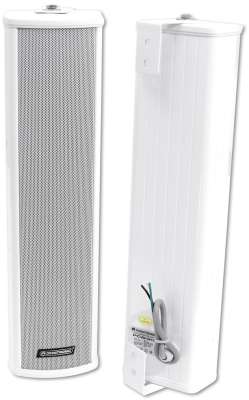
OMNITRONIC CST-8 2-Wege-Deckenlautsprecher
OMNITRONIC CST-8 2-Way Ceiling Speaker
8" flush-mount speaker, public address systems 100V, 40 W RMS, Ø 24 cm 2-way system for excellent sound playback • Swivel tweeter • For speech and background music in indoor...
€55.90 *
incl. tax, plus shipping costs
Availability:
Delivery time: 3-5 days
OMNITRONIC WPC-5S Deckenlautsprecher
OMNITRONIC WPC-5S Ceiling Speaker
Passive speaker with 5,5" woofer, 0,5" driver and 10 W RMS 2-way system with 14 cm woofer (5.5") and 1.5 cm tweeter (0.5") • Mounted with an aluminum tube and integrated...
€47.58 *
incl. tax, plus shipping costs
Availability:
Delivery time: 3-5 days
MONACOR EDL-620 ELA-Lautsprecher, 20W
MONACOR EDL-620 PA ceiling speaker
PA ceiling speaker 100 V line technique via audio transformer with power taps • Extra high maximum tapping power • For a ceiling thickness from 5 to 22 mm • Full range speaker, type...
€41.00 *
incl. tax, plus shipping costs
Availability:
Delivery time: 3-5 days
OMNITRONIC WP-5H Deckenlautsprecher
OMNITRONIC WP-5H Ceiling Speaker
This ceiling mounted pendant speaker is best suited for supersonic sounding in restaurants or hallways of all types. With its stylish 70ies design and its great sound the ELA-speaker easily...
€51.67 *
incl. tax, plus shipping costs
Availability:
Delivery time: 3-5 days
OMNITRONIC CS-4S Deckenlautsprecher sw
OMNITRONIC CS-4S Ceiling Speaker black
4" full-range flush-mount speaker, public address systems 100V, 6 W RMS, Ø 11 cm 10 cm full-range speaker (4") • Easy mounting, similar to standard flush-mount lights...
€24.90 *
incl. tax, plus shipping costs
Availability:
Delivery time: 3-5 days
OMNITRONIC WPC-5W Deckenlautsprecher
OMNITRONIC WPC-5W Ceiling Speaker
Passive speaker with 5,5" woofer, 0,5" driver and 10 W RMS 2-way system with 14 cm woofer (5.5") and 1.5 cm tweeter (0.5") • Mounted with an aluminum tube and integrated...
€47.58 *
incl. tax, plus shipping costs
Availability:
Delivery time: 3-5 days
OMNITRONIC CS-6 Deckenlautsprecher weiß
OMNITRONIC CS-6 Ceiling Speaker white
6,5" full-range flush-mount speaker, public address systems 100V, 5 W RMS, Ø 19,5 cm For speech and background music in indoor PA systems • Scratchproof and shockproof • Easy...
€27.50 *
incl. tax, plus shipping costs
Availability:
Delivery time: 3-5 days
OMNITRONIC WP-3S ELA-Wandlautsprecher
OMNITRONIC WP-3S PA Wall Speaker
2-way speaker with mount, public address systems 100V, 15 W RMS 2-way system • Trapezoidal cabinet for corner installation • With mounting bracket • Scratchproof and shockproof...
€44.36 *
incl. tax, plus shipping costs
Availability:
Delivery time: 3-5 days
1 From 14 pages
Facts
ELA 100V Speakers – Professional Constant Voltage Systems for Events and Installations: ELA 100V speakers are the professional solution for distributed audio in events, hospitality and permanent installations. These constant voltage systems allow you to connect multiple speakers in parallel over long cable runs without signal loss, making them ideal for restaurants, conference venues, trade show stands and outdoor events. At LTT you will... Read more »
Viewed
Facts

ELA 100V Speakers – Professional Constant Voltage Systems for Events and Installations

ELA 100V speakers are the professional solution for distributed audio in events, hospitality and permanent installations. These constant voltage systems allow you to connect multiple speakers in parallel over long cable runs without signal loss, making them ideal for restaurants, conference venues, trade show stands and outdoor events. At LTT you will find a comprehensive range of ELA 100V speakers from leading manufacturers – from compact ceiling speakers to powerful horn speakers for outdoor use. Whether you are planning background music for a corporate event or a voice alarm system for a large venue, our ELA speaker systems deliver reliable performance and excellent speech intelligibility.

What Are ELA 100V Speakers?

ELA 100V speakers are loudspeakers designed for constant voltage distribution systems, commonly known as 100 volt line systems. The term "ELA" stands for "elektroakustische Anlage" (electroacoustic system) and describes professional public address and background music installations.

Unlike conventional low-impedance speakers (typically 4 or 8 ohms), ELA speakers contain an integrated line matching transformer that steps the audio signal up to 100 volts. This high voltage, low current transmission offers several key advantages: you can connect dozens of speakers in parallel without complex impedance calculations, use smaller cable cross-sections even over distances exceeding 100 metres, and add or remove speakers without recalculating the entire system.

Each ELA speaker has a power tap selector on its transformer, typically offering settings such as 1.5W, 3W, 6W, 12W or more. You simply set the desired power level for each speaker location, and the transformer automatically matches the impedance. The total connected power must not exceed the amplifier's rated output, but otherwise the system is highly flexible.

This technology was originally developed for large commercial installations – department stores, airports, railway stations – but has become indispensable in event technology. Mobile PA systems for trade shows, corporate events and outdoor festivals benefit from the same advantages: fast setup, long cable runs without signal degradation, and the ability to distribute audio across multiple zones without complex wiring.

Compared to traditional PA speaker systems with low-impedance connections, 100V systems are less suited to high-fidelity music reproduction at concert SPL levels, but they excel at speech intelligibility, background music and distributed coverage in acoustically challenging environments.

Applications in Events, Hospitality and Installations

ELA 100V speakers are the backbone of professional audio distribution in countless event and hospitality scenarios. In the events industry, they are used extensively for trade show stands, conference venues, product launches and corporate events where clear speech reproduction and background music are required across large areas. A typical trade show booth might use a combination of compact ceiling speakers for uniform coverage and directional sound projectors to focus audio on specific zones without spilling into neighbouring stands.

In hospitality – restaurants, bars, hotels, beer gardens – 100V systems provide discreet background music and paging announcements. Ceiling speakers blend into the interior design, while outdoor horn speakers withstand weather exposure (IP55 or IP65 rated) and deliver intelligible announcements across large terraces or garden areas. The ability to run long cable distances without dedicated amplifier racks in every zone makes installation straightforward and cost-effective.

Permanent installations in schools, sports facilities, places of worship and retail spaces also rely on ELA technology. In these environments, voice alarm systems certified to EN 54-24 are often mandatory, and 100V speakers with A/B wiring (dual redundant circuits) ensure that emergency announcements reach every zone even if one cable is damaged.

For event technicians, the flexibility of 100V systems is a major advantage: you can quickly scale a system up or down by adding or removing speakers, and the parallel wiring topology means a single cable fault does not bring down the entire installation. Whether you are setting up a temporary outdoor festival site or a multi-room conference centre, ELA 100V speakers deliver reliable, intelligible audio with minimal setup time.

Types of ELA 100V Speakers and Their Technical Characteristics

The ELA 100V speaker family encompasses a wide range of form factors, each optimised for specific installation scenarios and acoustic requirements. Understanding the technical characteristics of each type helps you select the optimal solution for your event or installation.

Ceiling Speakers

Ceiling speakers are the most common type in permanent installations and mobile event setups. They typically feature a 4-inch to 8-inch driver with a coaxial tweeter, delivering frequency response from around 80 Hz to 18 kHz. Power taps range from 1.5W to 20W, and coverage patterns are usually 120° to 180° conical. Flush-mount models require a ceiling cutout (typically 165 mm to 225 mm diameter), while surface-mount versions attach directly to ceilings or walls. Fire-rated back-cans are available for installations requiring compliance with building codes.

Wall and Cabinet Speakers

Wall-mount ELA speakers come in compact ABS or MDF enclosures, often with integrated mounting brackets. These are ideal for environments where ceiling installation is impractical – historic buildings, tented structures, outdoor stages. Typical specifications include 4-inch to 6.5-inch woofers, power handling from 6W to 40W at 100V, and IP54 to IP65 weather protection for outdoor models. Two-way designs with separate tweeters offer improved music reproduction compared to single-driver ceiling speakers.

Horn Speakers and Sound Projectors

Horn speakers (also called pressure chamber speakers or trumpet speakers) are designed for high SPL and long-throw applications – outdoor festivals, sports venues, large trade show halls. They typically feature a compression driver coupled to a horn, delivering 100 dB SPL or more at one metre. Power ratings range from 10W to 50W at 100V, and the narrow directivity (60° to 90°) focuses sound over distances of 30 to 80 metres. Weatherproof models with IP65 rating are standard.

Sound projectors (beam-steering line arrays) represent the cutting edge of ELA technology. These active DSP-controlled systems use multiple small drivers (often 16 or more) to create steerable acoustic beams, allowing you to aim sound precisely at the audience area while minimising reflections from ceilings and walls. They are particularly effective in reverberant spaces – exhibition halls, atriums, railway stations – where traditional speakers struggle with intelligibility.

Subwoofers for 100V Systems

While most ELA applications prioritise speech intelligibility, background music installations benefit from the addition of 100V subwoofers. These typically feature 8-inch to 12-inch drivers in ported enclosures, with power taps from 20W to 100W and frequency response down to 40 Hz. They integrate seamlessly into 100V systems, providing the low-frequency extension needed for music reproduction without requiring separate amplifier channels.

Leading manufacturers in the LTT range include Audac, Bose Professional, JBL, Monacor and Omnitronic, each offering models tailored to specific installation requirements and budget levels.

Installation and Wiring Guidelines for 100V Systems

Proper installation and wiring are critical to achieving reliable performance and long service life from your ELA 100V speaker system. While 100V technology simplifies many aspects of system design, several technical considerations must be observed.

Cable Specification and Voltage Drop

Because 100V systems operate at high voltage and low current, cable cross-sections can be significantly smaller than in low-impedance systems. For cable runs up to 50 metres, 0.75 mm² (18 AWG) is typically sufficient for total loads up to 100W. For runs between 50 and 100 metres, use 1.5 mm² (16 AWG), and for distances exceeding 100 metres or total loads above 200W, specify 2.5 mm² (14 AWG) or larger.

Voltage drop should not exceed 1 volt (1% of the 100V line voltage) to avoid audible level differences between speakers. Calculate voltage drop using Ohm's law: V_drop = (2 × length × current) / (conductivity × cross-section). For copper, conductivity is approximately 56 S·m/mm².

Parallel Wiring and Ring Circuits

All ELA speakers connect in parallel to the 100V line. The simplest topology is a star configuration, where individual cable runs extend from the amplifier to each speaker or speaker group. This provides maximum reliability but uses the most cable.

A more efficient approach is daisy-chain wiring, where the cable runs from speaker to speaker in sequence. This minimises cable length but means a break in the cable disconnects all downstream speakers.

For critical applications – especially voice alarm systems complying with EN 54-24 – a ring circuit (A/B wiring) is mandatory. Two independent cables run in opposite directions around the circuit, and each speaker connects to both. If either cable is damaged, all speakers remain operational via the intact circuit. Special A/B speakers with dual transformers are required for this topology.

Power Calculation and Amplifier Sizing

Sum the power tap settings of all connected speakers to determine the minimum amplifier power required. Always specify an amplifier with at least 20% headroom above the total connected load to avoid clipping and ensure dynamic range. For example, if your speaker system totals 80W, choose a 100W amplifier.

Most professional ELA amplifiers include impedance monitoring, which continuously measures the total load and triggers an alarm if a speaker is disconnected or short-circuited. This feature is essential for installations where system integrity must be verified.

Safety Considerations

100V speaker lines carry voltages that can be hazardous to humans. Always de-energise the system before making wiring changes, and ensure all connections are properly insulated. In permanent installations, 100V wiring must comply with local electrical codes, which may require conduit, cable trays or fire-rated cable.

For mobile event setups, use robust multi-core cable (e.g. 2 × 1.5 mm²) with durable outer jackets, and protect cable runs from mechanical damage. Clearly label 100V speaker cables to prevent accidental connection to low-impedance amplifier outputs, which can destroy transformers.

Power Calculation, System Design and Integration with Stage Equipment

Designing a professional ELA 100V system for events requires careful attention to power distribution, coverage patterns and integration with existing stage equipment. This section addresses the specific challenges faced by event technicians and installation professionals.

Coverage and SPL Requirements

Begin by defining the coverage area and required sound pressure level (SPL). For background music in hospitality environments, 70–75 dB SPL is typical; for paging and announcements, 80–85 dB SPL ensures intelligibility even in moderately noisy environments. For outdoor events or large halls, you may need 90 dB SPL or more.

Each speaker has a specified sensitivity (typically 88–92 dB SPL at 1 watt / 1 metre) and coverage angle (e.g. 120° conical). Use these values to calculate the number of speakers required and their spacing. As a rule of thumb, ceiling speakers should be spaced at a distance equal to 1.5 times the mounting height to achieve uniform coverage without dead spots or excessive overlap.

Zoning and Multi-Channel Systems

Large events often require multiple audio zones – for example, a trade show stand might have a presentation area, a lounge zone and a reception desk, each with independent volume control and programme material. Implement zoning using separate amplifier channels or 100V zone controllers (passive attenuators or active DSP units).

For maximum flexibility, specify a multi-channel ELA matrix amplifier with built-in DSP. These units allow you to route any input (microphone, music player, emergency announcement) to any combination of zones, apply EQ and delay for each zone independently, and store presets for different event scenarios.

Integration with Mixing Consoles and Stage Equipment

In event applications, the 100V system often operates alongside a main PA system for music and a separate microphone system for presentations. The challenge is to integrate these sources seamlessly.

Most professional ELA amplifiers accept balanced line-level inputs (XLR or 6.3 mm jack, +4 dBu nominal). Connect the main output or a dedicated aux send from your mixing console to the ELA amplifier input. Use the console's EQ and dynamics processing to optimise the signal for speech intelligibility – typically a high-pass filter at 100 Hz to reduce rumble, and gentle compression (3:1 ratio, -10 dB threshold) to even out level variations.

For installations requiring automatic ducking – where background music is lowered when a microphone is active – specify an ELA amplifier with priority input or use an external auto-mixer. This ensures announcements are always intelligible without manual intervention.

EN 54-24 Certification and Voice Alarm Systems

When designing systems for venues where voice alarm capability is required (conference centres, hotels, public buildings), ensure all components – amplifiers, speakers, cabling – are certified to EN 54-24. This standard specifies stringent requirements for reliability, redundancy and monitoring.

EN 54-24 systems typically use A/B wiring (ring circuits) as described earlier, and the amplifier must include continuous impedance monitoring, battery backup and automatic switchover to emergency power. Speakers must be fire-rated and capable of reproducing alarm tones and voice messages with defined intelligibility (Speech Transmission Index STI ≥ 0.5).

While EN 54-24 compliance adds cost and complexity, it is non-negotiable in many jurisdictions and provides peace of mind that the system will function reliably in an emergency.

100V Systems vs Low-Impedance PA Systems – When to Use Which Technology

Event technicians and installation professionals often face the question: should I use a 100V constant voltage system or a traditional low-impedance PA system? Both technologies have their place, and understanding the trade-offs helps you make the right choice for each application.

Advantages of 100V Systems

100V systems excel in distributed audio applications where multiple speakers must cover a large area with moderate SPL. The key advantages are:

  • Simplified wiring: All speakers connect in parallel without complex impedance matching. You can add or remove speakers without recalculating the system.
  • Long cable runs: High voltage, low current transmission allows cable runs exceeding 100 metres with minimal loss, even using relatively thin cable (1.5 mm²).
  • Scalability: Systems can easily grow from a handful of speakers to dozens or even hundreds, limited only by amplifier power.
  • Flexibility: Each speaker's power level is independently adjustable via its transformer tap, allowing fine-tuning of coverage without changing amplifier settings.
  • Cost-effectiveness: For installations requiring many speakers spread over a wide area, 100V systems typically require less cable and fewer amplifiers than low-impedance systems.

Advantages of Low-Impedance PA Systems

Traditional PA systems with 4 or 8 ohm speakers remain the standard for high-fidelity music reproduction and high SPL applications. Their strengths include:

  • Superior audio quality: Without the transformer in the signal path, low-impedance speakers deliver wider frequency response, lower distortion and better transient response.
  • Higher SPL capability: Professional PA speakers can produce 120–130 dB SPL or more, far exceeding the capability of most ELA speakers.
  • Better bass response: Large-format woofers and subwoofers in ported or horn-loaded enclosures deliver deep, powerful low frequencies that 100V ceiling speakers cannot match.
  • Industry standard for live sound: Mixing consoles, amplifiers and speakers in the professional live sound market are designed around low-impedance connections.

Hybrid Approaches

Many event installations use both technologies in parallel: a low-impedance PA system for the main presentation or performance area, and a 100V system for distributed coverage in foyers, breakout rooms and outdoor areas. This hybrid approach delivers high-quality sound where it matters most while providing cost-effective coverage everywhere else.

For example, a corporate event might use a stereo pair of powered PA speakers for the keynote presentation, with a 100V system feeding ceiling speakers in the networking lounge and outdoor terrace. Both systems are fed from the same mixing console, with independent level control for each zone.

Decision Guidelines

Choose a 100V system when: - You need to cover a large area with many speakers - Cable runs exceed 30–50 metres - Speech intelligibility and background music are the primary requirements - Budget constraints favour a cost-effective distributed solution - The installation is permanent or semi-permanent

Choose a low-impedance PA system when: - High-fidelity music reproduction is essential - High SPL (>100 dB) is required - The system is mobile and must be reconfigured frequently - You are integrating with existing professional stage equipment - Bass response below 60 Hz is needed

In practice, experienced event technicians keep both types of equipment in their inventory and select the appropriate technology for each application. At LTT, you will find comprehensive ranges of both 100V speakers and low-impedance PA systems, plus the expertise to help you choose the right solution.

LTT – Your Specialist for Event Technology

At LTT, we have been supplying professional event technology for over 25 years, and our expertise in audio systems – from compact ELA installations to large-scale PA systems – is backed by thousands of successful projects. Our range of ELA 100V speakers includes models from leading manufacturers such as Audac, Bose Professional, JBL, Monacor and Omnitronic, covering every application from discreet ceiling speakers to powerful outdoor horn systems.

As both a retailer and manufacturer with our own production facility in Germany, we understand the technical demands of professional installations. Our team can advise you on system design, power calculation, cable specification and integration with existing equipment, ensuring your ELA system delivers reliable performance and excellent speech intelligibility.

We ship worldwide from our warehouse in Bocholt, Germany, with free shipping on orders over €69 and express delivery available when you need equipment fast. Our B2B customers benefit from wholesale pricing and dedicated account management, while our 3-year LTT warranty and over 100,000 positive customer reviews demonstrate our commitment to quality and service.

Whether you are planning a single-room installation or a multi-zone system for a large event, you will find the optimal solution in our comprehensive range. Explore our ELA 100V speaker selection today and experience the difference that professional equipment and expert advice make.

FAQ – Questions & Answers

How do 100V speakers work?

100V speakers (also called constant voltage speakers or ELA speakers) contain an integrated step-up transformer that converts the audio signal to 100 volts. This high-voltage, low-current transmission allows multiple speakers to be connected in parallel over long cable distances without signal loss or complex impedance calculations. Each speaker has a power tap selector on its transformer (typically 1.5W, 3W, 6W, 12W or more) that determines how much power the speaker draws from the 100V line. The amplifier is sized to deliver 100 volts at its rated power output, and the total connected speaker power must not exceed the amplifier's capacity. This technology was originally developed for large commercial installations but is now widely used in event technology, hospitality and permanent installations where distributed audio coverage is required.

Can 100V speakers work with a regular amplifier?

No, 100V speakers cannot be connected directly to a regular low-impedance amplifier (the type used with standard 4 or 8 ohm PA speakers). The transformer inside a 100V speaker is designed to operate at 100 volts; connecting it to a low-impedance amplifier output (typically 20–50 volts at full power) will result in very low volume and poor frequency response. Conversely, connecting a standard low-impedance speaker to a 100V amplifier will destroy the speaker due to excessive voltage. Always use 100V speakers with amplifiers specifically designed for constant voltage operation, and low-impedance speakers with standard PA amplifiers. If you need to integrate both types in a single system, use separate amplifier channels or a hybrid amplifier with both 100V and low-impedance outputs.

How do I calculate impedance for 100V speaker systems?

Calculating impedance for 100V speaker systems is straightforward: the impedance of each speaker is determined by its power tap setting, using the formula Z = V² / P, where V is 100 volts and P is the selected power in watts. For example, a speaker set to 6W has an impedance of 100² / 6 = 1,667 ohms. When multiple speakers are connected in parallel, the total impedance decreases according to 1/Z_total = 1/Z₁ + 1/Z₂ + 1/Z₃ + … However, in practice you do not need to calculate total impedance – simply sum the power tap settings of all speakers (e.g. 6W + 6W + 12W + 3W = 27W total) and ensure your amplifier is rated for at least that power, preferably with 20% headroom. The amplifier will automatically deliver the correct voltage (100V) regardless of the total connected load, as long as you do not exceed its power rating.

What cable specifications are needed for 100V systems?

Cable specification for 100V speaker systems depends on the cable length and total power being transmitted. For cable runs up to 50 metres with total loads up to 100W, 0.75 mm² (18 AWG) two-core cable is typically sufficient. For runs between 50 and 100 metres or loads between 100W and 200W, use 1.5 mm² (16 AWG) cable. For distances exceeding 100 metres or total loads above 200W, specify 2.5 mm² (14 AWG) or larger. The key criterion is voltage drop, which should not exceed 1 volt (1% of the 100V line voltage) to avoid audible level differences between speakers. Calculate voltage drop using the formula: V_drop = (2 × length in metres × current in amperes) / (56 × cross-section in mm²), where 56 is the conductivity of copper. For permanent installations, use fire-rated cable if required by local building codes; for mobile event setups, choose robust cable with durable outer jackets and protect cable runs from mechanical damage.

What is the difference between 100V and 70V speaker systems?

100V and 70V speaker systems are both constant voltage technologies that work on the same principle – they differ only in the operating voltage. 100V systems are the European standard and are used throughout the UK, Ireland and continental Europe. 70V systems are the North American standard, used in the USA and Canada. The choice between them is determined by regional electrical codes and equipment availability, not by performance differences. Some professional ELA speakers and amplifiers support both 100V and 70V operation via switchable transformer taps, allowing the same equipment to be used in different markets. When designing a system, always match the speaker voltage rating to the amplifier output voltage – never mix 100V and 70V components in the same system. For international touring or installations, specify dual-voltage equipment to ensure compatibility.

Which 100V speakers are best for outdoor events?

For outdoor events, choose 100V speakers with weather protection rated IP55 or higher (IP65 is preferable for permanent outdoor installations). Horn speakers (also called trumpet speakers or pressure chamber speakers) are the most common choice for outdoor use because they deliver high SPL (100 dB or more at one metre), have narrow directivity for long-throw coverage (30–80 metres), and feature robust ABS or aluminium housings with sealed driver assemblies. Typical power ratings are 10W to 50W at 100V. For more discreet installations – beer gardens, terraces, outdoor dining areas – weatherproof wall-mount cabinet speakers with 4-inch to 6.5-inch drivers offer better music quality and wider coverage (120° to 180°) at moderate SPL. Always check the IP rating, ensure all cable connections are properly sealed, and mount speakers under eaves or canopies where possible to extend service life. Leading outdoor-rated models in the LTT range include speakers from Audac, Bose Professional and JBL.

What does a 100V speaker system cost?

The cost of a 100V speaker system varies widely depending on the number of speakers, quality level and installation complexity. A basic system for a small restaurant or retail space might include four to six ceiling speakers (€30–€80 each), a 60W ELA amplifier (€150–€400) and cabling, totalling €400–€800. A mid-range system for a conference venue or trade show stand with 10–15 speakers, a 120W multi-zone amplifier with DSP, and professional installation typically costs €1,500–€3,500. Large installations for hotels, sports facilities or outdoor events with dozens of speakers, multiple amplifier channels, EN 54-24 voice alarm capability and A/B wiring can exceed €10,000. At LTT, we offer 100V speakers starting from around €25 for compact ceiling models up to €500+ for premium weatherproof horn speakers and sound projectors. Amplifiers range from €150 for basic single-zone units to €2,000+ for multi-channel matrix systems with full DSP control. Contact our team for a detailed quotation based on your specific requirements.

Can I use 100V speakers for music or are they only for speech?

100V speakers can be used for both speech and music, but their performance varies significantly depending on the model. Basic ceiling speakers with single full-range drivers (typically 4-inch to 6-inch) are optimised for speech intelligibility and background music in hospitality environments; they deliver adequate frequency response (80 Hz to 18 kHz) and moderate SPL (85–90 dB) but lack the bass extension and dynamic range for high-fidelity music reproduction. Two-way 100V speakers with separate woofers and tweeters offer significantly better music quality, with smoother frequency response and higher SPL capability (up to 95 dB). For applications where music quality is critical – bars, clubs, retail spaces – consider adding 100V subwoofers (8-inch to 12-inch drivers, 40 Hz low-frequency extension) to the system. Premium 100V speakers from manufacturers such as Bose Professional, JBL and Audac deliver music quality approaching that of low-impedance PA speakers, making them suitable for all but the most demanding live sound applications. If your event requires high SPL (>100 dB) or deep bass for electronic music, a traditional low-impedance PA system is the better choice.

// Countdown for Black Deals