

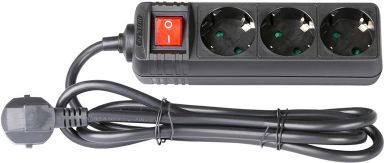
Top seller

3-way power strip
€4.10
*
incl. tax,
plus shipping costs
 Express delivery possible
Availability:
Delivery time: 1-3 days
Delivery time: 1-3 days

Adam Hall Accessories PRO PORT 6 T - Power Strip 6x IP54 + POWER TWIST TR1 IN/OUT
€59.09
*
incl. tax,
plus shipping costs
Availability:
Currently not available
Currently not available

Adam Hall Accessories 8747 S 6 - 6-Outlet Power Strip With On/Off Switch
€7.87
*
incl. tax,
plus shipping costs
Availability:
Delivery time: 1-3 days
Delivery time: 1-3 days

Adam Hall Accessories 8747 X 3 M 3 - 3-Outlet Power Strip 3m cable length
€8.22
*
incl. tax,
plus shipping costs
Availability:
Delivery time: 1-3 days
Delivery time: 1-3 days

Adam Hall Accessories 8747 X 3 M 5 - 3-Outlet Power Strip 5m cable length
€11.64
*
incl. tax,
plus shipping costs
Availability:
Delivery time: 1-3 days
Delivery time: 1-3 days
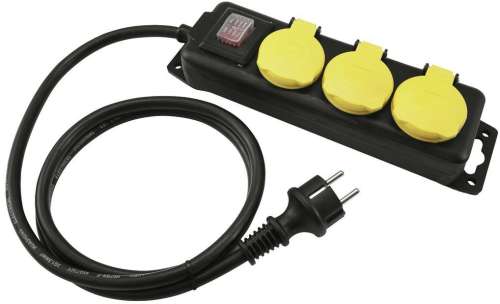
EUROLITE Distributor 3-fold IP44 bk 1.5m
€13.49
*
incl. tax,
plus shipping costs
Availability:
Delivery time: 3-5 days
Delivery time: 3-5 days

DAP-Audio Multisocket Schuko 4-way 3x 1.5 mm² 1.5 m
€17.50
*
incl. tax,
plus shipping costs
Availability:
Delivery time: 3-5 days
Delivery time: 3-5 days

Adam Hall Accessories 8747 IP 3 - 3-Outlet Power Strip with IP44 Rating
€11.92
*
incl. tax,
plus shipping costs
Availability:
Delivery time: 1-3 days
Delivery time: 1-3 days
44
Articles
No results were found for the filter!
3-way power strip
3-way power strip
Details: H05V V-F 3 x 1,5 mm², • sockets 45° rotated, • with child protection • GS approved •
€4.10
*
incl. tax,
plus shipping costs
Availability:
Delivery time: 1-3 days
Delivery time: 1-3 days
Adam Hall Accessories 8747 X 3 M 3 - 3-Outlet Power Strip 3m cable length
Adam Hall Accessories 8747 X 3 M 3 - 3-Outlet Power Strip 3m cable length
3-Outlet Power Strip 3m cable length Rated @ 250 V, 16 A • 45° angled outlets • Child proof • Transparent heat-shrink tube for labelling cables • The 8747X3 features three...
€8.22
*
incl. tax,
plus shipping costs
Availability:
Delivery time: 1-3 days
Delivery time: 1-3 days

SHOWGEAR PowerBOX 4 Pro Power In - 2x Pro Power Out
SHOWGEAR PowerBOX 4 Pro Power In - 2x Pro Power Out
Solutions can be as simple as our PowerBOX series. Providing a fast and easy way to provide your power for lighting / back-line / equipment, Showgear developed a diversity of different socket boxes...
€86.50
*
Availability:
Delivery time: 3-5 days
Delivery time: 3-5 days

Adam Hall Accessories 8747 X 6 M 5 - 6-Outlet Power Strip 5m cable length
Adam Hall Accessories 8747 X 6 M 5 - 6-Outlet Power Strip 5m cable length
6-Outlet Power Strip 5m cable length Rated @ 250 V, 16 A • 45° angled outlets • Child proof • Transparent heat-shrink tube for labelling cables • The 8747X6 features six...
€13.84
*
incl. tax,
plus shipping costs
Availability:
Delivery time: 1-3 days
Delivery time: 1-3 days

EUROLITE Distributor R19-8 1U bk 2.7m
EUROLITE Distributor R19-8 1U bk 2.7m
Attachable power distributor Package contents 1 x device, 4 x screw, 4 x nut, 4 x washer, 1 x end cap • Power connection: Fixed power supply cord with safety plug • Cable length: 2,7 m...
€39.90
*
incl. tax,
plus shipping costs
Availability:
Delivery time: 3-5 days
Delivery time: 3-5 days
Adam Hall Accessories 8747 S 6 - 6-Outlet Power Strip With On/Off Switch
Adam Hall Accessories 8747 S 6 - 6-Outlet Power Strip With On/Off Switch
6-Outlet Power Strip With On/Off Switch Rated @ 250 V, 16 A • 45° angled outlets • Child proof • The 8747S6 features six type F grounded outlets, an illuminated on/off switch and...
€7.87
*
incl. tax,
plus shipping costs
Availability:
Delivery time: 1-3 days
Delivery time: 1-3 days

EUROLITE Distributor 4-fold ALU bk
EUROLITE Distributor 4-fold ALU bk
Power strip Made in Europe • Package contents 1 x bar • Power connection: Mains input via screw terminal • Power output: 4 x safety contact (F), mounting version • Dimensions:...
€42.90
*
incl. tax,
plus shipping costs
Availability:
Delivery time: 3-5 days
Delivery time: 3-5 days

EUROLITE Distributor 6-fold ALU bk
EUROLITE Distributor 6-fold ALU bk
Power strip Made in Europe • Package contents 1 x bar • Power connection: Mains input via screw terminal • Power output: 6 x safety contact (F), mounting version • Dimensions:...
€52.90
*
incl. tax,
plus shipping costs
Availability:
Delivery time: 3-5 days
Delivery time: 3-5 days

OMNITRONIC Weather-Proof Protection Box outdoor
OMNITRONIC Weather-Proof Protection Box outdoor
IP44 protective container for cable connectors Protects against unintentional disconnection • Protects against dirt and damage • Robust PP plastic • Heat and UV resistant...
€4.90
*
incl. tax,
plus shipping costs
Availability:
Delivery time: 3-5 days
Delivery time: 3-5 days

Adam Hall Accessories PRO PORT 4 - Power Strip 4x IP54 + Powertwist I/O
Adam Hall Accessories PRO PORT 4 - Power Strip 4x IP54 + Powertwist I/O
Power Strip 4x IP54 + Powertwist I/O Rated @ 230 V, 16 A • 4 IP54 outlets with flip lid covers • Power Twist I/O connectors • All-metal enclosure • 2 M10 inserts • IP...
€55.76
*
incl. tax,
plus shipping costs
Availability:
Delivery time: 1-3 days
Delivery time: 1-3 days
Adam Hall Accessories 8747 X 3 M 5 - 3-Outlet Power Strip 5m cable length
Adam Hall Accessories 8747 X 3 M 5 - 3-Outlet Power Strip 5m cable length
3-Outlet Power Strip 5m cable length Rated @ 250 V, 16 A • 45° angled outlets • Child proof • Transparent heat-shrink tube for labelling cables • The 8747X3 features three...
€11.64
*
incl. tax,
plus shipping costs
Availability:
Delivery time: 1-3 days
Delivery time: 1-3 days

DAP-Audio Multisocket Schuko 5-way 3x 1.5 mm² 1.5 m
DAP-Audio Multisocket Schuko 5-way 3x 1.5 mm² 1.5 m
3x 1.5 mm² cable, 1.5 m. 5 schuko outputs (German version) (Not suitable for Belgium / French market) : Rated Current (A): 16 A • Power Connector In: Schuko Plug • Power Connector...
€18.90
*
incl. tax,
plus shipping costs
Availability:
Delivery time: 3-5 days
Delivery time: 3-5 days

DAP-Audio 2 + 2-way IP20 Multisocket 3x 1.5 mm² 1.5 m
DAP-Audio 2 + 2-way IP20 Multisocket 3x 1.5 mm² 1.5 m
1.5 m cable 3x 1.5 mm² : Rated Current (A): 16 A • Power Connector In: Schuko Plug • Power Connector Out: Schuko Socket, Type F • Cable Length: 1.5 m • Pins: 3 • Wire...
€19.55
*
incl. tax,
plus shipping costs
Availability:
Delivery time: 3-5 days
Delivery time: 3-5 days

EUROLITE Distributor 8-fold ALU bk
EUROLITE Distributor 8-fold ALU bk
Power strip Made in Europe • Package contents 1 x bar • Power connection: Mains input via screw terminal • Power output: 8 x safety contact (F), mounting version • Dimensions:...
€69.90
*
Availability:
Delivery time: 3-5 days
Delivery time: 3-5 days
Adam Hall Accessories 8747 IP 3 - 3-Outlet Power Strip with IP44 Rating
Adam Hall Accessories 8747 IP 3 - 3-Outlet Power Strip with IP44 Rating
3-Outlet Power Strip with IP44 Rating IP44 power strip • Rated 250 V, 16 A • 45° angled outlets • Transparent heat-shrink tube for labelling cables • The IP44 rated 8747 IP...
€11.92
*
incl. tax,
plus shipping costs
Availability:
Delivery time: 1-3 days
Delivery time: 1-3 days
DAP-Audio Multisocket Schuko 4-way 3x 1.5 mm² 1.5 m
DAP-Audio Multisocket Schuko 4-way 3x 1.5 mm² 1.5 m
3x 1.5 mm² cable, 1.5 m. 4 schuko outputs (German version) (Not suitable for Belgium / French market) : Rated Current (A): 16 A • Power Connector In: Schuko Plug • Power Connector...
€17.50
*
incl. tax,
plus shipping costs
Availability:
Delivery time: 3-5 days
Delivery time: 3-5 days

Adam Hall Accessories PRO PORT 2 T - Power Strip 2 x IP54 + Power Twist TR1 IN/OUT
Adam Hall Accessories PRO PORT 2 T - Power Strip 2 x IP54 + Power Twist TR1 IN/OUT
Power Strip 2 x IP54 + Power Twist TR1 IN/OUT 230 V operating voltage, max. 16 A • 2 x IP54 protective contact socket outlets with hinged lid • Black/yellow power I/O • Metal housing...
€50.33
*
incl. tax,
plus shipping costs
Availability:
Delivery time: 1-3 days
Delivery time: 1-3 days

MONACOR MC-62/SW Tabletop multi-socket power strip
MONACOR MC-62/SW Tabletop multi-socket power strip
Tabletop multi-socket power strip, with 6 earthed sockets. Sockets turned by 45° • Cable specification: H05VV-F3G x 1.5 mm2 • 1.5 m connection cable with earthed plug • :...
€12.00
*
incl. tax,
plus shipping costs
Availability:
Delivery time: 3-5 days
Delivery time: 3-5 days

Adam Hall Accessories 8747 S3 - 3-Outlet Power Strip With On/Off Switch
Adam Hall Accessories 8747 S3 - 3-Outlet Power Strip With On/Off Switch
3-Outlet Power Strip With On/Off Switch Rated @ 250 V, 16 A • 45° angled outlets • Child proof • Transparent heat-shrink tube for labelling cables • The 8747 S3 features...
€6.45
*
incl. tax,
plus shipping costs
Availability:
Near-term available
Delivery time: approx. 1 week
Delivery time: approx. 1 week
Delivery time: approx. 1 week

Adam Hall Accessories 874714 - Mains Power Strip with 14 Sockets
Adam Hall Accessories 874714 - Mains Power Strip with 14 Sockets
Mains Power Strip with 14 Sockets Power distributor with long (3m) cord for up to 14 devices. 12 safety sockets and 2 IEC sockets. (not 19") : Product type: Power strips • Type: 96 cm /...
€51.28
*
incl. tax,
plus shipping costs
Availability:
Near-term available
Delivery time: approx. 1 week
Delivery time: approx. 1 week
Delivery time: approx. 1 week

EUROLITE Distributor 3-fold IP44 bk 5m
EUROLITE Distributor 3-fold IP44 bk 5m
Power strip Control via on/off switch on device • Package contents 1 x device • Power connection: Fixed power supply cord with safety plug • Cable construction: 3 x 1,5 mm²...
€23.90
*
incl. tax,
plus shipping costs
Availability:
Delivery time: 3-5 days
Delivery time: 3-5 days

Adam Hall 19" Parts 87478 - 19" 1U Mains Power Strip with 8 Sockets ( French Connectors )
Adam Hall 19" Parts 87478 - 19" 1U Mains Power Strip with 8 Sockets ( French Connectors )
19" 1U Mains Power Strip with 8 Sockets ( French Connectors ) Mains Distribution Unit 19"/1 U • Illuminated 2-pole switch on the front panel • 8 french mains outlets on the rear...
€51.88
*
€37.14
*
incl. tax,
plus shipping costs
Availability:
Delivery time: 1-3 days
Delivery time: 1-3 days

Adam Hall Accessories 8747 IP 5 - 5-Outlet Power Strip with IP44 Rating
Adam Hall Accessories 8747 IP 5 - 5-Outlet Power Strip with IP44 Rating
5-Outlet Power Strip with IP44 Rating IP44 power strip • Rated 250 V, 16 A • 45° angled outlets • Transparent heat-shrink tube for labelling cables • The IP44 rated 8747 IP...
€15.16
*
incl. tax,
plus shipping costs
Availability:
Delivery time: 1-3 days
Delivery time: 1-3 days

EUROLITE Distributor 3-fold IP44 bk 3m
EUROLITE Distributor 3-fold IP44 bk 3m
Power strip Control via on/off switch on device • Package contents 1 x device • Power connection: Fixed power supply cord with safety plug • Cable construction: 3 x 1,5 mm²...
€17.90
*
incl. tax,
plus shipping costs
Availability:
Delivery time: 3-5 days
Delivery time: 3-5 days