

Top seller

Power Dynamics PDC75 Media Player with recorder
€119.00
*
 Express delivery possible
Availability:
Delivery time: 1-3 days
Delivery time: 1-3 days

Power Dynamics PDC40 DAB+ Tuner FM/USB/BT
€179.00
*
Availability:
Low stock; Delivery time: 1-3 days
Delivery time: 1-3 days

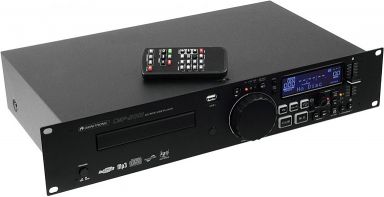
OMNITRONIC XCP-1400 CD Player
€179.00
*
Availability:
Delivery time: 3-5 days
Delivery time: 3-5 days

Power Dynamics PDC150 19'' DVD player with CD+G and USB
€169.90
*
Availability:
Delivery time: 1-3 days
Delivery time: 1-3 days

OMNITRONIC XMT-1400 MK2 Tabletop CD Player
€279.00
*
Availability:
Delivery time: 1-3 days
Delivery time: 1-3 days

DAP-Audio CDI-160BT CD & Media Player 1U CD, Internet, DAB+, FM radio, USB, Bluetooth 5.0
€259.00
*
Availability:
Delivery time: 3-5 days
Delivery time: 3-5 days

DAP-Audio MP-300SBU Professional USB/SD/BT Media Player 1U media player for SD cards, USB storage
€215.00
*
Availability:
Delivery time: 3-5 days
Delivery time: 3-5 days
36
Articles
No results were found for the filter!
OMNITRONIC XCP-1400 CD Player
OMNITRONIC XCP-1400 CD Player
Single CD player Easy-turning jog dial with mode selector (fast or frame search) and Pitch bend function function • Comfortable track selection via skip buttons and +10 button • Pitch...
€179.00
*
Availability:
Delivery time: 3-5 days
Delivery time: 3-5 days

OMNITRONIC DMP-102 USB/SD Card Player
OMNITRONIC DMP-102 USB/SD Card Player
MP3 player for SDHC/MMC memory cards and USB devices , incl. IR remote control SD card slot and USB port • Insensible against vibrations • Folder navigation • Pitch bend function...
€179.00
*
Availability:
Delivery time: 3-5 days
Delivery time: 3-5 days

OMNITRONIC DMP-103RDS Media Player
OMNITRONIC DMP-103RDS Media Player
CD/MP3 player with FM RDS tuner and USB port USB 2.0 port for USB storage media • FM/AM tuner with 30 memory places per band and station finding • Slot-in drive • Cue function...
€269.00
*
Availability:
Delivery time: 3-5 days
Delivery time: 3-5 days

OMNITRONIC XDP-1502 CD/MP3 Player
OMNITRONIC XDP-1502 CD/MP3 Player
Fresh breeze your DJ rackThe compact XDP-1502 is designed as a user-friendly player for DJ racks. It requires only 2 height units, yet is packed with intuitive features such as pitch control, beat...
€229.00
*
Availability:
Delivery time: 3-5 days
Delivery time: 3-5 days

OMNITRONIC XDP-1501 CD/MP3 Player
OMNITRONIC XDP-1501 CD/MP3 Player
Versatile media player for your DJ rackThe 1 U flat CD player XDP-1501 is particularly suitable for fixed installations in restaurants, dance studios and retail outlets where simple music control...
€279.00
*
Availability:
Delivery time: 3-5 days
Delivery time: 3-5 days

DAP-Audio Compact 6.2 6-channel 1U install mixer/player
DAP-Audio Compact 6.2 6-channel 1U install mixer/player
2x mic/line, 2x RCA, AUX input & USB input • Suitable for group workouts such as fitness & spinning • Compressor, limiters & high pass filters • Adj. audio settings at...
€385.00
*
Availability:
Delivery time: 3-5 days
Delivery time: 3-5 days

MONACOR TXA-1802CD CD player insertion module
MONACOR TXA-1802CD CD player insertion module
CD player insertion module, with anti-shock system and MP3 reproduction. Particularly suitable for the TXA-8xx series • Slot-in mechanism • SD card reader • USB port for external...
€355.00
*
Availability:
Delivery time: 3-5 days
Delivery time: 3-5 days

MONACOR DMP-130MIXBT MP3 player and microphone line mixer
MONACOR DMP-130MIXBT MP3 player and microphone line mixer
MP3 player and microphone line mixer With this unit combination, it is possible to mix 3 audio signal sources. The integrated MP3 player can be switched between SD card, USB port and Bluetooth...
€332.00
*
Availability:
Delivery time: 3-5 days
Delivery time: 3-5 days

OMNITRONIC CMP-102 MK2 CD/MP3 Player
OMNITRONIC CMP-102 MK2 CD/MP3 Player
1U CD/MP3 player with XLR connectors and IR remote control Slot-in drive • Adjustable microphone input (XLR/6.3mm jack) • Master output (XLR and RCA) • Recording output (RCA)...
€232.43
*
Availability:
Delivery time: 3-5 days
Delivery time: 3-5 days
Power Dynamics PDC40 DAB+ Tuner FM/USB/BT
Power Dynamics PDC40 DAB+ Tuner FM/USB/BT
This 1U DAB+ Tuner is a perfect device for e.g. bars, restaurants, at home, discos, drive-in shows, etc. The unit comes with an DAB+/FM Tuner, USB port, BT, a blue backlight LCD display and a full...
€179.00
*
Availability:
Low stock; Delivery time: 1-3 days
Delivery time: 1-3 days
Power Dynamics PDC150 19'' DVD player with CD+G and USB
Power Dynamics PDC150 19'' DVD player with CD+G and USB
The PDC150 is an 19'' DVD-player with CD+G support for karaoke. Due to it's 1U size, the player can easily fit into existing installations. The many outputs ensure easy installation onto your...
€169.90
*
Availability:
Delivery time: 1-3 days
Delivery time: 1-3 days
Power Dynamics PDC75 Media Player with recorder
Power Dynamics PDC75 Media Player with recorder
The PDC75 is an all-in-one 1U media player with an integrated MP3 player that can play files directly from the USB and SD inputs. Besides that, the PDC75 is also equipped with a BT receiver to...
€119.00
*
Availability:
Delivery time: 1-3 days
Delivery time: 1-3 days

OMNITRONIC EP-220NET Preamplifier with Internet Radio, DAB+ and Bluetooth
OMNITRONIC EP-220NET Preamplifier with Internet Radio, DAB+ and Bluetooth
19" preamplifier mit Internetradio, DAB+, Bluetooth and IR remote control Internet radio with DAB+ and FM tuner, Bluetooth and UPnP/DLNA support • Wide range of streaming options via...
€299.00
*
Availability:
Delivery time: 3-5 days
Delivery time: 3-5 days

DAP-Audio MP-100DBT Professional Media Player with DAB+ 1U Media Player with DAB+, FM Radio
DAP-Audio MP-100DBT Professional Media Player with DAB+ 1U Media Player with DAB+, FM Radio
1U 19” rack media player • Supports DAB+, FM Radio, USB/MP3, Bluetooth® 4.2 • 3.5-mm jack, XLR/combi mic, USB-A, and 4x RCA inputs • Suitable for stores, cafés,...
€140.32
*
Availability:
Delivery time: 3-5 days
Delivery time: 3-5 days

DAP-Audio IR-150BT Media Player 1U Internet radio with Wi-Fi, DAB+, and wireless audio (Bluetooth
DAP-Audio IR-150BT Media Player 1U Internet radio with Wi-Fi, DAB+, and wireless audio (Bluetooth
1U 19" rack media player • Supports DAB+, FM radio and Bluetooth® 4.2 • Suitable for stores, cafés, restaurants, sports canteens, etc. • 2.4" TFT display...
€277.67
*
Availability:
Delivery time: 3-5 days
Delivery time: 3-5 days

DAP-Audio PA-5500TU 1U Internet radio with 460 W Amp, DAB+, FM, BT 4.2, and network audio player
DAP-Audio PA-5500TU 1U Internet radio with 460 W Amp, DAB+, FM, BT 4.2, and network audio player
1U 19” Internet radio with 2x 250 W/8 Ω or 1x 250 W 100 V amp • Supports DAB+, FM radio, BT 4.2, and AUX in/out • Suitable for public places like fitness centres and shops...
€509.00
*
Availability:
Delivery time: 3-5 days
Delivery time: 3-5 days

ADJ Media Operator BT
ADJ Media Operator BT
The American Audio Media Operator BT is a fast, simple and reliable all-in-one MP3/Bluetooth media player designed for permanent installations where easy control of music is a must (ie....
€98.00
*
Availability:
Delivery time: 1-3 days
Delivery time: 1-3 days
OMNITRONIC XMT-1400 MK2 Tabletop CD Player
OMNITRONIC XMT-1400 MK2 Tabletop CD Player
DJ player for CD, USB and SD USB port for storage media and portable players • SD(HC) card slot • Anti-shock RAM buffer memory • Text display supports CD text and ID3 tags (artist...
€279.00
*
Availability:
Delivery time: 1-3 days
Delivery time: 1-3 days

MONACOR PA-1200IRD Internet radio, DAB+/FM RDS tuner insertion with USB port
MONACOR PA-1200IRD Internet radio, DAB+/FM RDS tuner insertion with USB port
Internet radio, DAB+/FM RDS tuner insertion with USB port, for PA mixing amplifier with insertion compartment. LAN or WLAN connection, WPS possible • Detachable WLAN antenna • Network...
€379.61
*
Availability:
Delivery time: 3-5 days
Delivery time: 3-5 days

MONACOR STREAM Spottune STREAM audio streamer
MONACOR STREAM Spottune STREAM audio streamer
Central audio/music streamer for Spottune speaker systems Wireless audio/music streaming transmitter/receiver for streaming music, announcements etc. via the Spottune speaker system. Reliable radio...
€559.01
*
Availability:
Delivery time: 3-5 days
Delivery time: 3-5 days
DAP-Audio CDI-160BT CD & Media Player 1U CD, Internet, DAB+, FM radio, USB, Bluetooth 5.0
DAP-Audio CDI-160BT CD & Media Player 1U CD, Internet, DAB+, FM radio, USB, Bluetooth 5.0
1U 19” rack CD and media player • CD, DAB+, FM and internet radio, USB, Bluetooth® 5.0 • Suitable for stores, cafes, restaurants, sports canteens etc. • 2.4” TFT...
€259.00
*
Availability:
Delivery time: 3-5 days
Delivery time: 3-5 days

MONACOR CD-114/BT CD and MP3 player
MONACOR CD-114/BT CD and MP3 player
CD and MP3 player, with Bluetooth receiver, USB port and SD card slot. Bluetooth receiver for wireless connection of laptops, smartphones or tablet PCs • USB storage media can be connected...
€399.00
*
Availability:
Delivery time: 3-5 days
Delivery time: 3-5 days

DAP-Audio SPA-100 Streaming Pre-Amplifier 1U Media Player with streaming function, USB/MP3 player
DAP-Audio SPA-100 Streaming Pre-Amplifier 1U Media Player with streaming function, USB/MP3 player
1U 19" Media Player • Supports LAN/Wi-Fi streaming via Airplay and Android casting • USB port with AAC, AAC+, ALAC, APE, FLAC, MP3 and WAV support • BT 5.0 with aptX HD...
€190.07
*
Availability:
Delivery time: 3-5 days
Delivery time: 3-5 days
DAP-Audio MP-300SBU Professional USB/SD/BT Media Player 1U media player for SD cards, USB storage
DAP-Audio MP-300SBU Professional USB/SD/BT Media Player 1U media player for SD cards, USB storage
1U 19” rackmount USB/SD card/BT 5.3 media player • Supports SD(HC) cards and USB devices with FAT16/FAT32 • Pitch and tempo control • RCA and balanced XLR outputs...
€215.00
*
Availability:
Delivery time: 3-5 days
Delivery time: 3-5 days