Frequency crossovers

Professional Crossovers for Event Technology: Crossovers are the invisible architects behind every professional PA system, ensuring that each speaker driver receives precisely the frequency range it was designed to handle. Whether you're building a custom speaker cabinet, upgrading an existing PA system, or designing a fixed installation for a venue, the right crossover makes the difference between muddy sound and crystal-clear audio reproduction. At LTT, you'll find professional crossovers from leading...
Read more »
Frequency crossovers
Close window
Frequency crossovers

Professional Crossovers for Event Technology

Crossovers are the invisible architects behind every professional PA system, ensuring that each speaker driver receives precisely the frequency range it was designed to handle. Whether you're building a custom speaker cabinet, upgrading an existing PA system, or designing a fixed installation for a venue, the right crossover makes the difference between muddy sound and crystal-clear audio reproduction. At LTT, you'll find professional crossovers from leading manufacturers, perfectly matched to the demands of event technology, stage applications, and professional sound reinforcement.

From compact passive crossovers for speaker cabinet construction to sophisticated active DSP controllers for line array systems, our range covers every application scenario in professional event technology. You benefit from over 25 years of experience in the industry and expert advice that helps you select the optimal solution for your specific requirements.

How Do Crossovers Work in PA Systems?

A crossover divides the audio signal into distinct frequency bands and routes each band to the appropriate speaker driver. This frequency-dependent signal splitting is essential because individual drivers — tweeters, midrange speakers, and woofers — are each optimised for specific frequency ranges. Without proper crossover filtering, a tweeter would attempt to reproduce bass frequencies it cannot physically handle, leading to distortion, overheating, and potentially driver failure.

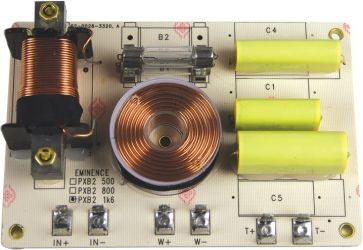
The core components of passive crossovers are capacitors and inductors. Capacitors act as high-pass filters, blocking low frequencies while allowing high frequencies to pass through to tweeters. Inductors function as low-pass filters, permitting low frequencies to reach woofers while blocking higher frequencies. The combination of these components creates the characteristic filter slopes measured in decibels per octave (dB/oct).

Filter Orders and Slopes

Crossovers are classified by their filter order, which determines how steeply they separate frequency bands:

  • 1st order (6 dB/oct): Simple design with minimal phase shift but gentle separation
  • 2nd order (12 dB/oct): Most common in professional applications, offering good balance between separation and phase coherence
  • 3rd order (18 dB/oct): Steeper separation, useful when drivers have overlapping frequency capabilities
  • 4th order (24 dB/oct): Very steep separation, often used in Linkwitz-Riley configurations for optimal phase alignment

The crossover frequency — typically between 400 Hz and 2,900 Hz for 2-way systems — is chosen based on the physical capabilities of the drivers and the acoustic requirements of the application. Professional PA systems often use crossover frequencies around 1,200–2,500 Hz for 2-way configurations, while 3-way systems add a second crossover point, typically between 300–600 Hz.

Active vs Passive Crossovers for Professional Audio

The choice between active and passive crossovers fundamentally affects system design, performance, and flexibility. Understanding the differences is crucial for professional applications in event technology.

Passive Crossovers

Passive crossovers are installed after the power amplifier, directly before the speaker drivers, and require no external power supply. They use only capacitors, inductors, and resistors to split the amplified signal. In speaker cabinet construction, passive crossovers are typically mounted inside the enclosure, making them the standard choice for portable PA speakers and monitor systems.

The advantages include simplicity — only one amplifier channel is needed per speaker cabinet — and reliability, as there are no active components to fail. However, passive crossovers must handle the full power of the amplifier, requiring large, robust components. This results in power losses through heat dissipation, typically 1–3 dB, and limits the ability to compensate for driver impedance variations. Passive crossovers with power handling of 400W at 4–8 ohms are common in professional applications.

Active Crossovers and DSP Controllers

Active crossovers split the signal before amplification, operating at line level. Modern implementations use digital signal processors (DSP) that offer unprecedented flexibility. Each frequency band requires its own amplifier channel, making active systems more complex but offering significant advantages.

Active crossovers eliminate power losses in the crossover network itself, allow precise driver protection through limiters, enable real-time adjustment of crossover frequencies and slopes, and permit sophisticated equalisation to compensate for driver and room acoustics. Professional DSP controllers often include additional functions such as delay alignment for phase coherence, parametric EQ for room correction, and individual limiters for each driver to prevent damage.

In touring systems and fixed installations, active crossovers have become the standard. They allow sound engineers to optimise system performance for specific venues and adapt to changing acoustic requirements. The ability to store and recall presets makes them invaluable for professional applications where consistency and flexibility are paramount.

2-Way, 3-Way and Multi-Way Systems

The number of "ways" in a speaker system refers to how many frequency bands are created and how many different driver types are used. Each configuration has specific applications in event technology.

2-Way Systems

A 2-way system divides the audio spectrum into two bands: low/mid frequencies for the woofer and high frequencies for the tweeter. The crossover frequency typically sits between 1,800 Hz and 3,500 Hz, depending on the capabilities of both drivers. This configuration is the most common in portable PA speakers, stage monitors, and smaller venue installations.

Professional 2-way systems often feature a 12-inch or 15-inch woofer paired with a 1-inch or 1.4-inch compression driver on a horn. The crossover must be carefully designed to ensure the woofer doesn't produce harsh midrange frequencies while the tweeter isn't overloaded by frequencies below its safe operating range. Typical power handling ranges from 300W to 800W continuous, with impedances of 4 or 8 ohms.

3-Way Systems

Three-way systems add a dedicated midrange driver, splitting the spectrum into bass (woofer), midrange, and treble (tweeter). Two crossover points are required: a lower crossover typically between 300–600 Hz separating woofer from midrange, and an upper crossover between 2,500–5,000 Hz separating midrange from tweeter.

This configuration is common in high-quality stage monitors, main PA systems for medium to large venues, and studio monitors. The dedicated midrange driver handles the critical frequency range where most vocal and instrumental fundamentals occur, resulting in improved clarity and reduced distortion. Professional 3-way systems can handle 600W to over 1,500W, making them suitable for demanding applications.

Multi-Way and Line Array Systems

Large-scale PA systems and line arrays may use four or more ways, with dedicated drivers for sub-bass, bass, low-mid, high-mid, and high frequencies. These systems almost exclusively use active crossovers with DSP control, allowing precise optimisation of each driver's contribution. The complexity requires sophisticated system design but delivers exceptional clarity and power handling for festival stages, concert halls, and large outdoor events.

Choosing the Right Crossover for Your Venue

Selecting the appropriate crossover depends on your specific application, venue characteristics, and system requirements. Professional event technology demands careful matching of crossover type to use case.

Outdoor Festivals and Large Events

Outdoor applications benefit from active crossover systems with DSP control. The ability to adjust crossover frequencies and apply equalisation compensates for environmental factors such as wind, temperature, and the absence of reflective surfaces. Line array systems for festivals typically use 3-way or 4-way active crossovers with individual amplifier channels for low-frequency, midrange, and high-frequency sections. This configuration allows sound engineers to optimise coverage patterns and adjust for varying audience distances.

Weather resistance becomes crucial for outdoor gear. While the crossover electronics are typically housed in rack-mounted processors, the amplifier-to-speaker connections must be robust and weatherproof. Professional touring systems often integrate crossover functions into powered speakers, simplifying setup and reducing potential failure points.

Clubs and Fixed Installations

Club installations benefit from the reliability of passive crossovers in the main PA speakers, combined with active subwoofer management via DSP. This hybrid approach provides the flexibility to adjust bass response for different music genres while maintaining the simplicity of passive full-range speakers. Fixed installations allow for careful acoustic measurement and crossover optimisation during commissioning, after which settings rarely need adjustment.

For clubs with multiple zones — main floor, VIP areas, outdoor terraces — a central DSP controller managing all crossover functions provides consistency and allows the venue to adapt quickly to different event types. Preset recall ensures that each area receives appropriate frequency distribution regardless of which staff member operates the system.

Theatres and Corporate Events

Theatre sound systems prioritise speech intelligibility and natural tonal balance. Two-way systems with carefully designed passive crossovers around 1,800–2,200 Hz often provide the most natural midrange reproduction for dialogue. The crossover design must avoid phase issues that could create comb filtering effects, particularly important when multiple speakers cover overlapping areas.

Corporate events with temporary setups favour portable powered speakers with integrated DSP crossovers. These all-in-one solutions eliminate external processors and reduce setup time while maintaining professional sound quality. The ability to link multiple speakers and control them from a tablet or laptop makes them ideal for conference centres and hotel ballrooms.

Trade Shows and Exhibitions

Trade show applications require compact systems with excellent speech intelligibility in acoustically challenging environments. Active crossovers with aggressive high-pass filtering (80–100 Hz) prevent wasted amplifier power on bass frequencies that exhibition halls cannot support. The crossover design should emphasise midrange clarity, typically 400–4,000 Hz, where speech intelligibility is determined.

Power Handling and Safety Standards

Professional crossovers must meet stringent power handling and safety requirements to ensure reliable operation in demanding event technology applications.

Power Ratings and Thermal Management

Passive crossovers must handle the full output power of the amplifier without overheating or component failure. Professional models specify continuous power handling (RMS), typically ranging from 200W for small monitors to over 1,000W for main PA systems. The power rating must match or exceed the amplifier's output at the speaker's impedance.

Inductors (coils) are the most thermally stressed components in passive crossovers. High-quality crossovers use air-core inductors or ferrite-core inductors with copper wire of sufficient gauge to minimise resistance and heat generation. Capacitors must be rated for continuous AC operation; film capacitors (MKP — metallised polypropylene) are preferred over electrolytic types for their stability and long service life.

Protection Circuits

Professional crossovers often incorporate protection for sensitive drivers. PTC (Positive Temperature Coefficient) thermistors are self-resetting devices that increase resistance when heated, automatically reducing power to tweeters during overload conditions. This protection prevents driver failure from excessive input levels while allowing normal operation to resume once the component cools.

Active crossovers with DSP control offer more sophisticated protection. Individual limiters for each frequency band prevent clipping and driver damage, while look-ahead limiters can anticipate signal peaks and apply gain reduction before distortion occurs. This active protection is particularly valuable in rental and touring applications where equipment is operated by different personnel with varying experience levels.

Safety Certifications and Standards

Professional audio equipment sold in Europe must comply with CE marking requirements, including electromagnetic compatibility (EMC) and electrical safety standards. Active crossovers and DSP controllers must meet EN 60065 (audio equipment safety) or the newer EN 62368-1 standard. These certifications ensure that equipment will not cause electrical hazards or interfere with other devices.

For permanent installations in public venues, compliance with local building codes and fire safety regulations may require additional certifications. Equipment used in touring applications should meet international safety standards to facilitate customs clearance and operation in multiple countries.

Impedance Matching and Amplifier Compatibility

Crossover design must account for the speaker's impedance curve, which varies with frequency. A speaker rated at 8 ohms nominal may present 6 ohms at some frequencies and 20 ohms at others, particularly near resonance. Professional crossovers include impedance linearisation networks — additional components that flatten the impedance curve seen by the amplifier, ensuring stable operation and preventing amplifier protection circuits from engaging unnecessarily.

When matching crossovers to professional power amplifiers, verify that the amplifier can deliver its rated power into the speaker's actual impedance. Many professional amplifiers are rated at 4 ohms, delivering less power into 8-ohm loads. The crossover design should maintain an impedance that allows the amplifier to operate efficiently without overheating or current limiting.

Installation and Setup Guide

Proper installation and configuration of crossovers are essential for achieving optimal system performance and reliability in professional applications.

Passive Crossover Installation

When building custom speaker cabinets, mount passive crossovers securely inside the enclosure using vibration-damping materials. Position the crossover away from the speaker's magnet structures to avoid magnetic interference with inductors. Use cable ties or mounting brackets to prevent components from vibrating loose during high-level operation.

Wiring must be appropriately gauged for the power levels involved. For systems handling 400W or more, use 14 AWG (2.5 mm²) or heavier wire for all connections between crossover and drivers. Solder all connections or use high-quality crimp terminals; mechanical security is as important as electrical conductivity. Label all wires clearly, indicating which driver each connects to and observing correct polarity throughout.

Some crossovers include adjustment options such as tweeter level controls (typically −3 dB, 0 dB, +3 dB) or impedance compensation switches. Set these based on acoustic measurements if possible, or start with the manufacturer's recommended neutral position and adjust by ear in the intended environment.

Active Crossover and DSP Setup

Active systems require careful gain structure setup. Begin by setting all crossover output levels to unity gain (0 dB) and all amplifier input controls to their minimum position. Apply a test signal (pink noise or music) at normal operating level and gradually increase amplifier gains until the system reaches the desired output level. This approach maximises signal-to-noise ratio and prevents accidental overload during setup.

Crossover frequencies should be set based on driver specifications and acoustic measurements. As a starting point, use the manufacturer's recommended crossover frequencies, then measure the system's frequency response using a measurement microphone and analysis software. Adjust crossover points and slopes to achieve the flattest possible response, paying particular attention to the crossover regions where driver outputs overlap.

Delay alignment is crucial in multi-way systems. High-frequency drivers are often physically recessed or mounted further forward than woofers, creating arrival-time differences. Use the DSP's delay function to time-align drivers so that all frequencies arrive at the listening position simultaneously. This typically involves delaying the tweeter by 0.5–2 milliseconds relative to the woofer, depending on physical spacing.

Rack Mounting and Cable Management

Active crossovers and DSP controllers are typically 19-inch rack-mountable units, either 1U or 2U in height. Mount them in a well-ventilated rack position, avoiding placement directly above heat-generating power amplifiers if possible. Leave at least 1U of space above and below for airflow, or use rack-mount fan panels in densely packed racks.

Use balanced XLR or TRS connections for all line-level signals between the crossover and amplifiers. Separate audio cables from power cables by at least 30 cm to minimise hum and interference. In permanent installations, use cable management panels and clearly label all connections. For touring systems, create a connection diagram and laminate it for attachment to the rack.

System Optimisation and Measurement

After initial setup, measure the system's performance using a real-time analyser (RTA) or dual-channel FFT analyser. Position the measurement microphone at typical listener locations and verify that the frequency response is smooth across the crossover regions. Look for dips or peaks of more than 3 dB, which indicate phase cancellation or driver mismatch.

Adjust parametric EQ to compensate for room modes and speaker response irregularities, but avoid excessive equalisation. More than 6 dB of boost or cut at any frequency suggests a fundamental system problem that EQ cannot properly solve. Document all settings and save them as a preset for future reference.

LTT – Your Specialist for Event Technology

At LTT, you'll find professional crossovers from leading manufacturers such as Omnitronic, Futurelight, and other established brands in event technology. Our range covers everything from compact passive crossovers for speaker cabinet construction to sophisticated DSP controllers for complex PA systems and fixed installations.

With over 25 years of experience in professional event technology, we understand the specific requirements of touring systems, permanent installations, and rental applications. Our team provides expert advice to help you select the optimal crossover solution for your specific application — whether you're building custom speaker cabinets, upgrading an existing PA system, or designing a complete venue installation.

We ship worldwide from our location in Bocholt, Germany, with free shipping on orders over €69 within Germany. Express delivery options ensure that you receive your equipment quickly when project deadlines are tight. As both a retailer and manufacturer with our own production facilities, we offer not only leading third-party brands but also our premium house brands Riggatec®, Naxpro-Truss®, and Bullstage®, all backed by our comprehensive 3-year LTT warranty.

Whether you need passive crossovers for speaker construction, active DSP controllers for line array systems, or expert advice on system design and optimisation, LTT is your reliable partner for professional event technology solutions.

FAQ – Questions & Answers

What are frequency crossovers?

Frequency crossovers are electronic circuits that divide an audio signal into separate frequency bands and route each band to the appropriate speaker driver. In professional PA systems and speaker cabinets, crossovers ensure that tweeters receive only high frequencies, woofers handle low frequencies, and midrange drivers (in 3-way systems) reproduce the middle frequency range. This frequency-dependent signal splitting is essential because each driver type is optimised for a specific frequency range and cannot accurately reproduce the entire audio spectrum. Crossovers use combinations of capacitors, inductors, and (in active systems) electronic amplifiers to create high-pass, low-pass, and band-pass filters with slopes typically ranging from 6 dB/octave to 24 dB/octave.

What do you need a crossover for?

Crossovers are necessary in multi-driver speaker systems to protect drivers from frequencies they cannot handle and to optimise sound quality. Without a crossover, a tweeter would attempt to reproduce bass frequencies that could cause mechanical damage and overheating, while a woofer cannot physically respond fast enough to reproduce high frequencies accurately. Crossovers prevent these problems by filtering the signal so each driver receives only its intended frequency range. Additionally, crossovers help avoid resonance frequencies where drivers exhibit peaks or irregularities in their response. In professional event technology applications, properly designed crossovers are essential for achieving clear, undistorted sound reproduction at high output levels, protecting expensive drivers from damage, and ensuring consistent system performance across different venues and operating conditions.

What's the difference between active and passive crossovers?

Passive crossovers are installed after the power amplifier and use only capacitors, inductors, and resistors to split the amplified signal. They require no external power supply and are typically mounted inside speaker cabinets, making them simple and reliable but limited in flexibility. Active crossovers operate at line level before amplification, using electronic circuits or digital signal processors (DSP) to split the signal. Each frequency band then requires its own amplifier channel. Active crossovers offer significant advantages including no power losses in the crossover network, precise driver protection through limiters, real-time adjustment of crossover frequencies and slopes, and sophisticated equalisation capabilities. In professional event technology, active crossovers with DSP control have become the standard for touring systems and large installations, while passive crossovers remain popular for portable PA speakers and applications where simplicity and reliability are priorities.

How do I calculate crossover frequencies?

Crossover frequencies should be chosen based on the physical capabilities of your speaker drivers and the acoustic requirements of your application, not simply calculated from formulas. For 2-way systems, typical crossover frequencies range from 1,800 Hz to 3,500 Hz, depending on the woofer's upper frequency limit and the tweeter's lower frequency capability. The woofer should be able to reproduce frequencies up to at least one octave above the crossover point without excessive distortion or beaming, while the tweeter must handle frequencies below the crossover point without mechanical stress. For 3-way systems, a lower crossover between 300–600 Hz separates the woofer from the midrange driver, and an upper crossover between 2,500–5,000 Hz separates midrange from tweeter. Professional crossover design requires acoustic measurements using analysis software to verify smooth frequency response and proper phase alignment at the crossover points. Simple online calculators provide component values but cannot account for driver impedance variations, frequency response irregularities, or cabinet effects that significantly affect real-world performance.

Which crossover is best for a 2-way PA speaker?

For a 2-way PA speaker in professional event technology applications, a passive crossover with 12 dB/octave (2nd order) slopes offers the best balance of performance, simplicity, and reliability. The crossover frequency should typically be set between 1,800 Hz and 2,500 Hz, depending on the specific drivers used. Choose a crossover rated for at least 400W continuous power handling if using a 12-inch or 15-inch woofer with a compression driver on a horn, which is the standard configuration for portable PA speakers. The crossover should include a tweeter protection circuit (PTC thermistor) to prevent driver damage from overload. High-quality crossovers use film capacitors (MKP type) rather than electrolytic capacitors for better stability and longer service life, and air-core or ferrite-core inductors with low DC resistance to minimise power losses. For touring applications or situations requiring flexibility, consider powered speakers with integrated DSP crossovers that allow adjustment of crossover frequencies and driver protection settings.

What does a crossover cost?

Passive crossovers for speaker cabinet construction typically cost between €15 and €150 per pair, depending on power handling capacity, component quality, and complexity. Simple 2-way crossovers with 200–400W power handling and basic components start around €20–40 per pair, while high-quality 2-way crossovers with 600–1,000W capacity, film capacitors, and impedance linearisation range from €60–100 per pair. Premium 3-way passive crossovers with sophisticated component selection and high power handling can exceed €150 per pair. Active crossovers and DSP controllers represent a larger investment, with entry-level 2-way/3-way active crossovers starting around €150–300, mid-range DSP processors with multiple inputs and outputs costing €400–800, and professional touring-grade DSP systems ranging from €1,000 to over €3,000. When comparing costs, consider that active systems require additional amplifier channels, while passive systems need only one amplifier per speaker cabinet. The total system cost depends on your specific application, required flexibility, and performance standards.

Can I use a crossover with different speaker impedances?

Passive crossovers are designed for specific speaker impedances, typically 4 ohms or 8 ohms, and using them with different impedances will shift the crossover frequencies and alter the filter slopes. If you use an 8-ohm crossover with 4-ohm drivers, the crossover frequencies will approximately double, and the system's tonal balance will be significantly affected. Some professional crossovers include impedance compensation switches or adjustable components to accommodate different driver impedances, but these are not universal. When building or modifying speaker systems, always match the crossover's design impedance to your drivers' nominal impedance. Active crossovers and DSP controllers do not have this limitation because they operate at line level before amplification and are independent of speaker impedance. This is one significant advantage of active systems — you can change drivers or reconfigure the system without redesigning the crossover network. For professional applications requiring flexibility or future upgrades, active crossover systems provide much greater adaptability than passive designs.

How do I protect tweeters in a PA system?

Tweeter protection in professional PA systems is achieved through proper crossover design and, in many cases, dedicated protection circuits. The crossover's high-pass filter prevents low-frequency energy from reaching the tweeter, which is the primary protection mechanism. A 12 dB/octave or steeper high-pass filter with a crossover frequency at least one octave below the tweeter's resonance frequency provides good protection under normal conditions. Additional protection comes from PTC (Positive Temperature Coefficient) thermistors, which are self-resetting devices that increase resistance when heated by excessive current, automatically reducing power to the tweeter during overload. These are commonly integrated into passive crossovers for professional applications. In active systems with DSP control, dedicated limiters for the high-frequency amplifier channel provide more sophisticated protection by preventing signal peaks from exceeding safe levels. Set limiter thresholds based on the tweeter's power handling specification, typically allowing peaks 6–10 dB above the continuous power rating. For touring and rental applications where equipment may be operated at high levels by different personnel, both passive PTC protection and active limiting provide redundant safety that prevents expensive driver failures.

Top seller
Skytec STP-1 Passive Frequenzweiche 1000W
Skytec STP-1 Passive crossover 1000W
€47.00 *
incl. tax, plus shipping costs
Availability:
Delivery time: 1-3 days
MONACOR DN-2618 2-Wege-Weiche
MONACOR DN-2618 2-way crossover network for 8 O
€39.00 *
incl. tax, plus shipping costs
Availability:
Delivery time: 3-5 days
MONACOR DN-200 3-Wege-Weiche
MONACOR DN-200 3-way crossover network for 8 O
€119.00 *
incl. tax, free shipping to Germany
[International shipping costs]
Availability:
Delivery time: 3-5 days
MONACOR DN-2618P 2-Wege-Weiche
MONACOR DN-2618P 2-way crossover network for 8 O
€41.00 *
incl. tax, plus shipping costs
Availability:
Delivery time: 3-5 days
MONACOR DN-1 2-Wege-Frequenzweiche
MONACOR DN-1 2-way crossover network for 8 O
€10.00 *
incl. tax, plus shipping costs
Availability:
Delivery time: 3-5 days
MONACOR DN-10 3-Wege-Weiche
MONACOR DN-10 3-way crossover network for 8 O
€53.00 *
incl. tax, plus shipping costs
Availability:
Currently not available
11 Articles
Close filters
 
  •  
  •  
from to
No results were found for the filter!
MONACOR DN-1218P 2-Wege-Weiche
MONACOR DN-1218P 2-way crossover network for 8 O for hi-fi and PA
2-way crossover network for 8 O for hi-fi and PA High slopes • High-quality version • Film capacitors • Tweeter protection • : : 2-way • Output impedance: 8 O...
€49.90 *
incl. tax, plus shipping costs
Availability:
Delivery time: 3-5 days
MONACOR DN-2618P 2-Wege-Weiche
MONACOR DN-2618P 2-way crossover network for 8 O
2-way crossover network for 8 O Tweeter protection (P) • Film capacitors • Low-pass filter also suitable for 4 O • : : 2-way • Output impedance: 8 O (bass also 4 O)...
€41.00 *
incl. tax, plus shipping costs
Availability:
Delivery time: 3-5 days
MONACOR DN-200 3-Wege-Weiche
MONACOR DN-200 3-way crossover network for 8 O
3-way crossover network for 8 O High-quality components • For general applications • : : 3-way • Output impedance: 8 O • Crossover frequency: 700/3,500 Hz • Slope/oct.: 12...
€119.00 *
incl. tax, free shipping to Germany
[International shipping costs]
Availability:
Delivery time: 3-5 days
MONACOR DN-2618 2-Wege-Weiche
MONACOR DN-2618 2-way crossover network for 8 O
2-way crossover network for 8 O Film capacitors • Low-pass filter also suitable for 4 O • : : 2-way • Output impedance: 8 O (bass also 4 O) • Crossover frequency: 3 kHz (B = 4...
€39.00 *
incl. tax, plus shipping costs
Availability:
Delivery time: 3-5 days
MONACOR DN-20 2-Wege-Weiche
MONACOR DN-20 2-way crossover network for 8 O
2-way crossover network for 8 O For hi-fi applications • Ideal in combination with high-quality speakers • : : 2-way • Output impedance: 8 O • Crossover frequency: 2,000 Hz...
€47.00 *
incl. tax, plus shipping costs
Availability:
Delivery time: 3-5 days
MONACOR DNL-1245 2-Wege-Weiche
MONACOR DNL-1245 Bass 2-way crossover network for 8 O for PA
Bass 2-way crossover network for 8 O for PA Highest power rating • Film capacitors • Transformer core coil • Frequency and slopes typical for PA • Extendable • : : PA -...
€54.00 *
incl. tax, plus shipping costs
Availability:
Delivery time: 3-5 days
MONACOR DN-1 2-Wege-Frequenzweiche
MONACOR DN-1 2-way crossover network for 8 O
2-way crossover network for 8 O Basic 6-dB crossover network • Low-pass filter with air core coil • High-pass filter with frequency capacitator • : : 2-way • Output impedance: 8...
€10.00 *
incl. tax, plus shipping costs
Availability:
Delivery time: 3-5 days
MONACOR DNH-185 Lautsprecher-Frequenzweiche
MONACOR DNH-185 Mono high-pass filter for 8 O for hi-fi and PA
Mono high-pass filter for 8 O for hi-fi and PA Top-quality components • Low-impedance coils • Film capacitors • : : high-pass filter • Output impedance: 8 O • Crossover...
€19.03 *
incl. tax, plus shipping costs
Availability:
Delivery time: 3-5 days
MONACOR DN-4 3-Wege-Weiche
MONACOR DN-4 3-way crossover network for 8 O
3-way crossover network for 8 O Air core coils • High-quality bipolar electrolytic capacitors • : : 3-way • Output impedance: 8 O • Crossover frequency: 650/6,000 Hz...
€29.00 *
incl. tax, plus shipping costs
Availability:
Delivery time: 3-5 days
Skytec STP-1 Passive Frequenzweiche 1000W
Skytec STP-1 Passive crossover 1000W
A 2-way passive crossover having a least effect on colouring the music. With a "musical" sound reproduction, a crossover-frequency of 180Hz and a high load capacity. This crossover is a...
€47.00 *
incl. tax, plus shipping costs
Availability:
Delivery time: 1-3 days
MONACOR DN-10 3-Wege-Weiche
MONACOR DN-10 3-way crossover network for 8 O
3-way crossover network for 8 O High-quality components • Film capacitors in the high-pass filter • : : 3-way • Output impedance: 8 O • Crossover frequency: 800/4,500 Hz...
€53.00 *
incl. tax, plus shipping costs
Availability:
Currently not available
Facts
Professional Crossovers for Event Technology: Crossovers are the invisible architects behind every professional PA system, ensuring that each speaker driver receives precisely the frequency range it was designed to handle. Whether you're building a custom speaker cabinet, upgrading an existing PA system, or designing a fixed installation for a venue, the right crossover makes the difference between muddy sound and crystal-clear audio... Read more »
Viewed
Facts

Professional Crossovers for Event Technology

Crossovers are the invisible architects behind every professional PA system, ensuring that each speaker driver receives precisely the frequency range it was designed to handle. Whether you're building a custom speaker cabinet, upgrading an existing PA system, or designing a fixed installation for a venue, the right crossover makes the difference between muddy sound and crystal-clear audio reproduction. At LTT, you'll find professional crossovers from leading manufacturers, perfectly matched to the demands of event technology, stage applications, and professional sound reinforcement.

From compact passive crossovers for speaker cabinet construction to sophisticated active DSP controllers for line array systems, our range covers every application scenario in professional event technology. You benefit from over 25 years of experience in the industry and expert advice that helps you select the optimal solution for your specific requirements.

How Do Crossovers Work in PA Systems?

A crossover divides the audio signal into distinct frequency bands and routes each band to the appropriate speaker driver. This frequency-dependent signal splitting is essential because individual drivers — tweeters, midrange speakers, and woofers — are each optimised for specific frequency ranges. Without proper crossover filtering, a tweeter would attempt to reproduce bass frequencies it cannot physically handle, leading to distortion, overheating, and potentially driver failure.

The core components of passive crossovers are capacitors and inductors. Capacitors act as high-pass filters, blocking low frequencies while allowing high frequencies to pass through to tweeters. Inductors function as low-pass filters, permitting low frequencies to reach woofers while blocking higher frequencies. The combination of these components creates the characteristic filter slopes measured in decibels per octave (dB/oct).

Filter Orders and Slopes

Crossovers are classified by their filter order, which determines how steeply they separate frequency bands:

  • 1st order (6 dB/oct): Simple design with minimal phase shift but gentle separation
  • 2nd order (12 dB/oct): Most common in professional applications, offering good balance between separation and phase coherence
  • 3rd order (18 dB/oct): Steeper separation, useful when drivers have overlapping frequency capabilities
  • 4th order (24 dB/oct): Very steep separation, often used in Linkwitz-Riley configurations for optimal phase alignment

The crossover frequency — typically between 400 Hz and 2,900 Hz for 2-way systems — is chosen based on the physical capabilities of the drivers and the acoustic requirements of the application. Professional PA systems often use crossover frequencies around 1,200–2,500 Hz for 2-way configurations, while 3-way systems add a second crossover point, typically between 300–600 Hz.

Active vs Passive Crossovers for Professional Audio

The choice between active and passive crossovers fundamentally affects system design, performance, and flexibility. Understanding the differences is crucial for professional applications in event technology.

Passive Crossovers

Passive crossovers are installed after the power amplifier, directly before the speaker drivers, and require no external power supply. They use only capacitors, inductors, and resistors to split the amplified signal. In speaker cabinet construction, passive crossovers are typically mounted inside the enclosure, making them the standard choice for portable PA speakers and monitor systems.

The advantages include simplicity — only one amplifier channel is needed per speaker cabinet — and reliability, as there are no active components to fail. However, passive crossovers must handle the full power of the amplifier, requiring large, robust components. This results in power losses through heat dissipation, typically 1–3 dB, and limits the ability to compensate for driver impedance variations. Passive crossovers with power handling of 400W at 4–8 ohms are common in professional applications.

Active Crossovers and DSP Controllers

Active crossovers split the signal before amplification, operating at line level. Modern implementations use digital signal processors (DSP) that offer unprecedented flexibility. Each frequency band requires its own amplifier channel, making active systems more complex but offering significant advantages.

Active crossovers eliminate power losses in the crossover network itself, allow precise driver protection through limiters, enable real-time adjustment of crossover frequencies and slopes, and permit sophisticated equalisation to compensate for driver and room acoustics. Professional DSP controllers often include additional functions such as delay alignment for phase coherence, parametric EQ for room correction, and individual limiters for each driver to prevent damage.

In touring systems and fixed installations, active crossovers have become the standard. They allow sound engineers to optimise system performance for specific venues and adapt to changing acoustic requirements. The ability to store and recall presets makes them invaluable for professional applications where consistency and flexibility are paramount.

2-Way, 3-Way and Multi-Way Systems

The number of "ways" in a speaker system refers to how many frequency bands are created and how many different driver types are used. Each configuration has specific applications in event technology.

2-Way Systems

A 2-way system divides the audio spectrum into two bands: low/mid frequencies for the woofer and high frequencies for the tweeter. The crossover frequency typically sits between 1,800 Hz and 3,500 Hz, depending on the capabilities of both drivers. This configuration is the most common in portable PA speakers, stage monitors, and smaller venue installations.

Professional 2-way systems often feature a 12-inch or 15-inch woofer paired with a 1-inch or 1.4-inch compression driver on a horn. The crossover must be carefully designed to ensure the woofer doesn't produce harsh midrange frequencies while the tweeter isn't overloaded by frequencies below its safe operating range. Typical power handling ranges from 300W to 800W continuous, with impedances of 4 or 8 ohms.

3-Way Systems

Three-way systems add a dedicated midrange driver, splitting the spectrum into bass (woofer), midrange, and treble (tweeter). Two crossover points are required: a lower crossover typically between 300–600 Hz separating woofer from midrange, and an upper crossover between 2,500–5,000 Hz separating midrange from tweeter.

This configuration is common in high-quality stage monitors, main PA systems for medium to large venues, and studio monitors. The dedicated midrange driver handles the critical frequency range where most vocal and instrumental fundamentals occur, resulting in improved clarity and reduced distortion. Professional 3-way systems can handle 600W to over 1,500W, making them suitable for demanding applications.

Multi-Way and Line Array Systems

Large-scale PA systems and line arrays may use four or more ways, with dedicated drivers for sub-bass, bass, low-mid, high-mid, and high frequencies. These systems almost exclusively use active crossovers with DSP control, allowing precise optimisation of each driver's contribution. The complexity requires sophisticated system design but delivers exceptional clarity and power handling for festival stages, concert halls, and large outdoor events.

Choosing the Right Crossover for Your Venue

Selecting the appropriate crossover depends on your specific application, venue characteristics, and system requirements. Professional event technology demands careful matching of crossover type to use case.

Outdoor Festivals and Large Events

Outdoor applications benefit from active crossover systems with DSP control. The ability to adjust crossover frequencies and apply equalisation compensates for environmental factors such as wind, temperature, and the absence of reflective surfaces. Line array systems for festivals typically use 3-way or 4-way active crossovers with individual amplifier channels for low-frequency, midrange, and high-frequency sections. This configuration allows sound engineers to optimise coverage patterns and adjust for varying audience distances.

Weather resistance becomes crucial for outdoor gear. While the crossover electronics are typically housed in rack-mounted processors, the amplifier-to-speaker connections must be robust and weatherproof. Professional touring systems often integrate crossover functions into powered speakers, simplifying setup and reducing potential failure points.

Clubs and Fixed Installations

Club installations benefit from the reliability of passive crossovers in the main PA speakers, combined with active subwoofer management via DSP. This hybrid approach provides the flexibility to adjust bass response for different music genres while maintaining the simplicity of passive full-range speakers. Fixed installations allow for careful acoustic measurement and crossover optimisation during commissioning, after which settings rarely need adjustment.

For clubs with multiple zones — main floor, VIP areas, outdoor terraces — a central DSP controller managing all crossover functions provides consistency and allows the venue to adapt quickly to different event types. Preset recall ensures that each area receives appropriate frequency distribution regardless of which staff member operates the system.

Theatres and Corporate Events

Theatre sound systems prioritise speech intelligibility and natural tonal balance. Two-way systems with carefully designed passive crossovers around 1,800–2,200 Hz often provide the most natural midrange reproduction for dialogue. The crossover design must avoid phase issues that could create comb filtering effects, particularly important when multiple speakers cover overlapping areas.

Corporate events with temporary setups favour portable powered speakers with integrated DSP crossovers. These all-in-one solutions eliminate external processors and reduce setup time while maintaining professional sound quality. The ability to link multiple speakers and control them from a tablet or laptop makes them ideal for conference centres and hotel ballrooms.

Trade Shows and Exhibitions

Trade show applications require compact systems with excellent speech intelligibility in acoustically challenging environments. Active crossovers with aggressive high-pass filtering (80–100 Hz) prevent wasted amplifier power on bass frequencies that exhibition halls cannot support. The crossover design should emphasise midrange clarity, typically 400–4,000 Hz, where speech intelligibility is determined.

Power Handling and Safety Standards

Professional crossovers must meet stringent power handling and safety requirements to ensure reliable operation in demanding event technology applications.

Power Ratings and Thermal Management

Passive crossovers must handle the full output power of the amplifier without overheating or component failure. Professional models specify continuous power handling (RMS), typically ranging from 200W for small monitors to over 1,000W for main PA systems. The power rating must match or exceed the amplifier's output at the speaker's impedance.

Inductors (coils) are the most thermally stressed components in passive crossovers. High-quality crossovers use air-core inductors or ferrite-core inductors with copper wire of sufficient gauge to minimise resistance and heat generation. Capacitors must be rated for continuous AC operation; film capacitors (MKP — metallised polypropylene) are preferred over electrolytic types for their stability and long service life.

Protection Circuits

Professional crossovers often incorporate protection for sensitive drivers. PTC (Positive Temperature Coefficient) thermistors are self-resetting devices that increase resistance when heated, automatically reducing power to tweeters during overload conditions. This protection prevents driver failure from excessive input levels while allowing normal operation to resume once the component cools.

Active crossovers with DSP control offer more sophisticated protection. Individual limiters for each frequency band prevent clipping and driver damage, while look-ahead limiters can anticipate signal peaks and apply gain reduction before distortion occurs. This active protection is particularly valuable in rental and touring applications where equipment is operated by different personnel with varying experience levels.

Safety Certifications and Standards

Professional audio equipment sold in Europe must comply with CE marking requirements, including electromagnetic compatibility (EMC) and electrical safety standards. Active crossovers and DSP controllers must meet EN 60065 (audio equipment safety) or the newer EN 62368-1 standard. These certifications ensure that equipment will not cause electrical hazards or interfere with other devices.

For permanent installations in public venues, compliance with local building codes and fire safety regulations may require additional certifications. Equipment used in touring applications should meet international safety standards to facilitate customs clearance and operation in multiple countries.

Impedance Matching and Amplifier Compatibility

Crossover design must account for the speaker's impedance curve, which varies with frequency. A speaker rated at 8 ohms nominal may present 6 ohms at some frequencies and 20 ohms at others, particularly near resonance. Professional crossovers include impedance linearisation networks — additional components that flatten the impedance curve seen by the amplifier, ensuring stable operation and preventing amplifier protection circuits from engaging unnecessarily.

When matching crossovers to professional power amplifiers, verify that the amplifier can deliver its rated power into the speaker's actual impedance. Many professional amplifiers are rated at 4 ohms, delivering less power into 8-ohm loads. The crossover design should maintain an impedance that allows the amplifier to operate efficiently without overheating or current limiting.

Installation and Setup Guide

Proper installation and configuration of crossovers are essential for achieving optimal system performance and reliability in professional applications.

Passive Crossover Installation

When building custom speaker cabinets, mount passive crossovers securely inside the enclosure using vibration-damping materials. Position the crossover away from the speaker's magnet structures to avoid magnetic interference with inductors. Use cable ties or mounting brackets to prevent components from vibrating loose during high-level operation.

Wiring must be appropriately gauged for the power levels involved. For systems handling 400W or more, use 14 AWG (2.5 mm²) or heavier wire for all connections between crossover and drivers. Solder all connections or use high-quality crimp terminals; mechanical security is as important as electrical conductivity. Label all wires clearly, indicating which driver each connects to and observing correct polarity throughout.

Some crossovers include adjustment options such as tweeter level controls (typically −3 dB, 0 dB, +3 dB) or impedance compensation switches. Set these based on acoustic measurements if possible, or start with the manufacturer's recommended neutral position and adjust by ear in the intended environment.

Active Crossover and DSP Setup

Active systems require careful gain structure setup. Begin by setting all crossover output levels to unity gain (0 dB) and all amplifier input controls to their minimum position. Apply a test signal (pink noise or music) at normal operating level and gradually increase amplifier gains until the system reaches the desired output level. This approach maximises signal-to-noise ratio and prevents accidental overload during setup.

Crossover frequencies should be set based on driver specifications and acoustic measurements. As a starting point, use the manufacturer's recommended crossover frequencies, then measure the system's frequency response using a measurement microphone and analysis software. Adjust crossover points and slopes to achieve the flattest possible response, paying particular attention to the crossover regions where driver outputs overlap.

Delay alignment is crucial in multi-way systems. High-frequency drivers are often physically recessed or mounted further forward than woofers, creating arrival-time differences. Use the DSP's delay function to time-align drivers so that all frequencies arrive at the listening position simultaneously. This typically involves delaying the tweeter by 0.5–2 milliseconds relative to the woofer, depending on physical spacing.

Rack Mounting and Cable Management

Active crossovers and DSP controllers are typically 19-inch rack-mountable units, either 1U or 2U in height. Mount them in a well-ventilated rack position, avoiding placement directly above heat-generating power amplifiers if possible. Leave at least 1U of space above and below for airflow, or use rack-mount fan panels in densely packed racks.

Use balanced XLR or TRS connections for all line-level signals between the crossover and amplifiers. Separate audio cables from power cables by at least 30 cm to minimise hum and interference. In permanent installations, use cable management panels and clearly label all connections. For touring systems, create a connection diagram and laminate it for attachment to the rack.

System Optimisation and Measurement

After initial setup, measure the system's performance using a real-time analyser (RTA) or dual-channel FFT analyser. Position the measurement microphone at typical listener locations and verify that the frequency response is smooth across the crossover regions. Look for dips or peaks of more than 3 dB, which indicate phase cancellation or driver mismatch.

Adjust parametric EQ to compensate for room modes and speaker response irregularities, but avoid excessive equalisation. More than 6 dB of boost or cut at any frequency suggests a fundamental system problem that EQ cannot properly solve. Document all settings and save them as a preset for future reference.

LTT – Your Specialist for Event Technology

At LTT, you'll find professional crossovers from leading manufacturers such as Omnitronic, Futurelight, and other established brands in event technology. Our range covers everything from compact passive crossovers for speaker cabinet construction to sophisticated DSP controllers for complex PA systems and fixed installations.

With over 25 years of experience in professional event technology, we understand the specific requirements of touring systems, permanent installations, and rental applications. Our team provides expert advice to help you select the optimal crossover solution for your specific application — whether you're building custom speaker cabinets, upgrading an existing PA system, or designing a complete venue installation.

We ship worldwide from our location in Bocholt, Germany, with free shipping on orders over €69 within Germany. Express delivery options ensure that you receive your equipment quickly when project deadlines are tight. As both a retailer and manufacturer with our own production facilities, we offer not only leading third-party brands but also our premium house brands Riggatec®, Naxpro-Truss®, and Bullstage®, all backed by our comprehensive 3-year LTT warranty.

Whether you need passive crossovers for speaker construction, active DSP controllers for line array systems, or expert advice on system design and optimisation, LTT is your reliable partner for professional event technology solutions.

FAQ – Questions & Answers

What are frequency crossovers?

Frequency crossovers are electronic circuits that divide an audio signal into separate frequency bands and route each band to the appropriate speaker driver. In professional PA systems and speaker cabinets, crossovers ensure that tweeters receive only high frequencies, woofers handle low frequencies, and midrange drivers (in 3-way systems) reproduce the middle frequency range. This frequency-dependent signal splitting is essential because each driver type is optimised for a specific frequency range and cannot accurately reproduce the entire audio spectrum. Crossovers use combinations of capacitors, inductors, and (in active systems) electronic amplifiers to create high-pass, low-pass, and band-pass filters with slopes typically ranging from 6 dB/octave to 24 dB/octave.

What do you need a crossover for?

Crossovers are necessary in multi-driver speaker systems to protect drivers from frequencies they cannot handle and to optimise sound quality. Without a crossover, a tweeter would attempt to reproduce bass frequencies that could cause mechanical damage and overheating, while a woofer cannot physically respond fast enough to reproduce high frequencies accurately. Crossovers prevent these problems by filtering the signal so each driver receives only its intended frequency range. Additionally, crossovers help avoid resonance frequencies where drivers exhibit peaks or irregularities in their response. In professional event technology applications, properly designed crossovers are essential for achieving clear, undistorted sound reproduction at high output levels, protecting expensive drivers from damage, and ensuring consistent system performance across different venues and operating conditions.

What's the difference between active and passive crossovers?

Passive crossovers are installed after the power amplifier and use only capacitors, inductors, and resistors to split the amplified signal. They require no external power supply and are typically mounted inside speaker cabinets, making them simple and reliable but limited in flexibility. Active crossovers operate at line level before amplification, using electronic circuits or digital signal processors (DSP) to split the signal. Each frequency band then requires its own amplifier channel. Active crossovers offer significant advantages including no power losses in the crossover network, precise driver protection through limiters, real-time adjustment of crossover frequencies and slopes, and sophisticated equalisation capabilities. In professional event technology, active crossovers with DSP control have become the standard for touring systems and large installations, while passive crossovers remain popular for portable PA speakers and applications where simplicity and reliability are priorities.

How do I calculate crossover frequencies?

Crossover frequencies should be chosen based on the physical capabilities of your speaker drivers and the acoustic requirements of your application, not simply calculated from formulas. For 2-way systems, typical crossover frequencies range from 1,800 Hz to 3,500 Hz, depending on the woofer's upper frequency limit and the tweeter's lower frequency capability. The woofer should be able to reproduce frequencies up to at least one octave above the crossover point without excessive distortion or beaming, while the tweeter must handle frequencies below the crossover point without mechanical stress. For 3-way systems, a lower crossover between 300–600 Hz separates the woofer from the midrange driver, and an upper crossover between 2,500–5,000 Hz separates midrange from tweeter. Professional crossover design requires acoustic measurements using analysis software to verify smooth frequency response and proper phase alignment at the crossover points. Simple online calculators provide component values but cannot account for driver impedance variations, frequency response irregularities, or cabinet effects that significantly affect real-world performance.

Which crossover is best for a 2-way PA speaker?

For a 2-way PA speaker in professional event technology applications, a passive crossover with 12 dB/octave (2nd order) slopes offers the best balance of performance, simplicity, and reliability. The crossover frequency should typically be set between 1,800 Hz and 2,500 Hz, depending on the specific drivers used. Choose a crossover rated for at least 400W continuous power handling if using a 12-inch or 15-inch woofer with a compression driver on a horn, which is the standard configuration for portable PA speakers. The crossover should include a tweeter protection circuit (PTC thermistor) to prevent driver damage from overload. High-quality crossovers use film capacitors (MKP type) rather than electrolytic capacitors for better stability and longer service life, and air-core or ferrite-core inductors with low DC resistance to minimise power losses. For touring applications or situations requiring flexibility, consider powered speakers with integrated DSP crossovers that allow adjustment of crossover frequencies and driver protection settings.

What does a crossover cost?

Passive crossovers for speaker cabinet construction typically cost between €15 and €150 per pair, depending on power handling capacity, component quality, and complexity. Simple 2-way crossovers with 200–400W power handling and basic components start around €20–40 per pair, while high-quality 2-way crossovers with 600–1,000W capacity, film capacitors, and impedance linearisation range from €60–100 per pair. Premium 3-way passive crossovers with sophisticated component selection and high power handling can exceed €150 per pair. Active crossovers and DSP controllers represent a larger investment, with entry-level 2-way/3-way active crossovers starting around €150–300, mid-range DSP processors with multiple inputs and outputs costing €400–800, and professional touring-grade DSP systems ranging from €1,000 to over €3,000. When comparing costs, consider that active systems require additional amplifier channels, while passive systems need only one amplifier per speaker cabinet. The total system cost depends on your specific application, required flexibility, and performance standards.

Can I use a crossover with different speaker impedances?

Passive crossovers are designed for specific speaker impedances, typically 4 ohms or 8 ohms, and using them with different impedances will shift the crossover frequencies and alter the filter slopes. If you use an 8-ohm crossover with 4-ohm drivers, the crossover frequencies will approximately double, and the system's tonal balance will be significantly affected. Some professional crossovers include impedance compensation switches or adjustable components to accommodate different driver impedances, but these are not universal. When building or modifying speaker systems, always match the crossover's design impedance to your drivers' nominal impedance. Active crossovers and DSP controllers do not have this limitation because they operate at line level before amplification and are independent of speaker impedance. This is one significant advantage of active systems — you can change drivers or reconfigure the system without redesigning the crossover network. For professional applications requiring flexibility or future upgrades, active crossover systems provide much greater adaptability than passive designs.

How do I protect tweeters in a PA system?

Tweeter protection in professional PA systems is achieved through proper crossover design and, in many cases, dedicated protection circuits. The crossover's high-pass filter prevents low-frequency energy from reaching the tweeter, which is the primary protection mechanism. A 12 dB/octave or steeper high-pass filter with a crossover frequency at least one octave below the tweeter's resonance frequency provides good protection under normal conditions. Additional protection comes from PTC (Positive Temperature Coefficient) thermistors, which are self-resetting devices that increase resistance when heated by excessive current, automatically reducing power to the tweeter during overload. These are commonly integrated into passive crossovers for professional applications. In active systems with DSP control, dedicated limiters for the high-frequency amplifier channel provide more sophisticated protection by preventing signal peaks from exceeding safe levels. Set limiter thresholds based on the tweeter's power handling specification, typically allowing peaks 6–10 dB above the continuous power rating. For touring and rental applications where equipment may be operated at high levels by different personnel, both passive PTC protection and active limiting provide redundant safety that prevents expensive driver failures.