Extension Cables
Extension Cables – Your Specialist for Event Technology
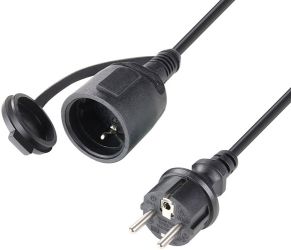
Extension cables are the backbone of every professional event setup. Whether you're powering stage lighting, sound systems, or special effects equipment, reliable power distribution is non-negotiable. At LTT, you'll find touring-grade extension cables engineered for the demanding conditions of live events, festivals, theatre productions, and trade shows. Our range includes robust outdoor cables with IP44 protection, high-amperage CEE variants for power-hungry equipment, and flexible indoor solutions for studio and rehearsal spaces. Every cable is selected to deliver safe, uninterrupted power exactly where you need it.
What Are Extension Cables and How Do They Work in Event Technology?
An extension cable is a flexible electrical conductor that bridges the distance between a fixed power source and your equipment. In event technology, this means connecting lighting rigs mounted on truss systems, fog machines positioned across a stage, or audio consoles placed at front-of-house positions to the nearest power outlet or distribution box.
Professional extension cables for events differ fundamentally from household variants. They feature heavy-duty insulation (rubber or reinforced PVC), higher current ratings (16A, 32A, or even 63A for CEE variants), and robust connectors designed to withstand repeated plugging, cable pulls, and exposure to dust, moisture, and mechanical stress. The cable cross-section – typically 1.5mm² for light-duty indoor use, 2.5mm² for standard stage applications, and up to 6mm² or more for high-power touring rigs – determines how much current the cable can safely carry without overheating or voltage drop.
Unlike simple household extension leads, event cables often incorporate locking connectors (Powerlock, CEE, or True1 connectors) to prevent accidental disconnection during a show. They are also colour-coded: orange or yellow for high visibility on dark stages, black for discreet installation in corporate events, and blue for outdoor festival environments. The choice of connector type – Schuko for 230V single-phase, red CEE for 400V three-phase, or blue CEE for 230V caravan-style – depends on the equipment you're powering and the available infrastructure.
Applications: Where Extension Cables Are Essential in Event Production
Extension cables are deployed across every discipline of event technology. Stage lighting demands long cable runs from dimmer racks or power distributors to moving heads, LED wash fixtures, and strobe units mounted on overhead truss. Audio engineers rely on extension cables to power mixing consoles, monitor speakers, and wireless microphone charging stations positioned far from stage boxes.
Special effects technicians use heavy-duty outdoor cables to supply fog machines, haze generators, pyrotechnic controllers, and CO₂ jets placed at strategic points around a venue. In trade show and exhibition environments, extension cables connect booth lighting, digital displays, and demonstration equipment to temporary power outlets, often routed under carpet or through cable ramps to maintain a clean, trip-free floor.
Touring productions face the toughest conditions: cables must survive daily coiling and uncoiling, transport in flight cases, exposure to rain during outdoor festivals, and the mechanical stress of being run over by flight cases or stage carts. Here, touring-grade rubber cables (H07RN-F specification) with reinforced strain relief and high-flex conductors are the industry standard. For corporate events and theatre, lighter PVC cables (H05VV-F) offer sufficient durability while remaining easy to handle and store.
Cable length is chosen based on venue size and equipment placement. 5m and 10m cables suit small club stages and rehearsal rooms. 25m variants are the workhorse for mid-sized theatres and outdoor stages. 50m heavy-duty cables are reserved for festival main stages, arena tours, and large-scale outdoor events where power distribution points are far from the stage edge.
Quality Standards and Buying Criteria for Professional Extension Cables
When selecting extension cables for professional event use, several technical parameters and safety standards must guide your decision. Current rating is paramount: a 16A Schuko cable can handle up to 3,680W at 230V, sufficient for most lighting fixtures and small fog machines. For high-power equipment like large moving heads, discharge lamps, or multi-kilowatt audio amplifiers, 32A or 63A CEE cables are required.
Cable cross-section directly affects both current capacity and voltage drop over distance. A 1.5mm² cable is adequate for short runs (up to 10m) with moderate loads, but for 25m or 50m lengths, 2.5mm² or 4mm² conductors are necessary to prevent power loss and overheating. Voltage drop becomes critical when powering sensitive equipment like LED fixtures or digital dimmers, which may flicker or malfunction if supply voltage falls below specification.
Insulation material determines durability and environmental suitability. Rubber sheathing (H07RN-F) offers superior flexibility in cold conditions, excellent abrasion resistance, and oil/chemical tolerance – ideal for outdoor festivals and industrial venues. PVC insulation (H05VV-F) is lighter, more economical, and perfectly adequate for indoor theatre, studio, and corporate event use.
IP rating is essential for outdoor applications. An IP44 rating guarantees protection against solid objects larger than 1mm and splashing water from any direction – the minimum for outdoor stage use. For permanent outdoor installations or extreme weather conditions, IP54 (dust-protected and splash-proof) or IP67 (dust-tight and submersion-resistant) connectors are available.
Reputable manufacturers in the event technology sector include Showtec, Eurolite, DAP-Audio, Titanex, and SOMMER CABLE. These brands offer cables that comply with EN 60332 (flame retardant), DGUV Vorschrift 17 (German accident prevention regulations for temporary electrical installations), and IEC 60309 (CEE connector standards). Prices range from €15–€30 for a 10m Schuko indoor cable to €80–€150 for a 25m 32A CEE touring-grade cable, and €200–€400 for 50m heavy-duty variants with reinforced connectors.
Cable Management and Safety: Best Practices for Touring and Fixed Installations
Professional cable management is not just about aesthetics – it's a safety and operational necessity in event technology. Improperly deployed extension cables create trip hazards, risk electrical faults, and can cause equipment damage or even fire.
Never daisy-chain extension cables unless explicitly rated for series connection. Each additional connection point increases resistance, generates heat, and raises the risk of contact failure. If you need more length, use a single longer cable or a professional power distribution box with multiple outlets.
Always fully unwind cable reels before use. A coiled cable carrying high current acts as an inductor, generating heat that can melt insulation and cause short circuits. Even a 10A load on a partially wound 25m cable can raise core temperature to dangerous levels within minutes.
Use cable ramps and bridges wherever cables cross walkways, audience areas, or vehicle paths. This prevents mechanical damage to the cable and eliminates trip hazards. In touring environments, gaffer tape (never duct tape, which leaves residue) is used to secure cables to stage floors and truss, but tape alone is insufficient for high-traffic areas.
Inspect cables before every deployment. Check for cuts, abrasions, exposed conductors, damaged plugs, and bent pins. A damaged cable is a potential electrocution hazard and must be withdrawn from service immediately. Professional touring companies maintain cable logs documenting inspection dates, repair history, and retirement schedules.
Load capacity must never be exceeded. A 16A cable can theoretically handle 3,680W, but continuous operation at maximum load accelerates insulation degradation. Best practice is to derate by 20% – so a 16A cable should carry no more than 3,000W in continuous use. For high-power equipment, always choose the next higher current rating.
Storage and transport matter too. Cables should be coiled using the over-under technique to prevent twisting and kinking. Store them in ventilated flight cases or cable bags, never in damp environments. Rubber cables remain flexible down to -25°C, but PVC cables stiffen in cold and can crack if bent when frozen.
LTT – Your Specialist for Event Technology
At LTT, you'll find everything you need to power your events safely and reliably. Our extension cable range spans compact 3m indoor leads to heavy-duty 50m touring cables, all selected from trusted manufacturers like Showtec, Eurolite, SOMMER CABLE, and Titanex. Every cable meets stringent European safety standards and is backed by our 3-year LTT warranty.
We ship worldwide from our warehouse in Bocholt, Germany, with free delivery on orders over €69 and express options for urgent productions. Whether you're equipping a small club stage, a touring production, or a major festival, our team understands the demands of professional event technology. With over 25 years of experience and more than 100,000 satisfied customers, LTT is your reliable partner for innovative solutions that deliver impressive results.
Power Distribution Solutions: Beyond Simple Extension Cables
While extension cables are essential, professional event setups often require more sophisticated power distribution systems. A power distribution box (also called a distro or spider box) takes a single high-amperage input – typically 32A or 63A CEE – and splits it into multiple 16A Schuko or 32A CEE outputs, each protected by its own circuit breaker or RCD.
This approach offers several advantages over daisy-chaining extension cables. Centralised overload protection prevents a single faulty fixture from tripping the entire rig. Shorter cable runs from the distro to individual fixtures reduce voltage drop and clutter. Faster setup and teardown times are critical in touring environments where every minute counts.
Multicore power cables bundle multiple conductors in a single sheath, reducing cable spaghetti on stage. A typical 5-way multicore carries five independent 16A circuits in one robust, tour-grade package. At the stage end, it terminates in a breakout box with five Schuko outlets; at the power source, it connects via five individual CEE plugs or a single high-amperage connector.
For outdoor festivals and large-scale events, cable drums (also called cable reels) are indispensable. These allow you to deploy and retrieve long cable runs quickly, keep cables organised during transport, and provide a convenient storage solution. Professional models feature thermal overload protection that trips if the cable is used while still wound, preventing the inductive heating hazard described earlier.
Powerlock and True1 connectors are the gold standard in touring. These high-amperage, single-pole connectors lock together mechanically and are colour-coded (blue for neutral, brown for live, yellow/green for earth) to prevent mis-wiring. They're faster to connect than CEE plugs, more robust than Schuko, and rated for 400A or more – essential for main power feeds on arena tours.
FAQ – Questions & Answers
The best extension cable for event technology depends on your specific application. For indoor theatre and studio use, a 10m or 25m H05VV-F PVC cable with 16A Schuko connectors (2.5mm² cross-section) offers excellent value and sufficient durability. For outdoor festivals and touring productions, choose H07RN-F rubber cables with IP44-rated connectors, 2.5mm² or 4mm² conductors, and high-visibility orange or yellow sheathing. For high-power equipment like large moving heads or audio amplifiers, 32A or 63A CEE cables with 4mm² or 6mm² conductors are essential. Trusted brands in event technology include Showtec, Eurolite, SOMMER CABLE, and Titanex. Always match the cable rating to your equipment's power draw and the environmental conditions of your venue.
In event technology, high-power heating devices (electric heaters, hot-air blowers) should not be connected to standard 16A extension cables, as they draw sustained high current that can overheat the cable. Medical equipment and life-safety systems (emergency lighting, fire alarm panels) must never rely on temporary extension cables – they require fixed, inspected wiring. Devices with damaged plugs or exposed wiring must not be connected to any extension cable, as they pose electrocution and fire risks. Daisy-chaining multiple extension cables is prohibited under DGUV Vorschrift 17 unless each cable is explicitly rated for series connection. Finally, never connect equipment whose total power draw exceeds the cable's current rating – a 16A cable can handle 3,680W maximum, but continuous operation should not exceed 3,000W to prevent insulation degradation.
Extension cables for stage and event use are commonly available in 5m, 10m, 25m, and 50m lengths. The maximum practical length depends on the cable cross-section and load. A 1.5mm² cable should not exceed 10m for loads above 10A, as voltage drop becomes significant. For 25m runs, use 2.5mm² conductors; for 50m, 4mm² or 6mm² is recommended to minimise voltage drop and prevent overheating. In touring productions, 25m cables are the workhorse for most stage applications, while 50m heavy-duty cables are reserved for festival main stages and large outdoor venues. Always choose the shortest cable that reaches your equipment – longer cables increase resistance, voltage drop, and the risk of damage. If you need more length, use a professional power distribution box rather than daisy-chaining multiple cables.
H05VV-F cables have PVC insulation and are designed for indoor use in dry, moderate-temperature environments. They are lighter, more economical, and easier to coil than rubber cables, making them ideal for theatre, studio, rehearsal spaces, and corporate events. However, PVC stiffens in cold weather and offers limited resistance to oils, solvents, and abrasion. H07RN-F cables feature rubber sheathing and are the touring-grade standard for outdoor and heavy-duty applications. Rubber remains flexible down to -25°C, resists oils and chemicals, and withstands the mechanical stress of repeated coiling, transport in flight cases, and exposure to rain, dust, and stage traffic. H07RN-F cables are heavier and more expensive, but essential for festivals, outdoor stages, and industrial venues. Both types are available with Schuko or CEE connectors and in various cross-sections (1.5mm² to 6mm²).
Connecting extension cables in series (daisy-chaining) is prohibited in professional event technology under DGUV Vorschrift 17 unless each cable is explicitly rated for series connection. Each additional connection point introduces contact resistance, which generates heat and increases the risk of fire. The cumulative resistance of multiple cables causes voltage drop, which can damage sensitive equipment like LED fixtures, digital dimmers, and audio processors. Daisy-chaining also creates mechanical weak points – a single loose plug can disconnect the entire chain, causing equipment failure mid-show. Finally, series connections make it difficult to calculate total load accurately, increasing the risk of overloading individual cables. If you need more length, use a single longer cable or a professional power distribution box with multiple protected outlets.
IP44 is an Ingress Protection rating that indicates the extension cable's connectors are protected against solid objects larger than 1mm (e.g. wires, small tools) and splashing water from any direction. This is the minimum standard for outdoor event use, including festivals, open-air concerts, and outdoor trade shows. IP44-rated connectors feature rubber seals and screw-locking caps that prevent moisture ingress when plugged in or capped off. However, IP44 does not protect against submersion, high-pressure water jets, or prolonged exposure to heavy rain. For permanent outdoor installations or extreme weather conditions, consider IP54 (dust-protected and splash-proof) or IP67 (dust-tight and submersion-resistant up to 1m for 30 minutes). Always ensure outdoor cables are fully unwound, not lying in puddles, and that unused sockets are capped to maintain IP protection.
Professional extension cables for event technology range from €15 to €400 depending on length, current rating, and construction. A 10m indoor H05VV-F cable with 16A Schuko connectors costs €15–€30. A 25m outdoor H07RN-F rubber cable with IP44 connectors ranges from €40–€80. 32A CEE cables in 25m length cost €80–€150, while 50m heavy-duty touring cables with reinforced connectors and 4mm² or 6mm² conductors range from €200–€400. High-amperage 63A CEE cables and multicore power cables can exceed €500 for 50m lengths. Prices vary by brand – Showtec, Eurolite, and DAP-Audio offer excellent value, while SOMMER CABLE and Titanex represent premium touring-grade quality. At LTT, you'll find competitive prices across all categories, backed by our 3-year warranty and free shipping on orders over €69.
Cable cross-section (measured in mm²) determines how much current an extension cable can safely carry. For short runs up to 10m with loads under 10A (2,300W), 1.5mm² is sufficient. For standard stage applications with 16A loads (3,680W) and cable lengths up to 25m, use 2.5mm² conductors. For long runs (50m) or high-power equipment (moving heads, discharge lamps, audio amplifiers), choose 4mm² or 6mm² to minimise voltage drop and prevent overheating. As a rule of thumb, voltage drop should not exceed 3% of supply voltage (approximately 7V on a 230V circuit). If your equipment is sensitive to voltage fluctuations – LED fixtures, digital dimmers, wireless systems – err on the side of a larger cross-section. Always consult the equipment manufacturer's power requirements and factor in the total load on the cable, not just a single device.




 Express delivery possible


