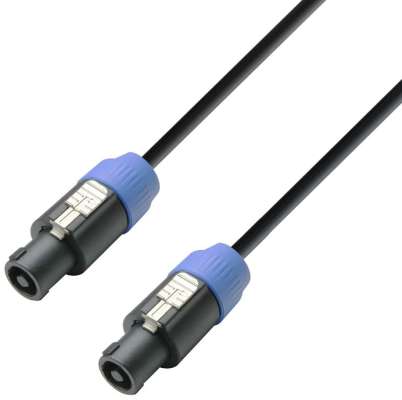
Speaker Cables
Professional Speaker Cables for Event Technology – Your Specialist LTT
Speaker cables form the critical link between power amplifiers and loudspeakers in professional event technology. At LTT, you will find a comprehensive range of high-quality speaker cables designed specifically for demanding applications in live sound, touring, and permanent installations. Our selection includes cables from leading manufacturers such as SOMMER CABLE, Neutrik, and Accu Cable, with cross-sections ranging from 0.75 mm² for short connections to 10 mm² for high-power PA systems and long cable runs. Whether you are equipping a festival stage, a theatre installation, or a mobile DJ setup, we offer the optimal solution for reliable audio transmission with minimal signal loss.
What Are Speaker Cables and How Do They Work?
A speaker cable is a two-conductor electrical cable that transmits low-frequency audio signals and electrical power from an audio amplifier to passive loudspeakers. Unlike signal cables that carry line-level voltages, speaker cables must handle significantly higher currents – typically between 2 and 20 amperes depending on amplifier power and loudspeaker impedance. The cable consists of two insulated conductors, usually made from copper or oxygen-free copper (OFC), enclosed in a protective outer jacket.
The fundamental principle is straightforward: the amplifier converts the audio signal into alternating current, which flows through the speaker cable to drive the voice coil of the loudspeaker. This current generates a magnetic field that interacts with the permanent magnet in the speaker, causing the diaphragm to move and produce sound waves. The efficiency of this energy transfer depends critically on the cable's electrical properties – primarily its resistance, inductance, and capacitance.
Key Electrical Parameters
The DC resistance of a speaker cable increases with length and decreases with cross-sectional area. For a 10-metre run using 2.5 mm² copper cable, the total loop resistance is approximately 0.14 ohms. When driving an 8-ohm loudspeaker, this represents less than 2% power loss – acceptable for most professional applications. However, at 50 metres, the same cable would exhibit 0.7 ohms resistance, resulting in nearly 9% power loss and audible damping factor degradation.
Inductance and capacitance also influence signal transmission, particularly at higher frequencies. Professional speaker cables typically exhibit inductance values between 0.3 and 0.8 microhenries per metre. While this has minimal impact on frequencies below 10 kHz, it can affect the interaction between amplifier and loudspeaker at the upper end of the audio spectrum, especially with complex crossover networks in multi-way systems.
Unlike microphone or instrument cables, speaker cables generally do not require shielding for short to medium runs in typical event environments. The high signal levels (often exceeding 10 volts RMS) provide excellent immunity to electromagnetic interference. However, in installations near high-power lighting dimmers, radio transmitters, or other strong EMI sources, twisted-pair construction helps cancel induced noise through common-mode rejection.
Applications in Professional Event and Stage Technology
Speaker cables serve diverse roles across the event technology sector, each application demanding specific cable characteristics. In touring production, cables must withstand constant coiling and uncoiling, exposure to weather, and mechanical stress from transport cases and stage builds. Multicore speaker cables with four, eight, or more conductors streamline setup for line array systems and distributed loudspeaker networks, reducing installation time and cable clutter on stage.
Permanent installations in theatres, concert halls, and houses of worship require cables that meet fire safety regulations and can be concealed within walls or suspended from rigging points. These applications often specify plenum-rated or low-smoke zero-halogen (LSZH) jackets to comply with building codes. Cable runs may extend 30 to 100 metres from amplifier racks to ceiling-mounted loudspeakers, necessitating larger cross-sections – typically 4 mm² or 6 mm² – to maintain damping factor and minimise power loss.
Mobile DJ and small-venue applications prioritise flexibility and ease of handling. Cables with stranded conductors and soft PVC jackets coil smoothly and resist kinking, essential when setting up and breaking down equipment multiple times per week. For these scenarios, 1.5 mm² or 2.5 mm² cross-sections suffice for cable runs under 15 metres, balancing performance with portability and cost.
Integration with Professional Audio Systems
Modern PA systems increasingly employ powered loudspeakers with integrated amplifiers, reducing the need for long speaker cable runs. However, passive systems remain prevalent in high-power applications where centralised amplifier racks offer better thermal management and easier maintenance. In these configurations, speaker cables connect rack-mounted power amplifiers – such as models from dB Technologies, RCF, or JBL – to passive cabinets via Speakon or binding post connectors.
Bi-wiring and bi-amping configurations, common in high-end installations, require separate cable runs for low-frequency and high-frequency drivers. This approach eliminates passive crossover losses and allows independent optimisation of each frequency band. Such setups demand careful cable management and clear labelling to prevent mis-connections that could damage drivers or degrade sound quality.
Quality Criteria and Professional Standards for Speaker Cables
Selecting the appropriate speaker cable requires understanding both electrical specifications and construction quality. The conductor material fundamentally determines performance: oxygen-free copper (OFC) offers 99.9% purity and superior conductivity compared to copper-clad aluminium (CCA). While CCA cables cost less, their higher resistance and reduced flexibility make them unsuitable for professional touring applications. Manufacturers such as SOMMER CABLE and Neutrik exclusively use OFC copper in their professional-grade products, ensuring consistent performance and long service life.
Cross-sectional area directly impacts resistance and current-carrying capacity. For cable runs up to 10 metres with amplifier power below 500 watts, 1.5 mm² suffices. Between 10 and 25 metres, or for power levels up to 1000 watts, specify 2.5 mm². High-power systems exceeding 1500 watts or cable runs beyond 30 metres require 4 mm² or larger. In large-scale touring productions with line arrays drawing several kilowatts, 10 mm² cables are standard to maintain damping factor above 50 and keep resistive losses below 0.5 dB.
Connector Systems and Termination
Professional applications overwhelmingly favour Speakon connectors, developed by Neutrik and now an industry standard. The NL4 variant provides four poles, allowing bi-amping or parallel connections within a single connector. The locking mechanism prevents accidental disconnection during performance – a critical safety feature when loudspeakers are suspended overhead. Gold-plated or nickel-plated contacts resist corrosion in outdoor and high-humidity environments.
Banana plugs and binding posts remain common in installed sound systems and smaller venues. High-quality banana plugs feature spring-loaded contacts with 24-karat gold plating, ensuring low contact resistance (typically below 5 milliohms) and long-term reliability. Screw-terminal binding posts accommodate bare wire or spade terminals, offering flexibility but requiring careful tightening to prevent intermittent connections.
Compliance and Safety Standards
In professional event technology, cables must comply with relevant safety regulations. For permanent installations in public buildings, cables often require certification to EN 50575 (Construction Products Regulation) with classifications ranging from Eca (basic) to B2ca (enhanced fire performance). Touring applications prioritise mechanical durability and flexibility over fire ratings, though many venues now mandate LSZH jackets to reduce toxic smoke in fire scenarios.
Cables used in outdoor festivals or temporary structures must withstand UV exposure, moisture, and temperature extremes. Jackets made from thermoplastic elastomer (TPE) or cross-linked polyethylene offer superior weather resistance compared to standard PVC. Manufacturers specify operating temperature ranges – professional cables typically function from -20°C to +60°C without degradation in electrical properties or mechanical flexibility.
Cable Management and Installation Best Practices
Proper cable management extends service life and maintains signal integrity in professional installations. When routing speaker cables alongside power distribution, maintain a minimum separation of 30 centimetres to prevent induced hum, particularly with high-current dimmer circuits. Cross power and audio cables at 90-degree angles where separation is unavoidable, minimising the area of the magnetic coupling loop.
Cable drums and reels facilitate organised storage and rapid deployment in touring scenarios. Wind cables loosely in figure-eight patterns rather than tight coils to prevent twisting and conductor fatigue. Over-under coiling technique, standard in professional AV crews, ensures cables unroll smoothly without kinks or tangles. Label both ends of every cable with unique identifiers, length, and cross-section using heat-shrink tubing or durable cable tags.
Strain Relief and Mechanical Protection
At connection points, provide adequate strain relief to prevent stress on solder joints or crimp connections. Speakon connectors incorporate integral strain relief boots; ensure the cable jacket seats fully within the boot before tightening the rear clamp. For permanent installations, use cable ties or Velcro straps at 1-metre intervals along horizontal runs and 0.5-metre intervals on vertical drops to prevent sagging and mechanical stress.
In stage environments, protect cables from foot traffic using rubber cable ramps or recessed floor channels. Where cables cross aisles or walkways, secure them with gaffer tape (never duct tape, which leaves residue) or purpose-built cable bridges. Suspend overhead cables using rated rigging hardware – never drape cables over truss without proper cable management accessories such as cable hangers or zip-tie mounts designed for the specific truss profile.
Testing and Maintenance Procedures
Regular testing identifies developing faults before they cause failures during events. Use a digital multimeter to measure DC resistance across the cable length; compare readings against calculated values (approximately 0.007 ohms per metre for 2.5 mm² copper). Significant deviations indicate damaged conductors or poor connections. Insulation resistance testing with a megohmmeter verifies jacket integrity – readings below 10 megohms suggest moisture ingress or insulation breakdown.
Inspect connectors for bent pins, cracked housings, or corrosion after each event. Clean contacts with isopropyl alcohol and a lint-free cloth, removing oxidation or residue that increases contact resistance. Replace connectors showing mechanical damage or contact resistance exceeding 20 milliohms. Maintain service logs documenting cable lengths, cross-sections, connector types, and test results to track performance trends and schedule preventive replacement before failures occur.
Understanding Cable Specifications: Cross-Section, Length, and Impedance Matching
The relationship between cable cross-section, length, and loudspeaker impedance determines system performance and efficiency. Amplifier damping factor – the ratio of loudspeaker impedance to total output impedance – critically affects bass response and transient accuracy. A high-quality power amplifier may exhibit a damping factor of 500 or more at the output terminals, but cable resistance degrades this figure. For an 8-ohm loudspeaker connected via 20 metres of 1.5 mm² cable (total resistance 0.28 ohms), the system damping factor drops to approximately 29 – still acceptable but noticeably lower than the amplifier's intrinsic performance.
Power loss in speaker cables follows Ohm's law: P = I² × R. For a 500-watt amplifier driving an 8-ohm load, the current is approximately 7.9 amperes. Using 1.5 mm² cable over 20 metres (0.28 ohms total resistance), the power dissipated in the cable is 17.5 watts – about 3.5% of the amplifier output. While this may seem modest, it represents a loss of 0.15 dB, perceptible in critical listening environments. Upgrading to 2.5 mm² cable reduces resistance to 0.17 ohms, cutting losses to 10.6 watts (2.1%) and 0.09 dB.
Frequency-Dependent Effects
Cable inductance introduces frequency-dependent impedance that interacts with loudspeaker characteristics. A typical speaker cable exhibits 0.5 microhenries per metre inductance. Over a 10-metre run, this totals 5 microhenries, presenting an inductive reactance of 0.31 ohms at 10 kHz. For an 8-ohm loudspeaker, this represents a 4% impedance increase at high frequencies – generally negligible. However, in bi-wired systems or with loudspeakers exhibiting complex impedance curves, cable inductance can subtly alter frequency response, particularly above 5 kHz.
Capacitance between conductors typically ranges from 50 to 150 picofarads per metre. Over practical cable lengths (under 50 metres), this has minimal impact on audio frequencies. However, some amplifier designs exhibit instability when driving highly capacitive loads. Consult amplifier specifications for maximum capacitive load ratings – most professional power amplifiers tolerate at least 1000 picofarads without issue.
Practical Cross-Section Selection Guide
For cable runs under 5 metres with amplifier power below 200 watts, 0.75 mm² provides adequate performance. Between 5 and 15 metres, or for power levels up to 500 watts, specify 1.5 mm². From 15 to 30 metres, or for amplifiers delivering 500 to 1000 watts, use 2.5 mm². Beyond 30 metres or for power exceeding 1000 watts, 4 mm² becomes necessary. Large-format line array systems and subwoofer arrays often require 6 mm² or 10 mm² to maintain damping factor and minimise losses over cable runs that may extend 50 metres or more from amplifier racks to stage positions.
When parallel-connecting multiple loudspeakers, calculate the total current draw to determine appropriate cable gauge. Two 8-ohm loudspeakers in parallel present a 4-ohm load, doubling the current for a given amplifier power. A 1000-watt amplifier driving a 4-ohm load delivers 15.8 amperes – requiring 2.5 mm² cable for runs up to 15 metres or 4 mm² for longer distances to maintain acceptable losses.
LTT – Your Specialist for Professional Event Technology
At LTT, we understand the demands of professional event technology. Our comprehensive range of speaker cables combines proven reliability with competitive pricing, backed by over 25 years of experience in the industry. We stock premium brands including SOMMER CABLE, Neutrik, Accu Cable, and MONACOR, ensuring you have access to the same cables trusted by touring professionals and installation specialists worldwide.
Every speaker cable in our range undergoes rigorous quality control, and we provide detailed technical specifications to help you select the optimal solution for your application. Whether you need a single 10-metre cable for a small venue or bulk quantities of multicore cable for a major festival, our team offers expert guidance and fast delivery from our warehouse in Bocholt, Germany. We ship internationally and offer free shipping on orders over €69 within Germany.
Our commitment extends beyond product supply. We back every cable with a 3-year warranty, and our technical support team can assist with cable selection, connector compatibility, and installation best practices. For professional installers and rental companies, we offer trade pricing and volume discounts – contact us to discuss your requirements.
Explore our complete range of professional audio solutions, including power amplifiers, mixing consoles, and stage equipment, all designed to work seamlessly together. Trust LTT as your reliable partner for professional event technology – from initial planning through to flawless execution.
FAQ – Questions & Answers
The right speaker cable depends on three factors: cable length, amplifier power, and loudspeaker impedance. For runs under 10 metres with power below 500 watts, use 1.5 mm² cable. Between 10 and 25 metres, or for power up to 1000 watts, specify 2.5 mm². High-power systems exceeding 1500 watts or cable runs beyond 30 metres require 4 mm² or larger. Professional touring applications often use 10 mm² cables to maintain damping factor and minimise power loss. Always choose oxygen-free copper (OFC) cables from manufacturers such as SOMMER CABLE or Neutrik for reliable performance in demanding event technology environments.
Thicker speaker cable is not always better – the optimal cross-section depends on cable length and system power. Oversized cables offer no audible benefit for short runs or low-power systems, while adding unnecessary cost and reduced flexibility. A 5-metre cable with 0.75 mm² cross-section performs identically to 4 mm² cable when driving a 100-watt amplifier into 8 ohms. However, for a 30-metre run with a 1000-watt amplifier, 4 mm² cable maintains damping factor above 50 and keeps power loss below 0.5 dB, whereas 1.5 mm² would lose 2 dB and degrade bass response. Match cable gauge to your specific application for optimal performance and value.
Professional loudspeaker systems require two-conductor speaker cables with cross-sections between 1.5 mm² and 10 mm², depending on cable length and power requirements. Passive systems use speaker cables to connect power amplifiers to loudspeaker cabinets, typically via Speakon connectors in touring applications or binding posts in permanent installations. Active (powered) loudspeakers eliminate long speaker cable runs, requiring only mains power and balanced audio signal cables. For bi-amped systems, separate speaker cables connect to low-frequency and high-frequency drivers. Professional installations also use multicore speaker cables with four, eight, or more conductors to streamline cabling for distributed loudspeaker networks and line array systems.
Speaker cables use colour coding, ribbing, or printed text to distinguish conductors. Commonly, one conductor features a red stripe, red insulation, or printed markings, indicating the positive (+) terminal connection. The other conductor remains plain or carries a black stripe. Some cables use ribbed versus smooth insulation surfaces instead of colour. Connect the marked conductor to the red or positive (+) terminal on both amplifier and loudspeaker. Consistent polarity across all loudspeakers is essential – reversed polarity causes phase cancellation, reducing bass output and degrading stereo imaging. Professional installers use cable testers to verify polarity before energising systems, preventing costly troubleshooting during events.
OFC (Oxygen-Free Copper) cables use 99.9% pure copper conductors, offering superior electrical conductivity and flexibility compared to CCA (Copper-Clad Aluminium) cables, which feature aluminium cores with thin copper plating. OFC cables exhibit approximately 40% lower resistance than equivalent CCA cables, reducing power loss and maintaining damping factor over long runs. OFC also resists work-hardening and conductor breakage from repeated coiling, essential for touring applications. CCA cables cost less but are unsuitable for professional event technology due to higher resistance, reduced current capacity, and poor mechanical durability. Manufacturers such as SOMMER CABLE and Neutrik exclusively use OFC in professional-grade products to ensure reliable performance.
Touring and live sound applications demand speaker cables with OFC conductors, flexible stranded construction, and durable outer jackets resistant to abrasion and UV exposure. Speakon-terminated cables from SOMMER CABLE, Neutrik, or Accu Cable are industry standards, offering locking connectors that prevent accidental disconnection. For high-power line arrays, specify 4 mm² or 6 mm² cross-sections to maintain damping factor over cable runs exceeding 20 metres. Multicore speaker cables streamline setup for complex systems. Choose cables with thermoplastic elastomer (TPE) or cross-linked polyethylene jackets for outdoor festivals, as these materials withstand temperature extremes from -20°C to +60°C without degradation. Proper cable management using figure-eight coiling extends service life in demanding touring environments.
Professional speaker cable prices vary by cross-section, length, and connector configuration. Bulk cable (sold per metre) ranges from €1.50 per metre for 1.5 mm² OFC cable to €8 per metre for 10 mm² touring-grade cable with premium TPE jackets. Pre-terminated cables with Speakon connectors typically cost €25 to €45 for 5-metre lengths in 2.5 mm² cross-section, rising to €80 to €150 for 20-metre lengths in 4 mm² with ruggedised connectors. Multicore cables command premium pricing – an 8-conductor, 50-metre touring multicore may cost €400 to €600. Budget CCA cables appear cheaper but offer false economy due to higher resistance and poor durability. Invest in OFC cables from reputable manufacturers for reliable long-term performance.
Permanent installations in theatres, concert halls, and houses of worship require speaker cables meeting fire safety regulations and offering long-term reliability. Specify cables certified to EN 50575 with Cca or B2ca classifications for compliance with Construction Products Regulation. Low-smoke zero-halogen (LSZH) jackets reduce toxic emissions in fire scenarios, essential for public buildings. For concealed installation within walls or ceilings, use 2.5 mm² or 4 mm² cross-sections to accommodate cable runs up to 50 metres without significant power loss. Stranded OFC conductors from manufacturers such as SOMMER CABLE ensure flexibility during installation while maintaining low resistance. Terminate cables with screw-terminal binding posts or Speakon connectors, providing secure connections that withstand decades of service without maintenance.