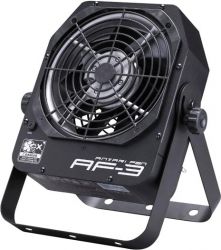
Fans
Professional Blowers for Events and Stage Technology
Professional blowers are essential equipment for event technology, stage productions and live entertainment. Whether You need powerful air movement for cooling performers and equipment, distributing fog effects evenly across a stage, or inflating large-scale structures for festivals and exhibitions, the right blower makes all the difference. LTT offers a comprehensive range of radial blowers, axial fans and specialised wind machines designed specifically for the demanding requirements of professional event applications. With decades of experience in stage technology and a deep understanding of the technical challenges faced by event professionals, LTT provides not just equipment but complete solutions that integrate seamlessly with Your existing truss systems, lighting rigs and special effects setup.
What Are Blowers and How Do They Work?
A blower is a mechanical device that moves air or gas by creating a pressure differential. Unlike simple fans that primarily move air at low pressure, blowers generate higher pressure ratios and can push air through ducting, over longer distances, or against resistance. In event technology, blowers serve multiple critical functions that go far beyond basic ventilation.
The two main types of blowers used in professional event applications are radial blowers (also called centrifugal blowers) and axial fans. Radial blowers draw air in along the axis of the impeller and expel it radially at 90 degrees, creating high pressure and focused airflow. This design makes them ideal for applications requiring concentrated air delivery, such as inflating large structures, pushing fog through ducting systems, or cooling specific equipment zones. Typical radial blowers for event use deliver pressure ratings between 200 and 500 Pa with airflow volumes from 400 to 2,000 m³/h.
Axial fans, by contrast, move air parallel to the shaft axis, creating high-volume airflow at lower pressure. These are the workhorses for general stage cooling, audience ventilation in temporary structures, and broad distribution of fog or haze effects. Professional axial fans for events typically deliver between 1,500 and 5,000 m³/h at pressure ratings of 100 to 250 Pa. The choice between radial and axial depends entirely on Your specific application: radial for focused, high-pressure tasks; axial for volume and coverage.
Modern event blowers incorporate brushless EC motors that offer variable speed control, significantly reduced noise levels (typically 65–80 dB at full power), and energy efficiency that matters when You are running dozens of units from temporary power supplies. Understanding these fundamentals helps You select the optimal solution for each production scenario.
Applications of Blowers in Event and Stage Technology
Professional blowers serve remarkably diverse roles in event production, each demanding specific performance characteristics. Stage cooling represents one of the most critical applications: under intense stage lighting, temperatures can soar to uncomfortable and even dangerous levels for performers. High-capacity axial fans positioned strategically around the stage perimeter deliver cooling airflow without creating excessive noise that would interfere with sound systems. For outdoor festivals and concerts, large industrial-grade blowers with outputs exceeding 4,000 m³/h provide essential cooling for both performers and front-of-house technical equipment.
Fog and haze distribution requires precise airflow control. When You deploy fog machines or hazers to create atmospheric effects, blowers ensure even distribution across the stage area rather than allowing fog to pool in low spots or dissipate unevenly. Radial blowers with adjustable speed control allow lighting designers to shape fog patterns, create dramatic reveals, or maintain consistent haze density throughout a performance. This application demands blowers that can operate continuously for hours without overheating.
Inflatable structures and set pieces have become increasingly popular in large-scale productions, from inflatable stages and archways to giant product replicas at trade shows. These applications require continuous-duty radial blowers capable of maintaining precise pressure levels, typically in the 300–400 Pa range. The blower must compensate for natural leakage while avoiding over-pressurisation that could damage the structure.
Equipment cooling extends beyond stage areas to technical zones where lighting control desks, amplifiers, video servers and other heat-generating equipment concentrate. Targeted cooling with compact radial blowers prevents thermal shutdowns and extends equipment life. In temporary structures like festival tents or exhibition halls, blowers integrated with ducting systems provide climate control where conventional HVAC is impractical.
Each application demands careful matching of blower type, power rating and mounting solution to achieve optimal results while maintaining the safety standards required in professional event environments.
Selecting Professional-Grade Blowers: Technical Criteria and Quality Standards
Choosing the right blower for professional event applications requires evaluating several critical technical parameters and understanding the quality differences between consumer-grade and professional equipment. Power ratings for event blowers typically range from 80 W for compact units up to 2,300 W for industrial-capacity models. However, wattage alone does not tell the complete story—You must consider the relationship between power consumption, airflow delivery (measured in m³/h or CFM) and pressure capability (measured in Pascals).
Professional event blowers from manufacturers such as Futurelight, Eurolite and Showtec deliver airflow volumes between 1,720 and 4,373 CFM (approximately 2,900 to 7,400 m³/h) with pressure ratings from 175 to 470 Pa. These specifications directly determine the blower's suitability for specific tasks: lower pressure, higher volume for general cooling; higher pressure, focused flow for inflatable structures or ducted applications. Operating speeds typically range from 2,800 to 4,100 RPM, with variable-speed models offering crucial flexibility for different production scenarios.
Motor technology represents a key quality differentiator. Professional units employ brushless EC (electronically commutated) motors that offer multiple advantages over traditional AC motors: significantly longer service life (often exceeding 50,000 hours), reduced maintenance requirements, lower noise generation, and superior energy efficiency. EC motors also enable precise speed control via DMX or analogue control signals, allowing integration with lighting and effects control systems. This integration capability transforms a simple blower into a programmable element of Your production design.
Noise levels matter enormously in live event contexts. Professional blowers specify noise output at various operating speeds, typically ranging from 65 dB at low speed to 79–80 dB at maximum output. For applications near performers or audiences, selecting units with noise ratings below 75 dB at operating speed prevents acoustic interference while maintaining necessary airflow.
Safety certifications are non-negotiable for professional use. Look for equipment certified to relevant European standards, with TÜV approval and compliance with DGUV Vorschrift 17 (formerly BGV C1) where applicable. Professional-grade blowers incorporate thermal protection, automatic shutdown on blockage, and reverse-polarity protection—features absent from consumer units but essential for reliable operation in demanding event environments.
Mounting and integration capabilities distinguish professional equipment. Quality blowers include standardised mounting brackets compatible with truss systems, adjustable positioning hardware, and weatherproof housings for outdoor applications. The ability to mount a blower securely to Naxpro-Truss or similar stage structures, with proper cable management and safety attachment points, ensures both operational effectiveness and compliance with safety regulations.
Price points for professional event blowers typically range from €150 for compact units to €800 or more for high-capacity industrial models with advanced control features. This investment delivers reliability, longevity and performance that consumer-grade alternatives simply cannot match in professional production environments.
Power Supply, Control Integration and DMX Compatibility
Professional event blowers must integrate seamlessly with the power distribution and control systems that define modern production environments. Voltage options include both 230V AC single-phase for standard applications and 12V/24V DC models for mobile setups, battery-powered applications, or integration with vehicle-based systems. When specifying blowers for international tours, verify voltage compatibility and consider units with universal power supplies that accept 100–240V input.
Power consumption directly impacts Your load calculations for temporary power distribution. A typical high-capacity axial fan draws between 200 and 400 watts at full speed, while industrial radial blowers may consume up to 2,300 watts. When You are deploying multiple units—common in large festival or arena productions—total power demand quickly becomes significant. Modern EC motor technology reduces consumption by 30–40% compared to older AC motor designs, a meaningful saving when running equipment for extended periods.
DMX control integration represents a game-changing capability for professional applications. DMX-compatible blowers accept standard DMX512 protocol signals, allowing You to control speed, start/stop functions, and in some cases direction through Your lighting console or dedicated effects controller. This integration enables precise synchronisation of airflow with lighting cues, fog effects, and musical elements. For example, You can program a gradual speed increase to distribute haze evenly during a scene transition, or trigger full-power operation in sync with pyrotechnic effects.
Blowers without native DMX capability can be integrated using external DMX-to-analogue converters or relay packs, though this adds complexity and potential failure points. Manufacturers like Antari and Eurolite offer models with built-in DMX receivers, simplifying system design and improving reliability.
Variable speed control via 0–10V analogue signals or PWM (pulse-width modulation) provides an alternative control method, particularly useful for architectural installations or fixed venue setups where DMX infrastructure may not extend to all equipment locations. Professional blowers with analogue control inputs allow precise speed adjustment from zero to full output, enabling fine-tuning of airflow to match specific acoustic, thermal or atmospheric requirements.
Safety interlocks and monitoring features in advanced models include thermal sensors that report temperature status via DMX, allowing Your control system to receive early warning of potential overheating. Some units provide current draw monitoring, enabling power management systems to track actual consumption and prevent overload conditions. These features transform blowers from simple mechanical devices into intelligent system components that contribute to overall production safety and efficiency.
Integration with Stage Infrastructure and Truss Systems
Effective deployment of blowers in professional event environments requires careful consideration of mounting, positioning and integration with existing stage infrastructure. Unlike permanent installations where equipment can be bolted to fixed structures, event production demands flexible, repeatable mounting solutions that meet rigorous safety standards while allowing rapid setup and strike.
Truss mounting represents the primary installation method for elevated blowers. Professional units include mounting brackets designed to attach securely to standard truss profiles—whether You are working with Naxpro-Truss FD31 (50mm diameter tubes), HD31 (50mm heavy-duty), or larger GS94 truss systems (60mm tubes). Proper mounting requires rated clamps or half-couplers, secondary safety attachments, and consideration of weight distribution along the truss span. A typical professional blower weighs between 8 and 25 kg; when mounting multiple units on a single truss section, calculate cumulative load and verify it remains well within the truss's rated capacity.
For ground-based positioning, professional blowers require stable bases that prevent tipping under operational vibration and airflow reaction forces. Manufacturers provide floor stands with adjustable height and tilt angle, allowing precise aiming of airflow. In high-traffic areas or where audience access is possible, equipment must be secured and protected with barriers or cases that prevent accidental contact with moving parts while maintaining necessary airflow.
Cable management becomes critical when integrating blowers with power distribution and control systems. Professional installations use rated cable ties or cable management accessories from manufacturers like Riggatec to secure power and control cables along truss runs, preventing cable sag that could create hazards or visual distractions. When running cables to floor-mounted units, proper cable ramps or covers prevent trip hazards and protect cables from damage.
Weatherproofing and outdoor use demand equipment rated to appropriate IP standards. While many professional blowers are designed for indoor use only (typically IP20), outdoor applications require units with at least IP54 rating to protect against dust and water spray. Even weather-rated equipment benefits from protective positioning under stage roofs or in equipment tents when possible, extending service life and reducing maintenance requirements.
Acoustic considerations influence positioning decisions. Placing high-output blowers near microphone positions or acoustic instruments creates obvious problems; strategic positioning behind backline, in wings, or elevated above stage level helps minimise acoustic interference. Some productions use ducting to move air from remotely positioned blowers to where it is needed, trading some efficiency for acoustic isolation.
Safety compliance in Germany and throughout Europe requires adherence to DGUV Vorschrift 17 (formerly BGV C1) for temporary structures and event technology. This includes proper load calculations, use of rated attachment hardware, secondary safety attachments for overhead equipment, and regular inspection of all rigging points. Professional blower installations should be documented in rigging plots and included in pre-show safety checks, just like lighting and audio equipment.
LTT – Your Specialist for Event Technology
LTT brings over 25 years of experience in professional event technology to every project, combining the product range of a comprehensive supplier with the technical expertise of a manufacturer. As both retailer and producer—with our own manufacturing facility in Germany—we understand the real-world demands of event production from both sides of the equipment equation. Our Naxpro-Truss systems, Riggatec rigging accessories, and Bullstage platforms are designed and built to the same exacting standards we apply when selecting third-party equipment for our range.
When You choose blowers and ventilation equipment from LTT, You benefit from expert technical advice that goes beyond product specifications. Our team understands how airflow integrates with lighting, fog effects, and stage design; we can help You calculate the number and type of blowers needed for specific venue dimensions, recommend mounting solutions that work with Your existing truss inventory, and suggest control integration approaches that simplify operation. This consultative approach ensures You invest in equipment that genuinely meets Your production requirements.
We stock professional blowers from leading manufacturers including Eurolite, Showtec, Futurelight and Antari, alongside the full range of mounting hardware, control accessories and safety equipment needed for complete installations. Free shipping on orders over €69 makes it economical to order exactly what You need, when You need it, while our express shipping option ensures critical equipment reaches You in time for tight production schedules. For international customers, our worldwide shipping network and experience with customs documentation streamline cross-border equipment supply.
Our 3-year LTT warranty on selected products provides peace of mind that extends well beyond standard manufacturer coverage, reflecting our confidence in the equipment we supply and our commitment to long-term customer relationships. For B2B customers and resellers, our wholesale pricing structure and dealer network support make LTT an ideal partner for recurring equipment needs. Discover the complete range of professional blowers, ventilation equipment and stage technology solutions at LTT—where technical expertise meets reliable supply.
FAQ – Questions & Answers
Radial blowers (also called centrifugal blowers) draw air in along the impeller axis and expel it radially at 90 degrees, creating high pressure and focused airflow. They are ideal for applications requiring concentrated air delivery such as inflating structures, pushing fog through ducting, or cooling specific equipment zones. Typical pressure ratings range from 200 to 500 Pa. Axial fans move air parallel to the shaft axis, creating high-volume airflow at lower pressure (typically 100–250 Pa). They excel at general stage cooling, audience ventilation and broad fog distribution. Choose radial blowers for focused, high-pressure tasks and axial fans for volume and coverage across larger areas.
Selecting the right blower depends on several factors: the volume of space You need to ventilate (measured in cubic metres), the specific application (cooling, fog distribution, or inflatable structures), and any acoustic constraints. For general stage cooling, calculate approximately 8–12 air changes per hour and select axial fans with sufficient m³/h capacity. For fog distribution, choose units with variable speed control to fine-tune airflow. For inflatable structures, specify radial blowers with pressure ratings matching the structure's requirements (typically 300–400 Pa). Consider noise levels if the blower will operate near performers or audiences—professional units specify dB ratings at various speeds. LTT's technical team can help You calculate requirements based on Your specific venue dimensions and production needs.
Power requirements for stage cooling depend on stage size, lighting heat load, and ambient conditions. For small stages (up to 50 m²) with moderate lighting, blowers in the 200–400 W range delivering 2,000–3,000 m³/h typically suffice. Medium stages (50–150 m²) with substantial lighting rigs benefit from 400–800 W units delivering 3,500–5,000 m³/h. Large festival stages or arena productions may require multiple industrial-capacity blowers of 1,000 W or more, each delivering over 5,000 m³/h. Remember that power consumption (watts) does not directly correlate with airflow—modern EC motor blowers deliver significantly more airflow per watt than older AC motor designs. Calculate based on airflow volume (m³/h) matched to Your space, then verify power consumption fits within Your available electrical capacity.
Yes, many professional event blowers offer DMX512 control capability, either built-in or via external DMX interfaces. DMX-compatible blowers allow You to control speed, start/stop functions, and sometimes direction through Your lighting console or dedicated effects controller. This enables precise synchronisation of airflow with lighting cues, fog effects and musical elements. Manufacturers such as Antari and Eurolite offer models with integrated DMX receivers. Blowers without native DMX can be controlled using external DMX-to-analogue converters or relay packs, though this adds system complexity. DMX control is particularly valuable for fog distribution, where You can program gradual speed changes to shape atmospheric effects, or for synchronised cooling that responds to lighting intensity changes during a performance.
Professional event blowers typically generate noise levels between 65 and 80 dB depending on operating speed and design. At low to medium speeds, quality units with brushless EC motors produce 65–72 dB, which is comparable to normal conversation and generally acceptable near performance areas. At maximum output, noise levels rise to 76–80 dB, similar to a vacuum cleaner or busy restaurant. For applications near performers, microphones or audiences, select blowers with noise ratings below 75 dB at Your intended operating speed. Variable-speed models allow You to balance airflow needs against acoustic constraints—You can often achieve adequate cooling or fog distribution at reduced speed with significantly lower noise output. Radial blowers tend to produce slightly higher noise levels than axial fans of equivalent airflow capacity due to their higher operating speeds.
Yes, professional event blowers used in temporary structures and public events must comply with relevant safety standards. In Germany and throughout Europe, equipment should meet DGUV Vorschrift 17 (formerly BGV C1) requirements for temporary event structures. Look for blowers with TÜV approval and CE marking indicating compliance with European safety directives. Professional-grade units incorporate essential safety features including thermal overload protection, automatic shutdown on blockage, and reverse-polarity protection. When mounting blowers overhead on truss systems, use rated clamps and secondary safety attachments as required by rigging safety standards. For outdoor use, equipment should carry appropriate IP ratings (typically IP54 or higher) to protect against dust and water ingress. Proper documentation, regular inspection, and inclusion in pre-show safety checks are essential for professional event applications.
Safe truss mounting of blowers requires several key elements: use rated clamps or half-couplers appropriate for Your truss profile (whether Naxpro-Truss FD31, HD31, or larger systems), attach secondary safety cables or chains rated for the equipment weight, and verify that cumulative load on the truss section remains within rated capacity. Professional blowers typically weigh 8–25 kg; when mounting multiple units, calculate total load including mounting hardware. Position blowers to maintain proper weight distribution along the truss span. Secure all power and control cables using rated cable ties or cable management accessories to prevent cable sag and strain on connections. Document blower positions in Your rigging plot and include them in pre-show safety inspections. Follow manufacturer mounting instructions and comply with DGUV Vorschrift 17 requirements. If You are uncertain about load calculations or rigging methods, consult with qualified rigging professionals.
Professional event blowers with brushless EC motors typically achieve service lives exceeding 50,000 operating hours when properly maintained, translating to many years of reliable use in typical event applications. Traditional AC motor blowers have shorter lifespans, often 20,000–30,000 hours, due to brush wear and bearing degradation. Actual lifespan depends heavily on operating conditions: units run continuously at maximum speed in dusty or high-temperature environments will wear faster than those operated at moderate speeds in clean conditions. Regular maintenance extends service life significantly—clean air intake filters monthly, inspect mounting hardware and electrical connections before each use, and verify smooth operation without unusual vibration or noise. Professional-grade units from manufacturers like Eurolite, Showtec and Futurelight are designed for the demanding duty cycles of event production. LTT's 3-year warranty on selected models provides additional assurance of long-term reliability and performance.