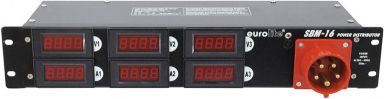
16 A 400 V power distributors
Professional 16 A 400 V Power Distributors for Events and Staging
When you're setting up lighting rigs, sound systems or stage equipment, reliable power distribution is essential. 16 A 400 V power distributors combine three-phase industrial power with multiple output sockets, giving you the flexibility to run both 400 V equipment and standard 230 V devices from a single feed. Whether you're rigging a festival stage, building a touring production or installing temporary event infrastructure, these distributors deliver the capacity and safety you need.
LTT offers a comprehensive range of CEE power distributors designed specifically for professional event technology. Our units feature robust IP44-rated housings, integrated safety covers and configurations that match real-world staging requirements. You get the power where you need it — safely, efficiently and ready for the demands of live events.
What Is a 16 A 400 V Power Distributor?
A 16 A 400 V power distributor is a portable or fixed electrical distribution unit that accepts a single three-phase CEE 400 V / 16 A input and splits it into multiple output sockets. The input is typically a 5-pin CEE plug (also known as a CEE industrial connector), which carries three phases, neutral and earth. Output configurations vary: most units provide a combination of CEE 400 V / 16 A sockets for high-power equipment and 230 V Schuko outlets for standard devices.
The 16 A rating refers to the maximum current per phase, which translates to a total load capacity of approximately 11 kW at 400 V (calculated as √3 × 400 V × 16 A). This makes 16 A distributors ideal for medium-sized event setups, where you need to power moving lights, haze machines, small PA systems and control equipment without overloading the supply.
How 16 A Distributors Differ from 32 A Units
Compared to 32 A 400 V distributors, which handle up to 22 kW, 16 A units are lighter, more compact and easier to transport. They're the preferred choice for mobile applications, smaller stages and installations where the available site supply is limited to 16 A. If your venue provides a 32 A CEE feed but you only need moderate power, a 16 A distributor with an appropriate adapter can still be used — though it's always safer to match the distributor rating to the supply.
The IP44 protection rating is standard across professional distributors. It guarantees protection against solid objects larger than 1 mm and splashing water from any direction, making these units suitable for outdoor events, construction sites and agricultural operations. The robust plastic housing withstands impacts, UV exposure and the rigours of touring.
Applications: Where 16 A 400 V Power Distributors Excel
16 A 400 V power distributors are the backbone of temporary power installations across the event industry. On festival stages, they feed lighting trusses, haze machines and monitor systems. In corporate events, they power projection rigs, LED walls and audio desks. For touring productions, they provide quick-setup power distribution that integrates seamlessly with road cases and rigging infrastructure.
Beyond live events, these distributors are equally at home on construction sites, where they supply power tools and site lighting, and in agricultural operations, where they run pumps, ventilation fans and mobile machinery. The combination of 400 V and 230 V outputs means you can connect a three-phase motor and a standard work light to the same distributor, reducing the number of separate feeds you need to run.
Integration with Stage Rigging and Truss Systems
One of the key advantages for event professionals is how easily 16 A distributors integrate with truss systems. When you're hanging a lighting rig from Naxpro-Truss or Prolyte truss, you can mount the distributor directly on the ground truss or suspend it from a side span using Riggatec rigging hardware. This keeps power close to the fixtures, minimises cable runs and reduces trip hazards on stage.
For mobile DJ setups and small band rigs, a single 16 A distributor can power the entire show: PA speakers on 230 V, a haze machine on 230 V and intelligent lights on 400 V if required. The compact form factor fits into standard equipment racks or road cases, and the built-in carry handle makes load-in and load-out faster.
Quality and Professional Standards: What to Look For
Not all 16 A 400 V power distributors are created equal. Professional-grade units from manufacturers such as Showtec, Eurolite and DAP-Audio feature high-impact polycarbonate housings, brass contact inserts and integrated strain relief for the input cable. Cheaper models may use thinner plastics, poorly fitted socket covers and undersized internal wiring — all of which compromise safety and longevity.
Output Socket Configurations
The most common configuration is 2 × CEE 400 V / 16 A + 4 × 230 V Schuko. This gives you two three-phase outputs for motors, pumps or high-power lighting fixtures, plus four single-phase outlets for control desks, laptops, chargers and small effect units. Some distributors offer 3 × CEE 400 V / 16 A with no 230 V sockets, which is ideal if you're feeding multiple three-phase devices and want to keep single-phase loads on a separate circuit.
All output sockets should have hinged safety covers that close automatically when not in use. This prevents ingress of dust and moisture, maintains the IP44 rating and reduces the risk of accidental contact with live terminals. Look for covers that are captive (attached to the housing) rather than loose caps, which are easily lost on site.
Circuit Protection and Safety Features
While basic distributors provide passive splitting with no internal protection, professional models include circuit breakers or RCD (residual current device) protection. An RCD with 30 mA sensitivity is mandatory in many jurisdictions for outdoor and temporary installations, as it disconnects the supply within milliseconds if a fault current is detected — potentially life-saving in wet conditions or when equipment is damaged.
Some distributors also feature individual miniature circuit breakers (MCBs) for each output socket, allowing you to isolate a faulty device without shutting down the entire rig. This is particularly valuable during live events, where you need to troubleshoot quickly without interrupting the show.
Price Brackets and Value
Entry-level 16 A distributors without RCD protection typically start around €40–€60. Mid-range units with RCD and robust housings sit in the €80–€150 bracket. High-end models with individual MCBs, digital current monitoring and aluminium reinforcement can reach €200–€300. For professional touring use, the extra investment in a quality unit pays off in reliability, safety compliance and reduced downtime.
Load Capacity Calculations for Event Staging
Understanding load capacity is critical when planning power distribution for events. A 16 A 400 V supply delivers a maximum of 11 kW across all three phases. However, this assumes a perfectly balanced load — in practice, you need to distribute devices evenly across phases to avoid overloading any single phase.
Practical Load Planning
Imagine you're powering a small stage rig with the following equipment:
- 4 × moving heads at 250 W each (1 kW total, split across two phases)
- 1 × haze machine at 1.2 kW (single-phase 230 V)
- 1 × PA system drawing 2 kW (single-phase 230 V)
- 1 × lighting desk and laptop at 200 W combined (single-phase 230 V)
The total load is approximately 4.4 kW. If you connect all the 230 V devices to the same phase, that phase carries 3.4 kW, which is well within the 3.68 kW per-phase limit (16 A × 230 V). However, if you add more single-phase devices without checking phase distribution, you risk tripping the breaker or, worse, overheating the wiring.
Professional distributors with phase indicators or current meters help you monitor load in real time. Alternatively, you can use a clamp meter to measure current on each phase during setup and rebalance connections as needed.
DGUV Vorschrift 17 Compliance for Events
In Germany, DGUV Vorschrift 17 (formerly BGV C1) governs electrical installations in entertainment venues and temporary events. It mandates that all power distribution equipment must be inspected and tested at regular intervals, and that only qualified personnel may install or modify electrical systems. While the regulation is German, its principles — regular inspection, proper earthing, RCD protection — are recognised as best practice internationally.
When you buy a 16 A power distributor from LTT, you receive equipment that meets these professional standards. Our units are supplied with test certificates where applicable, and we can advise on inspection intervals and documentation requirements for your specific use case.
CEE Plug and Socket Specifications: The Technical Foundation
The CEE 400 V / 16 A connector is a 5-pin industrial plug defined by IEC 60309. The five pins carry three phases (L1, L2, L3), neutral (N) and protective earth (PE). The plug is keyed so it can only be inserted in the correct orientation, and the earth pin makes contact first during insertion and breaks last during removal — a critical safety feature.
Pin Configuration and Colour Coding
The standard colour for 400 V CEE connectors is red. This distinguishes them from 230 V CEE connectors, which are blue, and 110 V connectors, which are yellow. The colour coding is universal across Europe and most international markets, reducing the risk of connecting equipment to the wrong voltage.
Inside the connector, the earth pin is longer and offset, ensuring it engages before the live pins. The phases are arranged symmetrically around the earth, and the neutral is positioned opposite the earth. This layout is consistent across all CEE 16 A, 32 A, 63 A and 125 A connectors, so the physical plug size increases with current rating, but the pin arrangement remains the same.
IP44 Rating and Environmental Protection
The IP44 rating applies to the entire distributor assembly, including the input plug, output sockets and housing. The first digit (4) indicates protection against solid objects larger than 1 mm — sufficient to exclude dust, sand and small debris. The second digit (4) indicates protection against splashing water from any direction, but not against direct water jets or immersion.
In practice, this means you can use a 16 A distributor outdoors in rain, provided it's positioned so water doesn't pool around the sockets and the safety covers are closed when sockets are not in use. For more extreme conditions — such as beach events with blowing sand or outdoor festivals with heavy rain — consider placing the distributor under a canopy or inside a weatherproof enclosure.
Cable Specifications and Input Leads
Most 16 A distributors are supplied with a 1.5 m to 2 m input cable terminated in a CEE 400 V / 16 A plug. The cable is typically H07RN-F 5 × 2.5 mm² — a flexible rubber-sheathed cable rated for outdoor use and mechanical stress. The 2.5 mm² conductor cross-section is the minimum required for 16 A continuous load; for longer cable runs or higher ambient temperatures, 4 mm² may be specified.
If you need to extend the input cable, use a CEE extension lead with the same or higher current rating. Never use a standard household extension lead with a CEE adapter — the conductors are too thin, and the plug and socket are not rated for outdoor use.
LTT – Your Specialist for Event Power Distribution
LTT has been supplying professional event technology for over 25 years, and our expertise in power distribution is backed by our own manufacturing capabilities in Germany. We don't just sell distributors — we understand how they integrate with Naxpro-Truss rigging systems, Riggatec hardware and the full spectrum of lighting, sound and effects equipment you use on site.
Every 16 A 400 V power distributor in our range is selected for reliability, safety and real-world performance. We stock units from leading manufacturers such as Showtec, Eurolite and DAP-Audio, and we can advise on the right configuration for your specific application — whether that's a touring production, a fixed installation or a one-off event.
With free shipping from €69 across Germany and express delivery options for urgent projects, you get your equipment when you need it. Our 3-year LTT warranty covers manufacturing defects, and our technical support team is available to answer questions about load calculations, compliance and integration with your existing rig. As a B2B supplier, we also offer trade pricing for resellers and volume discounts for large orders.
Explore our full range of power distribution solutions and discover why event professionals across Europe trust LTT to keep their shows running safely and reliably.
FAQ – Questions & Answers
A 16 A 400 V power distributor delivers a maximum load of approximately 11 kW across three phases, while a 32 A distributor provides up to 22 kW. The 16 A version is lighter, more compact and ideal for mobile applications, smaller stages and installations where the site supply is limited to 16 A. The 32 A unit is preferred for larger rigs with higher power demands, such as festival main stages or touring productions with extensive lighting and sound systems. Both use CEE industrial connectors, but the plug and socket sizes differ to prevent accidental cross-connection.
RCD (residual current device) protection is mandatory in many jurisdictions for outdoor and temporary installations, particularly where the public may come into contact with equipment. An RCD with 30 mA sensitivity disconnects the supply within milliseconds if a fault current is detected, significantly reducing the risk of electric shock. While basic 16 A distributors provide passive splitting with no internal protection, professional models include integrated RCDs. Even if your distributor lacks built-in RCD protection, you should install an upstream RCD at the supply point to comply with safety regulations such as DGUV Vorschrift 17 in Germany or BS 7671 in the UK.
A 16 A 400 V power distributor does not convert voltage — it distributes the incoming three-phase supply to multiple outputs. However, most distributors provide both 400 V CEE sockets (three-phase) and 230 V Schuko sockets (single-phase). The 230 V outlets are derived by connecting between one phase and neutral, giving you 230 V for standard equipment. This is not conversion in the electronic sense; it's simply tapping into the single-phase components of the three-phase supply. If you need to power only 230 V devices from a 400 V feed, choose a distributor with multiple Schuko outlets and distribute the load evenly across the three phases to avoid overloading any single phase.
A professional 16 A 400 V power distributor should include IP44-rated housing to protect against dust and splashing water, hinged safety covers on all output sockets to prevent accidental contact and ingress, and integrated strain relief for the input cable. Higher-specification models feature RCD protection (30 mA sensitivity) to guard against electric shock, individual miniature circuit breakers (MCBs) for each output to allow selective isolation of faulty devices, and brass contact inserts for reliable long-term performance. The input cable should be H07RN-F 5 × 2.5 mm² or heavier, rated for outdoor use and mechanical stress. Always verify that the unit carries CE marking and complies with IEC 60309 standards for industrial connectors.
The maximum load capacity of a 16 A 400 V distributor is approximately 11 kW, calculated as √3 × 400 V × 16 A. However, this assumes a perfectly balanced load across all three phases. In practice, you must distribute devices evenly to avoid overloading any single phase, which has a limit of 16 A × 230 V = 3.68 kW. List all equipment with their power ratings, assign each device to a phase, and sum the load per phase. If one phase exceeds 3.68 kW, redistribute devices or use a higher-rated distributor. For touring productions and live events, leave a 20% safety margin to account for inrush currents when motors and lighting fixtures start up.
For outdoor events, choose a 16 A 400 V distributor with IP44 rating, robust polycarbonate housing and integrated RCD protection. Models from Showtec, Eurolite and DAP-Audio are proven in festival and touring environments. Look for units with captive hinged safety covers on all sockets to maintain weather protection when outlets are not in use, and ensure the input cable is H07RN-F rubber-sheathed for UV and abrasion resistance. If the event involves heavy rain or beach conditions, position the distributor under a canopy or inside a weatherproof enclosure, even though the IP44 rating provides splash protection. For maximum reliability, inspect the unit before each event and test the RCD function using the built-in test button.
Yes, you can use a 16 A distributor with a 32 A site supply, provided you install an appropriate CEE 32 A to 16 A adapter cable. However, the distributor will still be limited to 11 kW total load, regardless of the higher-rated supply. The advantage of using a 32 A feed is that you have additional capacity available if you later add a second 16 A distributor or upgrade to a 32 A unit. Always ensure the adapter cable is rated for outdoor use (H07RN-F or equivalent) and that the connection is protected by an upstream RCD. Never exceed the 16 A rating of the distributor, even if the supply can deliver more current — doing so risks overheating the internal wiring and voiding any warranty or insurance coverage.
Professional 16 A 400 V power distributors range from approximately €40 to €300, depending on features and build quality. Entry-level units without RCD protection start around €40–€60 and are suitable for light-duty or occasional use. Mid-range models with RCD, IP44 housing and robust construction cost €80–€150 and represent the best value for regular event work. High-end distributors with individual MCBs, digital current monitoring and aluminium reinforcement reach €200–€300 and are designed for demanding touring applications. When comparing prices, consider the total cost of ownership: a quality unit with RCD protection and a 3-year warranty may cost more upfront but saves money on repairs, downtime and compliance testing over its working life.