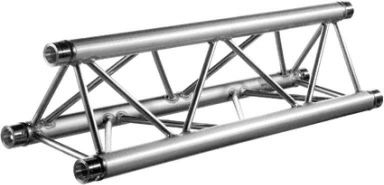
Prolyte H30D Truss
Prolyte H30D Triangular Truss at a Glance – Your Expert for Event Technology
The Prolyte H30D is a lightweight 3-point (triangular) aluminium truss connected by the proven CCS6 conical coupling system for fast, tool-light assembly. Whether you build a compact exhibition booth, a lighting rig or a small stage set, this truss delivers an excellent strength-to-weight ratio and a small transport volume.
At LTT you get the complete H30D range – straight lengths, corners and base plates – backed by 25 years of experience in professional event technology. Configure your triangular truss system exactly the way your production needs and rely on genuine Prolyte quality shipped from Germany.
What Is a Prolyte H30D Truss? Fundamentals and Function
A Prolyte H30D truss is a triangular aluminium load-bearing structure from the popular H30 series, designed for the installation, rental and exhibition market. The H30D is a 3-point truss, meaning three main chords are welded together in a triangular cross-section with diagonal bracing between them.
Construction facts
- Main chords: 48 x 3 mm
- Diagonal members: 16 x 2 mm
- Alloy: EN AW 6082 T6 aluminium
- Coupling system: CCS6 conical coupling
- Cross-section: triangular (3-point)
How it differs from adjacent truss types
Unlike a 4-point square truss, the triangular H30D uses only three chords, which reduces weight and transport volume while still carrying respectable spans. Compared with heavier-duty 40 or 50 series systems, the H30D is a light to medium-duty solution ideal for smaller loads and quick builds.
The defining feature of the H30D is its CCS6 conical coupling system. Instead of bolted plates, conical connectors are driven into the chord ends and locked, so two truss sections align precisely and self-centre. That is why the H30 truss is fast and easy to assemble and can be found in rental fleets all over the globe. If you need square-profile stability instead, take a look at heavier square truss systems – but for versatile, portable rigging the triangular H30D is a proven workhorse.
Construction and CCS6 Conical Coupling System Explained
The CCS6 conical coupling system is the heart of every Prolyte H30 truss. Each connection consists of a conical spigot connector plus locking pins that pull the two truss ends firmly together. Because the cone self-centres inside the chord, the joint is stiff, gap-free and repeatable – essential for predictable load behaviour.
Why CCS6 matters for you
- Fast assembly: conical connectors drive in quickly, so a crew can build a rig in a fraction of the time a bolted system needs.
- High rigidity: the cone eliminates play at the joint, which improves the effective span and deflection performance.
- Repeatable quality: every joint locks the same way, ideal for daily rental use.
The main chords measure 48 x 3 mm and the diagonals 16 x 2 mm, both made from EN AW 6082 T6 aluminium – a structural alloy chosen for its strength, weldability and corrosion resistance. The triangular geometry places one chord at the bottom and two at the top (or vice versa depending on orientation), which is why the load tables always reference a specific cross-sectional orientation.
Because the H30 series is also available in ladder, triangular and square profiles, you can extend an H30D installation with matching components while keeping the same CCS6 interface. When ordering, note that some straight sections are supplied without conical connectors, so always check whether couplers are included and order spares where needed.
Available Lengths, Weights and Item Codes – Types and Variants
The Prolyte H30D is available in a wide range of standard straight lengths, from short 0.25 m spacers up to full 4 m sections. This variety lets you assemble almost any span from stock parts, and custom lengths are available on request.
Standard lengths, codes and weights
Each length carries its own item number – for example, the popular 1 m section H30D-L100 is listed under item number 111050014. Naming follows a clear logic: the code always reads H30D-L plus the length in centimetres, so H30D-L200 is the 2 m straight and H30D-L400 the 4 m straight.
Finish and colour variants
The H30D is offered in two finishes: silver (natural anodised/mill aluminium) and black powder-coated RAL9005 (the PC variants). Black is the go-to choice when the truss should visually disappear on stage, while silver remains popular in rental and exhibition contexts. Both finishes share identical construction and load values.
Load Capacity, Span and Deflection Data – Technical Buying Criteria
Understanding the working load limit (WLL) of a Prolyte H30D truss is essential before you hang anything. Prolyte publishes load tables that are TÜV-certified and calculated in full compliance with European standards (Eurocode). The tables cover several load types you should know.
The five load types
- UDL – Uniformly Distributed Load (kg per metre)
- CPL – Centre Point Load (a single load at mid-span)
- TPL – single loads at third points
- QPL – single loads at quarter points
- FPL – single loads at fifth points
Real span examples
As the table shows, the load capacity drops sharply as the span grows, while deflection (sag) rises. As a Profi partner we advise you to plan not just for the raw kilogram figure but also for a sensible deflection limit – excessive sag looks unprofessional and can stress fixtures.
A few binding rules apply to every H30D loading figure: the values are valid only for static loads, only for single spans supported at both ends, and only for the cross-sectional orientation shown in the load table. The self-weight of the truss is already included, and a suitable safety factor is built in. Any other configuration – multi-span grids, cantilevers, ground support towers – needs an individual structural calculation. If you are unsure, contact a structural engineer before loading. Reading the load tables correctly is the difference between a safe rig and a dangerous one, so never simply add up the maximum figures across several load points.
Corners, Base Plates and Accessories for the H30D
A complete triangular truss structure needs more than straight sections. The Prolyte H30D range includes a full family of corners and accessories that share the same CCS6 interface.
Corners
- 2-way corners in 45°, 60°, 90° and 135° for flat or angled runs
- 3-way corners (codes around C010–C013) to branch a rig in three directions
- 4-way corners (e.g. C014) for creating box or grid layouts
With these corners you can build rectangles, triangles, arches and complex booth frames from a single system. For clean vertical mounting, the H30D / X30D base plate provides a stable footprint and is fully compatible across the H30D and X30D families.
Matching accessories
Beyond corners and base plates, typical accessories include spigot connectors and locking pins for the CCS6 joints, half couplers and clamps for hanging fixtures, spansets and steel wire ropes for suspension, plus flight cases to protect your truss in transit. When you plan a rig, budget for spare conical connectors – they are consumable hardware and easy to misplace on a busy load-out. LTT stocks a broad selection of rigging accessories and clamps so you can complete your H30D system in one order.
H30D vs X30D vs H30V: Comparison and Which Triangle Truss to Choose
One of the most common questions is how the H30D compares to the visually near-identical X30D and to the H30V. All three sit in the versatile 30 series, but they differ in wall thickness, cross-section and load behaviour.
The key distinction between the H and X versions is wall thickness: the H truss uses a thicker wall, giving higher load capacity and making it less vulnerable to transport damage, while the X version is lighter and typically more affordable. If your trusses live in a hard-working rental fleet or carry heavier fixtures, the H30D is usually the safer choice. If weight and budget dominate and loads are light, the X30D can be attractive.
Because the H30D and X30D share the same base plate and largely the same corner family, many users mix them within limits – but always check the specific load tables for the exact profile you install, since load figures are not interchangeable between H and X.
Safety, Norms and Certification: DGUV V17, EN 1090 and TÜV
Rigging over people is safety-critical, so compliance matters as much as raw load figures. The Prolyte H30D is TÜV type-tested (RWTÜV Baumuster geprüft), which confirms the published load tables under defined conditions.
Key norms and obligations
- DGUV Vorschrift 17 (formerly BGV C1): the German accident-prevention regulation for stages and production facilities, relevant whenever truss is used above audiences or crews.
- EN 1090: the European standard governing the execution of structural aluminium and steel components, underpinning certified truss manufacture.
- Eurocode: the load figures for the H30D are calculated in full compliance with European standards, with the self-weight already accounted for.
Practical safety rules
- Load figures apply only to static loads and single spans supported at both ends – dynamic loads or cantilevers require separate calculation.
- Never exceed the working load limit, and respect the deflection limits, not just the maximum kilograms.
- Inspect conical connectors, pins and chords regularly for damage, corrosion or bending.
- Read the manufacturer manual before assembling, using and loading the truss.
As your specialist, LTT recommends always keeping the TÜV documentation and a structural sign-off for non-standard installations. When in doubt about a complex grid or a tower, consult a qualified structural engineer before the show.
Applications: Stage, Exhibition and Lighting Rigging
The Prolyte H30D is a genuine all-rounder, which is exactly why it turns up in rental inventories worldwide. Its small transport volume and fast CCS6 assembly make it a favourite wherever crews build quickly and pack down often.
Where the H30D is used
- Exhibition and booth builds: lightweight frames, hanging signage and header structures for trade-fair stands.
- Small stage builds: goalpost frames, backdrops and modest overhead grids for club shows, corporate events and worship spaces.
- Lighting rigging: carrying moving heads, LED pars and spots on tour, in theatres and at festivals.
- Retail and display: temporary architecture, product presentations and pop-up installations.
Because the triangular profile is light yet stiff, a single crew can transport and erect an H30D structure fast – a real advantage for DJs, bands and small production companies. To complete a rig you will typically combine the H30D with clamps, hoists or manual chain blocks and a lighting control setup. If you need a taller or heavier structure, step up to a square or 40/50 series truss; for portable, versatile jobs the H30D remains the sweet spot.
Buying Guide: Configuring a Complete H30D System, Plus Brands and Alternatives
Buying single SKUs is easy – configuring a complete, safe triangular truss system takes a little planning. Here is how to approach it as a professional.
Step-by-step buying guide
- Define the span and layout. Sketch your structure, then read the H30D load tables for the exact span to confirm the WLL is sufficient for your fixtures.
- Pick your straight lengths. Combine stock lengths (e.g. 3 m + 1 m + 0.5 m) to reach the total run; spans can be assembled from different truss lengths.
- Add the right corners. Choose 2-way, 3-way or 4-way corners to match your geometry (rectangle, triangle, box).
- Secure the base. Add H30D/X30D base plates for standing towers, or plan suspension hardware for flown rigs.
- Order accessories. Include spare conical connectors, clamps, spansets and a flight case.
- Choose the finish. Silver for rental flexibility, black RAL9005 for a discreet stage look.
Brands and manufacturers to consider
Prolyte is a benchmark in professional truss, but at LTT you can also compare comparable systems. Alongside Prolyte, we carry Naxpro-Truss (our in-house range, manufactured in Germany), Global Truss, Litetruss and Alutruss – strong alternatives depending on your budget, load requirements and connector preference. Note that truss systems from different manufacturers are generally not cross-compatible, so plan to stay within one system per structure. If you need advice on choosing between a Prolyte H30D and an equivalent Naxpro-Truss profile, our team helps you find the optimal solution for your production.
Assembly, Transport and Care & Maintenance of Your H30D
Getting the most from a Prolyte H30D is not only about buying the right parts – proper handling keeps the truss safe and good-looking for years.
Assembly and transport tips
- Use the CCS6 correctly: align the cones, seat them fully and insert the locking pins completely – a half-seated joint compromises rigidity and load capacity.
- Exploit the small pack size: the triangular profile nests well; store and transport sections in flight cases to prevent dents to the chords.
- Keep connectors organised: carry spare conical connectors and pins in a labelled parts box so a load-in never stalls.
Care and maintenance
- Cleaning: wipe silver truss with a soft cloth; for black RAL9005 powder-coated sections, use mild, non-abrasive cleaners to protect the finish.
- Inspection: before each use, check chords and diagonals for bends, cracks or corrosion, and verify that conical connectors are not deformed.
- Storage: keep truss dry to avoid corrosion, especially at welds and connector bores.
- Retire damaged parts: any bent chord or worn connector must be taken out of service – load figures only hold for undamaged, correctly assembled truss.
Related Categories and Further Truss Systems
The Prolyte H30D is one building block in a much larger world of rigging and staging. To round out your production, explore closely related categories at LTT.
If you need heavier or square profiles, compare the H30D with square truss systems and larger series for high-load spans. For suspension, browse rigging hardware, clamps and hoists to fly your truss safely. And to complete the show, look at lighting fixtures and effect equipment that mount directly onto your triangular truss.
For in-house alternatives to Prolyte, take a look at our Naxpro-Truss ranges, engineered and manufactured in Germany. Whatever you build, combining the right truss, rigging and lighting is the fastest route to impressive, professional results.
LTT – Your Specialist for Event Technology
When it comes to professional truss systems for stage, exhibition and event technology, LTT is your reliable partner. As a manufacturer with our own production in Germany and more than 25 years of experience, we know truss inside out – and we back the Prolyte H30D you buy from us with genuine expertise, not just a price tag.
Order with confidence: your truss ships from Bocholt in Germany, with free shipping from €69, optional express delivery and worldwide dispatch through our international dealer network. Whether you are a rental company, an exhibition builder, a touring crew or an end customer, you benefit from high-quality branded products and hands-on advice.
Give your next show the structure it deserves and put your production in the spotlight with the Prolyte H30D. Explore the full range at LTT and build a system that delivers impressive, safe and professional results – event after event.
FAQ – Questions & Answers
The price of a Prolyte H30D truss depends on the length and finish. As a guide, short straight sections start at roughly €95–€135 for lengths between 0.29 m and 0.71 m, a 1 m H30D-L100 sits around €150, and longer 3 m to 4 m sections range from about €345 to €365. Corners and base plates are priced separately, typically from around €70 for a base plate up to €200–€270 for angled corners. Prices vary with finish (silver or black RAL9005) and current stock, so check the live listing at LTT for the exact figure.
The Prolyte H30D truss can span well over 10 metres as a single span supported at both ends, but its load capacity falls sharply as the span increases. At a 3 m span the H30D carries a uniformly distributed load of about 562 kg/m, at 6 m roughly 150 kg/m, and at 10 m only around 51 kg/m, with deflection rising accordingly. These figures apply to static loads on a single span with supports at both ends. For grids, cantilevers or any non-standard configuration, an individual structural calculation is required before loading the truss.
The Prolyte H30D truss is a 3-point (triangular) system built from main chords measuring 48 x 3 mm and diagonal members measuring 16 x 2 mm, all made from EN AW 6082 T6 aluminium. It is available in standard straight lengths of 0.25, 0.29, 0.50, 0.71, 0.75, 1.0, 1.5, 2.0, 2.5, 3.0 and 4.0 metres, with custom lengths on request. Weights range from about 2 kg for the shortest 0.25 m section up to roughly 17.75 kg for the 4 m section. The triangular cross-section keeps transport volume small.
The main difference between the Prolyte H30D and X30D lies in wall thickness. The H30D uses a thicker chord wall (48 x 3 mm), giving it higher load capacity and better resistance to transport damage, which makes it well suited to busy rental fleets and heavier fixtures. The X30D is built lighter, so it weighs less and is usually more affordable, but it carries lower loads. Both are triangular 3-point profiles that use the CCS6 conical coupling and share the same H30D/X30D base plate. Always use the load table for the exact profile, because the figures are not interchangeable.
The Prolyte H30D and H30V both belong to the versatile 30 series and are triangular 3-point trusses, but they are optimised for different needs. The H30D is the standard triangular truss with 48 x 3 mm chords and CCS6 conical coupling, widely used in rental, touring and exhibition work. The H30V is a variant designed for specific rig geometries and span requirements within the same series. In practice, most productions choose the H30D for its broad availability, extensive corner range and proven load tables. If a project calls for the particular characteristics of the V variant, our LTT team helps you decide.
The Prolyte H30D and X30D triangle truss share a comprehensive corner family. Available options include 2-way corners in 45°, 60°, 90° and 135° for flat and angled runs, 3-way corners (codes around C010 to C013) for branching a rig in three directions, and 4-way corners such as C014 for building boxes and grids. There are also T-pieces and up/down variants for vertical transitions. All corners use the same CCS6 conical coupling interface, so they connect directly to straight H30D sections. This lets you assemble rectangles, triangles, arches and complex booth frames from one system.
A Prolyte triangle truss such as the H30D is used wherever a lightweight, portable and versatile load-bearing structure is needed. Typical applications include small exhibition and trade-fair booths, header frames and hanging signage, compact stage builds like goalpost frames and backdrops, and lighting rigging for moving heads, LED pars and spots. Thanks to its small transport volume and fast CCS6 assembly, the triangular truss is a favourite in rental fleets worldwide and popular with DJs, bands, theatres, clubs and worship venues. For taller or heavier structures, a square or higher-series truss is the better choice.
The Prolyte H30D truss is connected by the CCS6 conical coupling system. This joint uses conical spigot connectors that are driven into the chord ends and secured with locking pins, so the two truss sections self-centre and lock together without bolted plates. The CCS6 system makes the H30 series fast and easy to assemble, delivers a rigid, gap-free connection that improves span and deflection performance, and provides repeatable quality for daily rental use. Note that some straight H30D sections are supplied without conical connectors, so always check whether couplers are included and keep spare connectors and pins on hand.