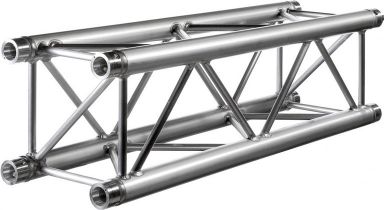
Prolyte H30V Truss
Prolyte H30V Truss at a Glance – Your Specialist for Event Technology
The Prolyte H30V truss is a proven 4-point square truss for stage building, exhibition stands and professional rigging. Built from 48.3 x 3 mm main chords and 16 x 2 mm diagonal members, it combines low weight with impressive load-bearing capacity. Thanks to the CCS6 conical coupling system, you assemble a complete rig fast, safely and with a single light aluminium hammer.
At LTT you get the full H30V system — straight lengths, corners, T-crosses, circular truss and every connector — from stock and ready for your next project. Set your production in scene with a truss system that is trusted in rental fleets all over the globe.
What Is a Prolyte H30V Truss? Fundamentals and Function
A Prolyte H30V truss is an aluminium square truss from the Prolyte H30 series, engineered as a light to medium-duty load-bearing structure for the installation, rental and exhibition market. The "H" designates the heavy-wall variant with a 3 mm chord wall thickness, which distinguishes it clearly from the thinner X30V version and gives it higher load capacity and better resistance to transport damage.
Each H30V section consists of four parallel main chords (48.3 x 3 mm) welded together by 16 x 2 mm diagonal braces, forming the classic four-point cross-section. This geometry lets the truss carry heavy point loads and long spans while keeping the self-weight low.
How it differs from other truss types
Unlike a 3-point triangular truss (H30D) or a flat 2-chord ladder truss (H30L), the 4-point square H30V carries loads evenly in all directions, which makes it the go-to profile for horizontal spans, towers and self-supporting goalpost structures.
The defining feature is the CCS6 conical coupling system. Instead of bolting chords together, tapered cones and pins pull the sections tight, creating a rigid, virtually play-free joint. This is what makes the H30V so popular for touring and rental work: fast to build, fast to strike and dimensionally stable across countless cycles.
Construction and Technical Specifications
The Prolyte H30V truss is manufactured from high-grade EN AW 6082 T6 aluminium alloy, a material chosen for its excellent strength-to-weight ratio and weldability. The key technical data are identical across every straight length, corner and circle in the series.
Core technical data
The 3 mm wall thickness is the decisive detail. Compared to the X30V (thinner wall), the extra material makes the H30V far less vulnerable to dents and transport knocks — a real advantage for demanding rental use.
Weights and item codes
Every length has its own catalogue and item number, which makes ordering and reordering precise. Typical straight lengths run from 0.25 m to 4.00 m, for example H30V-L100 (1.00 m, 7.0 kg, item 111050094) or H30V-L300 (3.00 m, 18.9 kg). Shorter fillers such as H30V-L025 (2.7 kg) let you hit exact dimensions, and other lengths are available on request. This granular length range means you can plan a stage or exhibition build down to the centimetre without improvising.
CCS6 Conical Coupling System and Assembly Workflow
The CCS6 conical coupling system is the heart of every Prolyte H30V truss and the reason assembly is so fast and secure. Rather than screwing chords together, the system uses precision-machined cones and conical pins that draw two truss ends together under tension, eliminating play at the joint.
The CCS6 component set
- CCS6-600 – conical coupler (the cone that sits inside the chord)
- CCS6-603 – conical pin (secures the coupler)
- CCS6-604 – conical pin with M8 thread and nut (for the alternative fixing)
- CCS6-605 – R-clip / spring pin (secures the pin against slipping out)
Step-by-step assembly
- Align the two truss ends so the coupler seats into both chords.
- Drive the CCS6-600 cone home with a light aluminium hammer — never a steel hammer, which would damage the alloy.
- Insert the conical pin (CCS6-603 or CCS6-604) through the coupler.
- Lock the pin with the CCS6-605 R-clip so it cannot work loose under vibration.
The only tool you need is a soft aluminium hammer. Note that different truss systems require their specific connector set, so always match the CCS6 parts to your H30V series. You will find all conical couplers, pins and R-clips in our accessories range.
Load Capacity, Span and Deflection Explained
Reading the Prolyte H30V load table correctly is the single most important skill for safe rigging. The table lists the maximum allowable loads for a single span supported at both ends, calculated in full compliance with the European standard (Eurocode). The self-weight of the truss is already included.
The load values you will see
- UDL – Uniformly Distributed Load (kg/m), for evenly spread weight such as a lighting bar.
- CPL – Centre Point Load (kg), a single load hung dead-centre.
- TPL / QPL / FPL – single loads distributed over third, fourth and fifth points.
- Deflection – how far the truss bends downward at the given load, in mm.
Span versus deflection in practice
As the span grows, the allowable load drops and the deflection rises. For an H30V at a 3 m span you can carry a UDL of roughly 649 kg/m with only 10 mm deflection, while at 8 m the UDL falls to about 194 kg/m and deflection climbs to 73 mm. At 14 m the UDL is down to around 60 kg/m.
Planning a safe rig
When you plan a stage-height truss bridge, first fix your span, then read the matching UDL or point-load value and check the deflection is acceptable for your fixtures. Keep total suspended weight (fixtures, cabling, motors) safely below the table figure.
Important: TÜV certification is only valid for the values in the loading table. The figures apply to static loads and single spans only. Any other configuration — cantilevers, multi-span grids, goalposts — requires an individual structural calculation by a qualified engineer. When in doubt, ask us or a structural engineer before you fly a load.
Types and Variants: H30V Lengths, Corners and Profiles
The Prolyte H30 series is a complete modular family, and the H30V square profile is its most versatile member. Understanding the variants helps you build exactly the structure your project needs.
Straight lengths
Straight H30V truss runs from 0.25 m fillers up to 4.00 m sections — for example L025, L050, L071, L100, L150, L200, L250, L300 and L400. Because spans can be assembled from different lengths, you can reach almost any dimension.
Corners and junctions
To turn a straight run into a frame, tower or goalpost you add corner blocks and junctions, such as the H30V-C017 4-point 3-way horizontal T-cross or the C001/C002/C004 angled corners (45°, 60°, 120°). These parts keep the CCS6 logic intact so the whole rig stays quick to build.
Circular truss
For eye-catching stage design the H30V-R200 circular truss creates full circles from arc segments. Circles are dimensionally stable and combine freely with any straight length or corner — perfect for a genuine wow effect above a dance floor or product stage.
Base plates
Base plates such as the H/X30V base plate give freestanding H30V towers a solid, load-spreading foot.
H30V Compared to H30D, Naxpro-Truss and Global Truss
Choosing the right truss means comparing profiles and systems side by side. The table below sets the square H30V against the triangular H30D and against comparable systems in our multi-brand range, so you can decide with confidence.
How to choose
Pick the H30V square when you need omnidirectional load capacity, towers or self-supporting spans. The H30D triangular is lighter and ideal for straight single-plane runs where you only load one axis.
If you compare across brands, our own Naxpro-Truss FD31 (50 mm tube, 2 mm wall) and HD31 (50 mm tube, 3 mm wall) offer a slightly larger tube diameter and are a strong, cost-effective alternative, while Global Truss F34 is a widely used compatible standard. As a multi-brand specialist, LTT helps you match the profile, wall thickness and connector system to your rig — an ideal cross-sell and decision aid you will not find on single-brand pages.
Application Areas: Stages, Exhibition Stands and Rigging
The Prolyte H30V truss is a true all-rounder, which is why it turns up in rental fleets all over the globe. Its balance of strength, low weight and fast CCS6 assembly suits a wide range of professional applications.
Typical uses
- Exhibition and trade fair stands – frames, headers and hanging structures that go up and down quickly during build days.
- Concert and stage lighting rigs – horizontal lighting bridges and front-of-house trusses carrying moving heads, wash lights and cabling.
- Load-bearing support structures – goalposts, portals and self-supporting grids for banners, screens and decor.
- Event rigging – flown and ground-supported structures for corporate events, festivals, theatre and clubs.
For a complete solution you will often combine H30V truss with lifting motors, clamps and safety accessories from our rigging range. Where you need base plates, sleeve blocks or truss towers, the H30V system integrates seamlessly.
Because H30V is a professional-grade system, it belongs in the hands of trained technicians who follow the load table and applicable safety rules — exactly the audience LTT serves as a specialist partner.
Standards, Safety and Certification (EN 1090, TÜV, DGUV)
Rigging aluminium truss is safety-critical work, and the Prolyte H30V is designed and documented to meet the relevant European requirements. Understanding what the certificates mean protects your production and your crew.
Key standards and documents
- TÜV certificate – confirms the truss meets the tested load values; the certification is only valid for the published loading table.
- EN 1090 certificate – the European standard for the manufacture of structural aluminium components, evidence of controlled, traceable production.
- Production control certificate – documents ongoing quality assurance in manufacturing.
- Data sheets, DWG/CAD symbols – downloadable files for accurate planning and structural drawings.
DGUV Vorschrift 17 and safe practice
In Germany, temporary stage and truss structures fall under DGUV Vorschrift 17 (formerly BGV C1). In practice this means qualified personnel, correct use within the working load limit, proper securing of every CCS6 pin with an R-clip, and an individual structural calculation for anything beyond a simple single span.
Always treat the load table as the upper limit, never the target, and add a safety margin for dynamic effects such as movement and wind. If your configuration is not a standard single span, consult a structural engineer before you fly any load.
Buying Guide: Choosing Length, Corners and Connectors
Buying a Prolyte H30V system is easier when you plan the whole build rather than ordering parts in isolation. This buying guide walks you through the key decisions.
Step 1 – Define your structure
Sketch the shape you need: a straight lighting bridge, a two-post goalpost, a full square frame or a circle. This tells you how many corners, T-crosses and base plates you require.
Step 2 – Choose your lengths
Combine standard lengths (L100, L200, L300, L400) to reach the total span, and add short fillers (L025, L050, L071) to hit exact dimensions. Remember every length has its own item code for precise reordering.
Step 3 – Order the CCS6 connectors
Each joint needs a full CCS6 set: cone (CCS6-600), pin (CCS6-603 or CCS6-604) and R-clip (CCS6-605). Count your joints and order connectors accordingly — running short on site costs you time.
Step 4 – Add corners and base plates
Select the right corner angles (45°, 60°, 90°, 120°) or the C017 T-cross for your junctions, plus base plates for freestanding towers.
Step 5 – Don't forget rigging and transport
Budget for clamps, motors, safety steels and cases. The H30V's low transport volume and 3 mm wall make it durable and efficient to move — a genuine long-term advantage for rental fleets.
Accessories, Connectors and Spare Parts
A Prolyte H30V truss is only as good as the accessories around it, and LTT stocks the complete range so you can build, secure and maintain a full system from one source.
Connection accessories
- CCS6-600 conical coupler, CCS6-603 / CCS6-604 conical pins and CCS6-605 R-clips — the essential connector set for every joint.
- Base plates (H/X30V) for freestanding towers and portals.
Structural accessories
- Corner blocks and T-crosses such as the H30V-C017 for frames and junctions.
- Circular truss segments (H30V-R200) for round designs.
Rigging and handling accessories
To fly or ground-support your H30V truss you will need clamps, lifting motors, steel safeties and cases. These accessories complete the system and keep it safe and mobile.
Always match accessories to the H30V/CCS6 standard — connectors from other truss systems are not interchangeable. If you are unsure which coupler, corner or clamp fits your build, our team helps you assemble the exact accessory list for your project.
Care, Maintenance and Transport in Rental Fleets
Good care keeps a Prolyte H30V truss safe and dimensionally stable for years — which is exactly why the heavy-wall H version is a rental-fleet favourite.
Inspection and maintenance
- Inspect every section before each use for dents, cracks, weld damage and bent diagonals; a damaged chord compromises the load rating.
- Check the CCS6 cones and pins for wear and clean them so joints seat cleanly.
- Keep the R-clips (CCS6-605) present and springy — a missing clip is an immediate safety risk.
- Retire and replace any truss that shows structural damage rather than continuing to use it.
Cleaning
Wipe down aluminium sections with a soft cloth; avoid aggressive abrasives that scratch the surface. Let truss dry fully before storage to prevent corrosion at the joints.
Transport and storage
The H30V's low transport volume and robust 3 mm walls make it efficient to move and stack. Use dedicated truss cases or trolleys, protect the chord ends and store sections dry and supported along their length. Handled properly, an H30V system survives countless build-and-strike cycles — the kind of long-term durability professional users rely on.
Related Categories and Further Truss Systems
To complete your Prolyte H30V build, explore our closely related truss and rigging categories. If you need a larger tube diameter or a budget-conscious alternative, our own Naxpro-Truss FD31 and HD31 (50 mm tube) are a strong choice, and Global Truss F34 is a widely used compatible standard.
Beyond straight truss you will find corner blocks, base plates, circular segments and the full CCS6 connector range in our accessories categories, plus lifting motors, clamps and safety steels in our rigging section. Cases and transport solutions round off a rental-ready package.
As your specialist for event technology, LTT carries the H30V system alongside a deep multi-brand range, so you can plan an entire stage, exhibition stand or lighting rig from a single supplier.
LTT – Your Specialist for Event Technology
At LTT you buy the Prolyte H30V truss from a genuine specialist, not a generalist. With over 25 years of experience in event technology and our own manufacturing in Germany, we understand rigging from the load table to the last R-clip — and we back it up with real service.
When you order H30V truss from us, you benefit from fast dispatch out of Bocholt, Germany, free shipping from €69 and express delivery when the show cannot wait. Our international dealer network means we ship worldwide, and B2B customers enjoy dedicated wholesale conditions. Every purchase is covered by the 3-year LTT warranty, backed by more than 100,000 positive customer reviews.
Whether you are building an exhibition stand, a concert lighting bridge or a self-supporting tower, we help you find the optimal solution — combining Prolyte H30V with our own Naxpro-Truss and the leading brands we stock. Set your next production in scene with a partner who knows truss inside out.
FAQ – Questions & Answers
The Prolyte H30V data sheet is available as a downloadable PDF and lists the full technical specifications, weights, item codes and the complete loading table. At LTT you can request the current H30V data sheet and matching DWG/CAD symbol files for your structural drawings directly from our team, or find them linked on the relevant product pages. Always plan your rig using the values from the official H30V data sheet, as the TÜV certification is only valid for the loads stated there.
To calculate the load capacity of a Prolyte H30V truss, use the official H30V loading table. First determine your span (the distance between supports), then read the matching Uniformly Distributed Load (UDL in kg/m) or Centre Point Load (CPL in kg). For example, an H30V at a 3 m span carries roughly 649 kg/m UDL, dropping to about 194 kg/m at an 8 m span. The table already includes the truss self-weight. These figures apply only to static single spans; any other configuration requires an individual structural calculation by a qualified engineer.
The price of a Prolyte H30V truss depends on the length and part type. As a guide, shorter straight lengths such as the H30V-L071 (0.71 m) start around €176, an H30V-L100 (1.0 m) around €210, and longer sections like the H30V-L300 (3.0 m) around €450 including VAT. Corners, T-crosses and circular segments cost more due to their complexity. For current pricing, exact availability and B2B wholesale conditions on Prolyte H30V truss, check the product listings at LTT or contact our sales team.
The Prolyte H30V truss is a 4-point square truss with main chords measuring 48.3 x 3 mm and diagonal members of 16 x 2 mm, made from EN AW 6082 T6 aluminium. The distance between the outer main chords is approximately 28.7 cm, giving the classic square cross-section. Straight lengths are available from 0.25 m up to 4.00 m, with a 1.0 m section weighing about 7.0 kg and a 3.0 m section about 18.9 kg. Other lengths are available on request from LTT.
A single Prolyte H30V truss span, supported at both ends, is documented in the loading table up to spans of 14 m and beyond, though the allowable load decreases sharply as the span grows. At a 3 m span the H30V carries around 649 kg/m with only 10 mm deflection, while at 14 m the UDL falls to roughly 60 kg/m with much greater deflection. The maximum usable span therefore depends entirely on the weight you need to fly. For any multi-span or non-standard setup, an individual structural calculation is mandatory.
You can buy the Prolyte H30V truss directly at LTT, your specialist for event technology. LTT stocks the complete H30V range — straight lengths, corners, T-crosses, circular truss, base plates and all CCS6 connectors — with dispatch from Bocholt, Germany. You benefit from free shipping from €69, optional express delivery, worldwide shipping through our international dealer network and dedicated wholesale conditions for B2B customers. Every Prolyte H30V purchase is covered by the 3-year LTT warranty and backed by over 100,000 positive customer reviews.
The Prolyte H30V manual and assembly instructions describe how to connect sections with the CCS6 conical coupling system using a light aluminium hammer, the cone (CCS6-600), the conical pin (CCS6-603 or CCS6-604) and the securing R-clip (CCS6-605). The manual also covers the safety notes for the loading table. At LTT you can request the current H30V documentation and data sheets, or find them referenced on the product pages. Always follow the official Prolyte H30V manual and applicable safety rules such as DGUV Vorschrift 17 when rigging.
The difference between the Prolyte H30V and H30D lies in the profile shape. The H30V is a 4-point square truss with four main chords, carrying loads in all directions and ideal for towers, grids and self-supporting spans. The H30D is a 3-point triangular truss with three chords, which is lighter and best suited to straight single-plane runs loaded mainly in one axis. Both share the 48.3 x 3 mm chord, 16 x 2 mm diagonals and the CCS6 coupling system. Choose H30V for omnidirectional strength and H30D where you need a lighter single-plane truss.