LED signs & tickers

LED Signs and Scrolling Displays – Professional Messaging for Events and Venues: LED signs and scrolling displays deliver your messages with maximum impact. Whether you need to communicate event schedules, sponsor messages, directional information or promotional content, programmable LED message boards ensure your information reaches your audience clearly and effectively. At LTT, you'll find professional LED signage solutions designed specifically for event technicians, venue operators, exhibition builders...
Read more »
LED signs & tickers
Close window
LED signs & tickers

LED Signs and Scrolling Displays – Professional Messaging for Events and Venues

LED signs and scrolling displays deliver your messages with maximum impact. Whether you need to communicate event schedules, sponsor messages, directional information or promotional content, programmable LED message boards ensure your information reaches your audience clearly and effectively. At LTT, you'll find professional LED signage solutions designed specifically for event technicians, venue operators, exhibition builders and professional applications – from compact single-line displays to multi-zone scrolling text systems.

What Are LED Signs and Scrolling Displays?

LED signs and scrolling displays are digital messaging systems built from arrays of light-emitting diodes arranged in a matrix configuration. Each LED acts as a pixel, and together they form characters, symbols, graphics and animations. The most common types are single-line scrolling text displays (also called LED tickers or news tickers) and multi-line message boards.

The fundamental difference between LED signs and traditional static signage lies in their programmability and dynamic content capability. While a printed banner displays one fixed message, an LED scrolling display can cycle through dozens of different messages, update in real-time, and incorporate animation effects to capture attention.

Pixel pitch is the key specification that determines viewing distance and resolution. P10 displays (10mm pixel pitch) are ideal for medium to long viewing distances of 10–50 metres, making them perfect for stage backdrops, exhibition halls and outdoor venue signage. P6 displays (6mm pixel pitch) offer higher resolution for closer viewing distances of 6–25 metres, suited to reception areas, conference rooms and indoor event spaces. P5 models provide even sharper text for close-range applications.

Compared to traditional neon signs or printed banners, LED message boards offer unmatched flexibility. A single LED scrolling display can replace dozens of printed signs throughout an event, with content updated instantly via smartphone app, WiFi connection or USB programming. For touring productions, this eliminates the need to produce new signage for each venue – simply reprogram the display with location-specific information.

Applications for LED Signs in Professional Event and Venue Environments

LED signs and scrolling displays serve critical communication functions across the event and entertainment industry. In concert and festival venues, LED tickers display sponsor messages, safety information, merchandise promotions and real-time social media feeds. Stage managers use programmable LED signs to communicate set changes, timing information and technical cues to crew members positioned throughout the venue.

Exhibition and trade show builders rely on LED message boards to guide attendees, highlight featured exhibitors and promote scheduled presentations. A scrolling display at the entrance can welcome visitors by name for VIP events, while directional LED signs help attendees navigate large exhibition halls. The ability to update content remotely means organisers can respond instantly to schedule changes or emergency announcements.

In corporate event production, LED signs provide professional branding and messaging. Conference organisers use multi-line displays to show session schedules, speaker introductions and live polling results. Awards ceremonies incorporate LED scrolling text to display nominee information and sponsor acknowledgements.

Permanent installation venues – theatres, clubs, houses of worship, sports facilities – use LED signs for wayfinding (toilets, exits, box office), promotional messaging (upcoming shows, ticket offers) and operational information (opening hours, safety notices). The weatherproof outdoor models with IP65 rating are particularly valuable for venue exteriors, car parks and outdoor event spaces.

For rental companies and touring productions, the combination of lightweight construction, flight case compatibility and quick programming makes LED scrolling displays an essential inventory item. A single 200cm display can be reconfigured for dozens of different clients and applications.

Quality Standards and Technical Specifications for Professional LED Message Boards

Professional-grade LED signs differ significantly from consumer-oriented models in brightness, build quality, control options and reliability. When specifying LED scrolling displays for event and venue applications, several technical parameters determine suitability.

Brightness levels are measured in candelas per square metre (cd/m²). Indoor LED signs typically deliver 4,000–6,000 cd/m² brightness, ensuring excellent visibility in ambient lighting conditions found in conference centres, theatres and exhibition halls. Outdoor-rated models require 6,000–8,000 cd/m² or higher to remain legible in direct sunlight. Leading manufacturers including Eurolite, Showtec and Futurelight offer models across this brightness range, with automatic brightness adjustment responding to ambient light conditions.

Viewing distance calculations follow a simple rule: minimum viewing distance (in metres) equals pixel pitch (in millimetres). A P10 display is readable from 10 metres and beyond; a P6 model from 6 metres. For stage backdrops viewed from 20+ metres, P10 is cost-effective and perfectly adequate. For reception desks or close-range applications, P6 or P5 delivers sharper text.

Power consumption varies with display size and brightness settings. A typical 100cm single-line RGB display draws 30–50 watts at full brightness, while a 200cm multi-zone model may require 80–120 watts. This modest power requirement means most LED signs operate safely from standard 230V mains supplies without requiring dedicated circuits. For touring applications, this simplifies power distribution planning.

Refresh rates of 60Hz or higher eliminate visible flicker, crucial when LED signs appear in camera shots for broadcast events or video production. Professional models from manufacturers such as Omnitronic and American DJ specify flicker-free operation suitable for HD and 4K video capture.

Price brackets reflect these quality differences. Entry-level 100cm single-colour displays start around €150–250, suitable for basic messaging in low-demand applications. Professional RGB multi-line displays in the 150–200cm range typically cost €400–800, offering app control, animation effects and robust construction. Premium models with DMX integration, weatherproof housings and modular panel systems range from €1,000–3,000, justified for permanent installations and high-use rental inventory.

Programming Options and Control Systems for LED Scrolling Displays

Modern LED signs offer multiple programming methods to suit different workflow requirements and technical capabilities. Understanding these control options helps you select the right system for your operational needs.

Smartphone app control via Bluetooth or WiFi has become the industry standard for ease of use. Free iOS and Android apps allow you to compose messages, select fonts, choose colours, set scrolling speeds and schedule content from your phone or tablet. Bluetooth connectivity typically works within 30 metres, ideal for programming displays in the same room. WiFi-enabled models can be updated remotely from anywhere with network access – particularly valuable for managing multiple displays across large venues or updating content from a central control room.

The apps typically support multiple languages, emoji and special characters, with message libraries storing up to 100 different texts. You can create playlists that cycle through messages automatically, set display durations (typically 1–60 seconds per message) and choose from animation effects including scroll up, scroll down, scroll left, scroll right, flash, fade, snow effect and laser effect. Six-stage speed control lets you match scrolling pace to message complexity.

Windows PC software provides more sophisticated control for complex installations. The software allows you to design custom graphics and animations using bitmap editors, manage multiple displays simultaneously through network managers, and schedule content with precision timers. This is particularly useful for permanent installations where displays turn on and off automatically at venue opening and closing times.

USB programming offers a simple offline option. Create your content using the PC software, save it to a USB drive, then plug the drive directly into the LED sign's USB port. The display imports the new content without requiring a computer connection – ideal for touring scenarios where you need to update content quickly between shows.

IR remote control provides basic functionality for pre-programmed modes and effects. While less flexible than app or software control, a remote is useful for quick adjustments during live events when you don't want to open an app or computer interface.

For advanced integration, some professional models support DMX512 control, allowing LED signs to synchronise with stage lighting systems. This enables coordinated colour changes, brightness adjustments and effect triggering as part of a unified lighting design – particularly impressive for concert productions and theatrical performances.

Installation and Mounting for Event Venues and Touring Applications

Proper installation ensures LED signs deliver maximum visibility and operate reliably throughout demanding event schedules. Professional models include versatile mounting options designed specifically for event and venue applications.

Most LED scrolling displays ship with wall-mounting brackets and hanging chains as standard accessories. The brackets allow secure fixing to walls, pillars or booth structures using the included screws and anchors. Adjustable hanging chains enable suspended installation from ceiling grids, truss systems or overhead rigging points. For temporary event setups, the hanging method offers quick installation and easy height adjustment.

Truss integration is a critical consideration for touring productions and stage installations. LED signs with standard mounting points can be attached directly to aluminium truss using half-couplers or quick-release clamps. When specifying displays for truss mounting, verify the weight – most single-line displays weigh 2–5kg, well within the capacity of standard truss accessories. For stage backdrops, multiple LED signs can be mounted side-by-side on the same truss span to create extended messaging zones.

Viewing angle affects placement decisions. Quality LED matrix displays offer 120–140° horizontal viewing angles, ensuring the message remains legible from oblique positions. This wide angle makes LED signs effective in corridor installations, exhibition booth corners and stage-side positions where audiences view from various directions.

For outdoor and semi-outdoor applications, weatherproof models with IP65 rating protect against rain, dust and temperature extremes. The sealed housings prevent moisture ingress while maintaining ventilation to dissipate heat. When installing outdoor LED signs, position them to avoid prolonged direct sunlight on the display face, which can reduce visibility and accelerate LED degradation. Covered locations such as building overhangs, canopies or stage roofs provide ideal protection.

Front-access maintenance is a valuable feature for permanent installations where the rear of the display is inaccessible. Professional models allow you to open the front panel to access internal components, change settings via DIP switches, or service LEDs without removing the entire unit from its mounting.

For touring and rental applications, transport protection is essential. LED signs fit standard flight cases, with foam inserts protecting the display face and control electronics. When building a touring inventory, budget for appropriate cases – a damaged display face renders the unit unusable, making protective transport cases a worthwhile investment that pays for itself by preventing repair costs.

LTT – Your Specialist for Professional Event Technology

At LTT, you'll find LED signs and scrolling displays selected specifically for professional event, venue and exhibition applications. Our range includes models from trusted manufacturers such as Eurolite, Showtec and Futurelight, chosen for their reliability in demanding production environments.

Every LED message board we supply ships from our warehouse in Bocholt, Germany, with free delivery on orders over €69. You benefit from our 3-year LTT guarantee, express shipping options for urgent projects, and worldwide delivery to support international productions. As both a specialist retailer and manufacturer with our own production facility in Germany, we understand the technical requirements and operational realities of professional event technology.

Whether you're equipping a permanent venue, building a touring production inventory or sourcing signage for a one-off exhibition, our team provides expert guidance on display selection, programming options and installation methods. With over 25 years of experience in event technology and more than 100,000 positive customer reviews, LTT is your reliable partner for professional LED signage solutions that deliver your messages with clarity and impact.

Flexible and Custom LED Display Configurations

Beyond standard rectangular scrolling displays, professional LED signage systems offer modular flexibility for custom installations. Modular panel systems allow you to build LED message boards in virtually any size by connecting multiple display modules. Each panel typically measures 32cm × 16cm or similar dimensions, with power and data connections linking panels together to form larger displays.

This modular approach enables custom shapes and configurations impossible with fixed-format displays. Create L-shaped displays that wrap around building corners, U-shaped installations that surround doorways, or circular arrangements for column wrapping. For exhibition stands, curved LED displays follow booth contours to maximise branding impact. The panels connect at 90-degree angles using corner connectors, maintaining seamless message flow around bends.

Multi-zone displays divide the screen into independent sections, each showing different content simultaneously. A three-zone display might show sponsor logos in the left section, scrolling event information in the centre, and time/date in the right section. This maximises information density while maintaining visual clarity.

For stage integration, LED scrolling displays can be incorporated into larger video wall systems or positioned as accent elements within scenic designs. The ability to synchronise multiple displays creates coordinated messaging across expansive stage backdrops. When combined with DMX control, the displays become dynamic lighting elements that respond to musical cues and dramatic moments.

Rental inventory considerations favour modular systems because they adapt to diverse client requirements. A rental company with modular LED panels can configure a 100cm display for one event, then reconfigure the same panels into a 200cm display or multi-line format for the next booking. This flexibility maximises utilisation and return on investment compared to fixed-format displays with limited application range.

FAQ – Questions & Answers

What is the difference between P10 and P6 LED resolution?

P10 and P6 refer to pixel pitch – the distance in millimetres between LED centres. P10 displays have 10mm spacing between pixels, making them suitable for viewing distances of 10 metres and beyond, ideal for stage backdrops, outdoor signage and large venues. P6 displays have 6mm pixel pitch, providing higher resolution for closer viewing distances of 6–25 metres, perfect for reception areas, conference rooms and indoor event spaces. P6 delivers sharper text and finer detail, while P10 offers cost-effective coverage for applications where viewers are further away. The choice depends on your typical viewing distance and budget.

How do I program LED signs via smartphone app?

Most modern LED scrolling displays include free iOS and Android apps for wireless programming. First, download the manufacturer's app from the App Store or Google Play. Enable Bluetooth or WiFi on your smartphone, then connect to the LED sign (it appears as an available device). Open the app, compose your message using the text editor, select font style, choose colours, set scrolling speed and animation effects, then tap "Send" to transfer the content to the display. The LED sign stores up to 100 messages in memory, and you can create playlists that cycle through multiple messages automatically. Connection range is typically 30 metres for Bluetooth, unlimited for WiFi-enabled models.

What are the standard sizes for LED scrolling signs?

Professional LED scrolling displays are commonly available in three standard lengths: 100cm (approximately 1 metre), 150cm (1.5 metres) and 200cm (2 metres). Height varies by model but typically ranges from 15cm to 40cm for single-line displays, with multi-line models reaching 60cm or more. The 100cm format suits small venues, reception desks and booth installations. The 150cm size provides good visibility for medium venues and stage-side messaging. The 200cm format delivers maximum impact for large venues, outdoor installations and stage backdrops. Custom lengths are available through modular panel systems that connect multiple display modules to achieve any desired dimension.

Can LED signs be used outdoors?

Yes, LED signs designed for outdoor use feature weatherproof construction with IP65 rating, protecting against rain, dust and temperature extremes. Outdoor LED scrolling displays use sealed housings to prevent moisture ingress while maintaining ventilation for heat dissipation. They deliver higher brightness levels (6,000–8,000 cd/m² or more) to remain legible in direct sunlight, compared to 4,000–6,000 cd/m² for indoor models. Outdoor-rated displays are ideal for venue exteriors, car parks, festival sites and semi-outdoor locations such as covered stages. Always verify the IP rating before outdoor installation – indoor-only models will fail if exposed to weather.

What power requirements do LED message boards have?

LED scrolling displays are remarkably energy-efficient. A typical 100cm single-line RGB display draws 30–50 watts at full brightness, similar to a domestic light bulb. A 150cm model requires approximately 50–80 watts, while a 200cm multi-zone display may consume 80–120 watts. All professional models operate from standard 230V mains supplies without requiring dedicated electrical circuits. This modest power consumption makes LED signs practical for touring applications where power availability may be limited, and keeps operating costs minimal for permanent installations. Most displays include power cables with standard plugs for immediate connection.

Which LED sign suits exhibition and trade show applications?

For exhibition and trade show use, choose LED scrolling displays with WiFi or Bluetooth app control for easy content updates throughout the event, RGB colour capability to match brand colours, and lightweight construction for simple transport and installation. A 150cm or 200cm display provides good visibility across exhibition halls. Look for models with included hanging chains and wall brackets to accommodate various booth structures. Front-access maintenance is valuable because booth installations often prevent rear access. Budget €400–800 for a professional RGB display with these features. For rental companies serving multiple exhibitors, modular panel systems offer maximum configuration flexibility.

How do LED signs integrate with stage lighting systems?

Professional LED scrolling displays with DMX512 control can integrate directly into stage lighting systems, allowing the message board to synchronise with other lighting fixtures. Connect the LED sign to your DMX controller using standard 3-pin or 5-pin XLR cables, assign a DMX address, then program colour changes, brightness adjustments and effect triggers as part of your lighting cues. This enables coordinated visual effects where the LED sign responds to musical beats, dramatic moments or scene changes. DMX integration is particularly impressive for concert productions, theatrical performances and corporate events where unified lighting design creates professional impact. Not all LED signs include DMX capability, so verify this feature if lighting integration is required.

What does a professional LED scrolling display cost?

Professional LED scrolling display prices vary by size, features and quality. Entry-level 100cm single-colour displays start around €150–250, suitable for basic messaging applications. Mid-range 100–150cm RGB displays with smartphone app control, animation effects and robust construction cost €300–500. Professional 150–200cm multi-zone RGB displays with WiFi control, DMX integration and weatherproof housings range from €600–1,200. Premium modular panel systems for custom configurations and permanent installations cost €1,000–3,000 or more. The investment reflects brightness levels, build quality, control sophistication and expected lifespan. For rental inventory, choose professional-grade models that withstand repeated transport and installation cycles.

Top seller
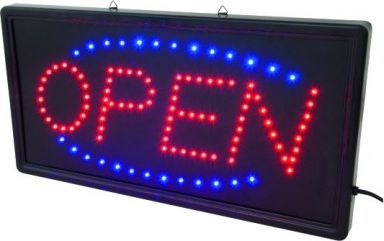
EUROLITE LED Schild OPEN classic
EUROLITE LED Sign OPEN classic
€29.90 *
incl. tax, plus shipping costs
Availability:
Delivery time: 3-5 days
1 Article
Close filters
  •  
No results were found for the filter!
EUROLITE LED Schild OPEN classic
EUROLITE LED Sign OPEN classic
An iconic classic with modern LED technologyWith its 92 LEDs (74x red, 18x blue), the LED sign OPEN classic welcomes your customers with brilliant light. For a more dynamic look, the blue LEDs can...
€29.90 *
incl. tax, plus shipping costs
Availability:
Delivery time: 3-5 days
Facts
LED Signs and Scrolling Displays – Professional Messaging for Events and Venues: LED signs and scrolling displays deliver your messages with maximum impact. Whether you need to communicate event schedules, sponsor messages, directional information or promotional content, programmable LED message boards ensure your information reaches your audience clearly and effectively. At LTT, you'll find professional LED signage solutions designed... Read more »
Viewed
Facts

LED Signs and Scrolling Displays – Professional Messaging for Events and Venues

LED signs and scrolling displays deliver your messages with maximum impact. Whether you need to communicate event schedules, sponsor messages, directional information or promotional content, programmable LED message boards ensure your information reaches your audience clearly and effectively. At LTT, you'll find professional LED signage solutions designed specifically for event technicians, venue operators, exhibition builders and professional applications – from compact single-line displays to multi-zone scrolling text systems.

What Are LED Signs and Scrolling Displays?

LED signs and scrolling displays are digital messaging systems built from arrays of light-emitting diodes arranged in a matrix configuration. Each LED acts as a pixel, and together they form characters, symbols, graphics and animations. The most common types are single-line scrolling text displays (also called LED tickers or news tickers) and multi-line message boards.

The fundamental difference between LED signs and traditional static signage lies in their programmability and dynamic content capability. While a printed banner displays one fixed message, an LED scrolling display can cycle through dozens of different messages, update in real-time, and incorporate animation effects to capture attention.

Pixel pitch is the key specification that determines viewing distance and resolution. P10 displays (10mm pixel pitch) are ideal for medium to long viewing distances of 10–50 metres, making them perfect for stage backdrops, exhibition halls and outdoor venue signage. P6 displays (6mm pixel pitch) offer higher resolution for closer viewing distances of 6–25 metres, suited to reception areas, conference rooms and indoor event spaces. P5 models provide even sharper text for close-range applications.

Compared to traditional neon signs or printed banners, LED message boards offer unmatched flexibility. A single LED scrolling display can replace dozens of printed signs throughout an event, with content updated instantly via smartphone app, WiFi connection or USB programming. For touring productions, this eliminates the need to produce new signage for each venue – simply reprogram the display with location-specific information.

Applications for LED Signs in Professional Event and Venue Environments

LED signs and scrolling displays serve critical communication functions across the event and entertainment industry. In concert and festival venues, LED tickers display sponsor messages, safety information, merchandise promotions and real-time social media feeds. Stage managers use programmable LED signs to communicate set changes, timing information and technical cues to crew members positioned throughout the venue.

Exhibition and trade show builders rely on LED message boards to guide attendees, highlight featured exhibitors and promote scheduled presentations. A scrolling display at the entrance can welcome visitors by name for VIP events, while directional LED signs help attendees navigate large exhibition halls. The ability to update content remotely means organisers can respond instantly to schedule changes or emergency announcements.

In corporate event production, LED signs provide professional branding and messaging. Conference organisers use multi-line displays to show session schedules, speaker introductions and live polling results. Awards ceremonies incorporate LED scrolling text to display nominee information and sponsor acknowledgements.

Permanent installation venues – theatres, clubs, houses of worship, sports facilities – use LED signs for wayfinding (toilets, exits, box office), promotional messaging (upcoming shows, ticket offers) and operational information (opening hours, safety notices). The weatherproof outdoor models with IP65 rating are particularly valuable for venue exteriors, car parks and outdoor event spaces.

For rental companies and touring productions, the combination of lightweight construction, flight case compatibility and quick programming makes LED scrolling displays an essential inventory item. A single 200cm display can be reconfigured for dozens of different clients and applications.

Quality Standards and Technical Specifications for Professional LED Message Boards

Professional-grade LED signs differ significantly from consumer-oriented models in brightness, build quality, control options and reliability. When specifying LED scrolling displays for event and venue applications, several technical parameters determine suitability.

Brightness levels are measured in candelas per square metre (cd/m²). Indoor LED signs typically deliver 4,000–6,000 cd/m² brightness, ensuring excellent visibility in ambient lighting conditions found in conference centres, theatres and exhibition halls. Outdoor-rated models require 6,000–8,000 cd/m² or higher to remain legible in direct sunlight. Leading manufacturers including Eurolite, Showtec and Futurelight offer models across this brightness range, with automatic brightness adjustment responding to ambient light conditions.

Viewing distance calculations follow a simple rule: minimum viewing distance (in metres) equals pixel pitch (in millimetres). A P10 display is readable from 10 metres and beyond; a P6 model from 6 metres. For stage backdrops viewed from 20+ metres, P10 is cost-effective and perfectly adequate. For reception desks or close-range applications, P6 or P5 delivers sharper text.

Power consumption varies with display size and brightness settings. A typical 100cm single-line RGB display draws 30–50 watts at full brightness, while a 200cm multi-zone model may require 80–120 watts. This modest power requirement means most LED signs operate safely from standard 230V mains supplies without requiring dedicated circuits. For touring applications, this simplifies power distribution planning.

Refresh rates of 60Hz or higher eliminate visible flicker, crucial when LED signs appear in camera shots for broadcast events or video production. Professional models from manufacturers such as Omnitronic and American DJ specify flicker-free operation suitable for HD and 4K video capture.

Price brackets reflect these quality differences. Entry-level 100cm single-colour displays start around €150–250, suitable for basic messaging in low-demand applications. Professional RGB multi-line displays in the 150–200cm range typically cost €400–800, offering app control, animation effects and robust construction. Premium models with DMX integration, weatherproof housings and modular panel systems range from €1,000–3,000, justified for permanent installations and high-use rental inventory.

Programming Options and Control Systems for LED Scrolling Displays

Modern LED signs offer multiple programming methods to suit different workflow requirements and technical capabilities. Understanding these control options helps you select the right system for your operational needs.

Smartphone app control via Bluetooth or WiFi has become the industry standard for ease of use. Free iOS and Android apps allow you to compose messages, select fonts, choose colours, set scrolling speeds and schedule content from your phone or tablet. Bluetooth connectivity typically works within 30 metres, ideal for programming displays in the same room. WiFi-enabled models can be updated remotely from anywhere with network access – particularly valuable for managing multiple displays across large venues or updating content from a central control room.

The apps typically support multiple languages, emoji and special characters, with message libraries storing up to 100 different texts. You can create playlists that cycle through messages automatically, set display durations (typically 1–60 seconds per message) and choose from animation effects including scroll up, scroll down, scroll left, scroll right, flash, fade, snow effect and laser effect. Six-stage speed control lets you match scrolling pace to message complexity.

Windows PC software provides more sophisticated control for complex installations. The software allows you to design custom graphics and animations using bitmap editors, manage multiple displays simultaneously through network managers, and schedule content with precision timers. This is particularly useful for permanent installations where displays turn on and off automatically at venue opening and closing times.

USB programming offers a simple offline option. Create your content using the PC software, save it to a USB drive, then plug the drive directly into the LED sign's USB port. The display imports the new content without requiring a computer connection – ideal for touring scenarios where you need to update content quickly between shows.

IR remote control provides basic functionality for pre-programmed modes and effects. While less flexible than app or software control, a remote is useful for quick adjustments during live events when you don't want to open an app or computer interface.

For advanced integration, some professional models support DMX512 control, allowing LED signs to synchronise with stage lighting systems. This enables coordinated colour changes, brightness adjustments and effect triggering as part of a unified lighting design – particularly impressive for concert productions and theatrical performances.

Installation and Mounting for Event Venues and Touring Applications

Proper installation ensures LED signs deliver maximum visibility and operate reliably throughout demanding event schedules. Professional models include versatile mounting options designed specifically for event and venue applications.

Most LED scrolling displays ship with wall-mounting brackets and hanging chains as standard accessories. The brackets allow secure fixing to walls, pillars or booth structures using the included screws and anchors. Adjustable hanging chains enable suspended installation from ceiling grids, truss systems or overhead rigging points. For temporary event setups, the hanging method offers quick installation and easy height adjustment.

Truss integration is a critical consideration for touring productions and stage installations. LED signs with standard mounting points can be attached directly to aluminium truss using half-couplers or quick-release clamps. When specifying displays for truss mounting, verify the weight – most single-line displays weigh 2–5kg, well within the capacity of standard truss accessories. For stage backdrops, multiple LED signs can be mounted side-by-side on the same truss span to create extended messaging zones.

Viewing angle affects placement decisions. Quality LED matrix displays offer 120–140° horizontal viewing angles, ensuring the message remains legible from oblique positions. This wide angle makes LED signs effective in corridor installations, exhibition booth corners and stage-side positions where audiences view from various directions.

For outdoor and semi-outdoor applications, weatherproof models with IP65 rating protect against rain, dust and temperature extremes. The sealed housings prevent moisture ingress while maintaining ventilation to dissipate heat. When installing outdoor LED signs, position them to avoid prolonged direct sunlight on the display face, which can reduce visibility and accelerate LED degradation. Covered locations such as building overhangs, canopies or stage roofs provide ideal protection.

Front-access maintenance is a valuable feature for permanent installations where the rear of the display is inaccessible. Professional models allow you to open the front panel to access internal components, change settings via DIP switches, or service LEDs without removing the entire unit from its mounting.

For touring and rental applications, transport protection is essential. LED signs fit standard flight cases, with foam inserts protecting the display face and control electronics. When building a touring inventory, budget for appropriate cases – a damaged display face renders the unit unusable, making protective transport cases a worthwhile investment that pays for itself by preventing repair costs.

LTT – Your Specialist for Professional Event Technology

At LTT, you'll find LED signs and scrolling displays selected specifically for professional event, venue and exhibition applications. Our range includes models from trusted manufacturers such as Eurolite, Showtec and Futurelight, chosen for their reliability in demanding production environments.

Every LED message board we supply ships from our warehouse in Bocholt, Germany, with free delivery on orders over €69. You benefit from our 3-year LTT guarantee, express shipping options for urgent projects, and worldwide delivery to support international productions. As both a specialist retailer and manufacturer with our own production facility in Germany, we understand the technical requirements and operational realities of professional event technology.

Whether you're equipping a permanent venue, building a touring production inventory or sourcing signage for a one-off exhibition, our team provides expert guidance on display selection, programming options and installation methods. With over 25 years of experience in event technology and more than 100,000 positive customer reviews, LTT is your reliable partner for professional LED signage solutions that deliver your messages with clarity and impact.

Flexible and Custom LED Display Configurations

Beyond standard rectangular scrolling displays, professional LED signage systems offer modular flexibility for custom installations. Modular panel systems allow you to build LED message boards in virtually any size by connecting multiple display modules. Each panel typically measures 32cm × 16cm or similar dimensions, with power and data connections linking panels together to form larger displays.

This modular approach enables custom shapes and configurations impossible with fixed-format displays. Create L-shaped displays that wrap around building corners, U-shaped installations that surround doorways, or circular arrangements for column wrapping. For exhibition stands, curved LED displays follow booth contours to maximise branding impact. The panels connect at 90-degree angles using corner connectors, maintaining seamless message flow around bends.

Multi-zone displays divide the screen into independent sections, each showing different content simultaneously. A three-zone display might show sponsor logos in the left section, scrolling event information in the centre, and time/date in the right section. This maximises information density while maintaining visual clarity.

For stage integration, LED scrolling displays can be incorporated into larger video wall systems or positioned as accent elements within scenic designs. The ability to synchronise multiple displays creates coordinated messaging across expansive stage backdrops. When combined with DMX control, the displays become dynamic lighting elements that respond to musical cues and dramatic moments.

Rental inventory considerations favour modular systems because they adapt to diverse client requirements. A rental company with modular LED panels can configure a 100cm display for one event, then reconfigure the same panels into a 200cm display or multi-line format for the next booking. This flexibility maximises utilisation and return on investment compared to fixed-format displays with limited application range.

FAQ – Questions & Answers

What is the difference between P10 and P6 LED resolution?

P10 and P6 refer to pixel pitch – the distance in millimetres between LED centres. P10 displays have 10mm spacing between pixels, making them suitable for viewing distances of 10 metres and beyond, ideal for stage backdrops, outdoor signage and large venues. P6 displays have 6mm pixel pitch, providing higher resolution for closer viewing distances of 6–25 metres, perfect for reception areas, conference rooms and indoor event spaces. P6 delivers sharper text and finer detail, while P10 offers cost-effective coverage for applications where viewers are further away. The choice depends on your typical viewing distance and budget.

How do I program LED signs via smartphone app?

Most modern LED scrolling displays include free iOS and Android apps for wireless programming. First, download the manufacturer's app from the App Store or Google Play. Enable Bluetooth or WiFi on your smartphone, then connect to the LED sign (it appears as an available device). Open the app, compose your message using the text editor, select font style, choose colours, set scrolling speed and animation effects, then tap "Send" to transfer the content to the display. The LED sign stores up to 100 messages in memory, and you can create playlists that cycle through multiple messages automatically. Connection range is typically 30 metres for Bluetooth, unlimited for WiFi-enabled models.

What are the standard sizes for LED scrolling signs?

Professional LED scrolling displays are commonly available in three standard lengths: 100cm (approximately 1 metre), 150cm (1.5 metres) and 200cm (2 metres). Height varies by model but typically ranges from 15cm to 40cm for single-line displays, with multi-line models reaching 60cm or more. The 100cm format suits small venues, reception desks and booth installations. The 150cm size provides good visibility for medium venues and stage-side messaging. The 200cm format delivers maximum impact for large venues, outdoor installations and stage backdrops. Custom lengths are available through modular panel systems that connect multiple display modules to achieve any desired dimension.

Can LED signs be used outdoors?

Yes, LED signs designed for outdoor use feature weatherproof construction with IP65 rating, protecting against rain, dust and temperature extremes. Outdoor LED scrolling displays use sealed housings to prevent moisture ingress while maintaining ventilation for heat dissipation. They deliver higher brightness levels (6,000–8,000 cd/m² or more) to remain legible in direct sunlight, compared to 4,000–6,000 cd/m² for indoor models. Outdoor-rated displays are ideal for venue exteriors, car parks, festival sites and semi-outdoor locations such as covered stages. Always verify the IP rating before outdoor installation – indoor-only models will fail if exposed to weather.

What power requirements do LED message boards have?

LED scrolling displays are remarkably energy-efficient. A typical 100cm single-line RGB display draws 30–50 watts at full brightness, similar to a domestic light bulb. A 150cm model requires approximately 50–80 watts, while a 200cm multi-zone display may consume 80–120 watts. All professional models operate from standard 230V mains supplies without requiring dedicated electrical circuits. This modest power consumption makes LED signs practical for touring applications where power availability may be limited, and keeps operating costs minimal for permanent installations. Most displays include power cables with standard plugs for immediate connection.

Which LED sign suits exhibition and trade show applications?

For exhibition and trade show use, choose LED scrolling displays with WiFi or Bluetooth app control for easy content updates throughout the event, RGB colour capability to match brand colours, and lightweight construction for simple transport and installation. A 150cm or 200cm display provides good visibility across exhibition halls. Look for models with included hanging chains and wall brackets to accommodate various booth structures. Front-access maintenance is valuable because booth installations often prevent rear access. Budget €400–800 for a professional RGB display with these features. For rental companies serving multiple exhibitors, modular panel systems offer maximum configuration flexibility.

How do LED signs integrate with stage lighting systems?

Professional LED scrolling displays with DMX512 control can integrate directly into stage lighting systems, allowing the message board to synchronise with other lighting fixtures. Connect the LED sign to your DMX controller using standard 3-pin or 5-pin XLR cables, assign a DMX address, then program colour changes, brightness adjustments and effect triggers as part of your lighting cues. This enables coordinated visual effects where the LED sign responds to musical beats, dramatic moments or scene changes. DMX integration is particularly impressive for concert productions, theatrical performances and corporate events where unified lighting design creates professional impact. Not all LED signs include DMX capability, so verify this feature if lighting integration is required.

What does a professional LED scrolling display cost?

Professional LED scrolling display prices vary by size, features and quality. Entry-level 100cm single-colour displays start around €150–250, suitable for basic messaging applications. Mid-range 100–150cm RGB displays with smartphone app control, animation effects and robust construction cost €300–500. Professional 150–200cm multi-zone RGB displays with WiFi control, DMX integration and weatherproof housings range from €600–1,200. Premium modular panel systems for custom configurations and permanent installations cost €1,000–3,000 or more. The investment reflects brightness levels, build quality, control sophistication and expected lifespan. For rental inventory, choose professional-grade models that withstand repeated transport and installation cycles.
// Countdown for Black Deals