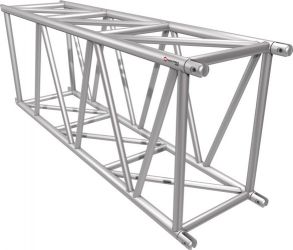
GS 94
GS 94 4-Point Truss – Heavy-Duty Rigging from Your Event Tech Specialist
The GS 94 is a heavy-duty 4-point aluminium truss built for the most demanding rigging tasks in professional event technology. With a robust 60 mm main tube and a 5 mm wall thickness, this system carries serious loads where standard truss reaches its limits. At LTT you get GS 94 truss engineered for stage roofs, large-span ground supports and long-throw trussing — the reliable choice when you need to set the scene with confidence and achieve impressive results under real load.
What is a GS 94 Truss? Fundamentals and Construction
The GS 94 is a square 4-point truss designed for high-load applications in staging and rigging. It belongs to the heavy-duty end of the aluminium truss family and is engineered for spans and point loads that lighter systems cannot handle safely.
Core construction
The defining feature of the GS 94 is its dimensioning: the four main chords use a 60 mm diameter tube with a 5 mm wall thickness, while the diagonal bracing tubes measure 40 x 3 mm. This gives the truss a very high load-bearing reserve and excellent stiffness over long spans.
Clear distinction from lighter truss
It is important not to confuse the GS 94 with lighter Naxpro-Truss systems. The FD31 and FD34 series use a 50 mm main tube with 2 mm wall thickness, and the HD31 to HD44 series use a 50 mm main tube with 3 mm wall thickness. The GS 94, by contrast, moves to a 60 mm tube with a full 5 mm wall — a step up in structural class. If you are building tall stage roofs, wide ground-support goalposts or long free spans, the GS 94 is the truss designed exactly for that job.
Applications: Where GS 94 Truss Is Used
The GS 94 is the go-to truss whenever loads and spans exceed what medium-duty systems can carry. Because of its 60 mm chord and 5 mm wall, it is a professional-grade solution for structural rigging rather than decorative trussing.
Typical applications for GS 94 truss include:
- Stage roof structures and covered outdoor stages
- Large ground-support systems and goalpost constructions for lighting and PA
- Long free spans across wide stages, arenas and exhibition halls
- Heavy hanging points for line arrays, moving heads and video walls
- Touring rigs that demand maximum load reserve and repeatable safety
For lighter decorative and display use, take a look at our wider truss range. If you also need lifting and hoisting equipment for these builds, explore our rigging and motor accessories to complete a safe, load-rated setup.
Types and Variants of GS 94 Truss
The GS 94 system is a modular family of components that lets you build almost any structural geometry. Instead of a single part, you combine straight lengths, corners and connectors to match your stage or ground-support design.
Common GS 94 variants and elements include:
- Straight sections in graduated lengths for spanning and building towers
- Corner blocks in 2-way, 3-way and 4-way configurations for T-, L- and X-junctions
- Book corners and adjustable corners for angled roofs and pitched structures
- Base plates and adapter plates for ground-support feet and sleeve blocks
- Coupling and connection hardware matched to the 60 mm chord
All GS 94 elements share the same 60 mm main tube with 5 mm wall thickness and 40 x 3 mm diagonals, so components combine into a coherent, load-rated structure. This modular approach makes the GS 94 a flexible, high-capacity truss platform for professional use.
Comparison: GS 94 vs. HD34 vs. FD34 Truss
Choosing the right truss class starts with understanding how the GS 94 differs from lighter Naxpro-Truss systems. The comparison below focuses on the structural values that matter for load and span.
In short: the GS 94 is the optimal solution when you need maximum load-bearing capacity and long free spans, while FD34 and HD34 cover lighter to medium tasks. If your build stays within moderate loads, a lighter system may be more cost-effective — but for structural rigging, the GS 94 is the safer, stiffer choice.
Technical Buying Criteria and Material of GS 94 Truss
When you buy GS 94 truss, the technical values determine both safety and performance. These are the concrete features to check.
Key technical data
- Main chord: 60 mm diameter tube, 5 mm wall thickness
- Diagonal bracing: 40 x 3 mm tubes
- Cross-section: square 4-point truss
- Material: high-strength aluminium alloy, welded construction
What to verify before purchase
- Working load limit (WLL) and load tables for your intended span and support configuration — never estimate loads, always work from the statics documentation.
- Compliance and certification relevant to event rigging, such as DGUV Vorschrift 17 (formerly BGV C1), EN 1090 manufacturing standards and TÜV SÜD assessments.
- Connection system compatibility so corners, sleeve blocks and base plates match the 60 mm chord.
- Span versus point load — the GS 94 excels at long free spans and heavy hanging points thanks to its 5 mm wall.
Because the GS 94 is a structural product, always plan with the published statics for your exact layout rather than generic assumptions.
Buying Guide: What to Look for When Choosing GS 94 Truss
A good buying guide for the GS 94 starts with your actual load case, not just the price. The right decision depends on span, load and how often you rebuild the structure.
Work through these steps:
- Define the load case first. Calculate the total weight of everything the truss will carry — lighting, moving heads, PA, video, motors — and confirm it against the GS 94 load tables.
- Match span to structure. For long free spans and tall towers, the 60 mm / 5 mm construction of the GS 94 gives you the stiffness and reserve that lighter truss cannot.
- Plan the full system. Order matching corners, base plates and sleeve blocks together so the geometry is complete and load-rated.
- Consider frequency of use. Touring and rental operations benefit from the durability and repeatable safety of a heavy-duty system.
- Factor in transport and handling. Heavy-duty truss is heavier — plan cases, dollies and enough crew for safe assembly.
If you are unsure which class fits, LTT advises you as your specialist and helps you find the optimal solution for your rig.
Brands and Manufacturers of GS 94 Compatible Truss
In the heavy-duty truss segment, quality and consistent statics are everything — which is why the choice of manufacturer matters. At LTT you benefit from Naxpro-Truss, our own leading truss brand manufactured in Germany with in-house production and full statics documentation.
Alongside our premium brand, LTT carries the relevant professional truss and rigging manufacturers for structural applications, including:
- Naxpro-Truss – LTT's own heavy-duty and standard truss systems
- Prolyte – established touring and structural truss
- Global Truss – widely used aluminium truss systems
- Alutruss – professional truss for staging and events
- Litec and Milos – recognised structural truss brands
As a manufacturer with 25 years of experience in event technology, LTT combines high-quality branded products with expert support — an approach built for professional use and for reliable results on demanding builds.
Accessories for GS 94 Truss
The right accessories turn a set of GS 94 lengths into a complete, safe rigging structure. Because the GS 94 is a structural system, every accessory must be load-rated and matched to the 60 mm chord.
Essential GS 94 accessories include:
- Corner blocks (2-, 3- and 4-way) for junctions and towers
- Base plates and ground-support feet for stable footing
- Sleeve blocks and adapter plates for ground-support and roof systems
- Coupling and connection hardware dimensioned for the GS 94
- Chain hoists, steels and slings for rigging and lifting
- Truss protectors and transport cases for safe handling
Explore our rigging and hoist range to combine the GS 94 with certified motors, steels and shackles. Adding the correct accessories from the start keeps your structure compliant and safe under full load.
Care and Maintenance of GS 94 Truss
Proper care and maintenance keeps your GS 94 truss safe and load-rated over its full service life. Because this is structural equipment, inspection is not optional — it is part of responsible rigging.
Key maintenance practices:
- Inspect before every use. Check chords, diagonals and welds for dents, cracks, corrosion or deformation. Any damaged section must be removed from service.
- Keep documentation up to date. Record inspections in line with the requirements for load-bearing rigging equipment (DGUV Vorschrift 17).
- Clean gently. Remove dirt with a soft cloth and mild cleaner; avoid aggressive abrasives that could damage the aluminium surface.
- Store and transport correctly. Use padded cases or dollies to prevent impact damage that could compromise the statics.
- Have periodic expert checks carried out for professionally used truss.
A well-maintained GS 94 stays a dependable partner for years of professional rigging.
Safety and Warnings for GS 94 Truss Rigging
Safety is non-negotiable with heavy-duty truss. The GS 94 carries large loads at height, so correct planning and rigging practice protect both your crew and your audience.
Observe these safety principles:
- Never exceed the load tables. Always plan spans and point loads from the published GS 94 statics for your exact configuration.
- Work to recognised standards. Structural rigging in event technology must follow DGUV Vorschrift 17 (formerly BGV C1) and relevant manufacturing standards such as EN 1090.
- Use only load-rated, undamaged components. Any dented, cracked or corroded element must be taken out of service immediately.
- Qualified personnel only. Rigging and load calculation should be carried out by trained, competent riggers.
- Secure all connections. Check every corner, pin and hoist connection before loading and lifting.
When in doubt, involve a structural engineer — no show is worth compromising rigging safety.
Problems and Solutions with GS 94 Truss
Even with a robust system like the GS 94, avoidable problems can occur if planning or handling is rushed. Here are typical pitfalls and their solutions.
- Problem: Underestimated load or span. Solution: Always work from the GS 94 load tables and involve statics for large spans — never estimate.
- Problem: Mixed or incompatible components. Solution: Use matching GS 94 corners, plates and connectors dimensioned for the 60 mm chord; do not combine incompatible truss classes.
- Problem: Hidden damage from transport. Solution: Inspect chords, diagonals and welds before every build and use padded cases to prevent impact damage.
- Problem: Corrosion after outdoor use. Solution: Clean and dry the truss, store it properly and check the surface regularly.
- Problem: Unsafe hoisting. Solution: Use certified, load-rated hoists, steels and shackles and have rigging carried out by qualified personnel.
Addressing these points early keeps your GS 94 structure safe and your production running smoothly.
Related Categories to GS 94 Truss
The GS 94 is one part of a complete rigging ecosystem. To plan a full structure, explore these closely related categories at LTT.
If your load case is lighter, the medium-duty and standard Naxpro-Truss series (FD and HD ranges) may be the better fit. For lifting and suspension, our rigging, chain hoist and steel accessories complete your setup. And for stable footing, our base plates and ground-support components round off any GS 94 build. Combining the right truss class with certified rigging accessories gives you a safe, professional structure from a single specialist source.
LTT – Your Specialist for Event Technology
As a manufacturer with our own production in Germany, LTT does more than sell truss — we build it. With Naxpro-Truss engineered and produced in Bocholt, you get heavy-duty GS 94 systems backed by real statics, in-house expertise and more than 25 years of experience in event technology.
When you order your GS 94 truss from LTT, you benefit from our 3-year LTT warranty, free shipping from €69 and fast dispatch straight from Germany, with express delivery and worldwide shipping available. B2B customers and resellers also enjoy dedicated wholesale conditions through our international dealer network.
Whether you are equipping a touring rig, a fixed installation or a large stage roof, LTT stands by you as a reliable partner with innovative solutions for professionals. To complete your rig, explore our wider truss ranges and our rigging and hoist accessories — everything you need to set your production in scene, from a single specialist source.
FAQ – Questions & Answers
A GS 94 truss is a heavy-duty square 4-point aluminium truss designed for high-load rigging in event technology. What sets the GS 94 apart is its dimensioning: a 60 mm main chord with a 5 mm wall thickness and 40 x 3 mm diagonal tubes. This gives the GS 94 a much higher load reserve and greater stiffness than lighter Naxpro-Truss systems, making it the right choice for stage roofs, large ground-support structures and long free spans.
The main difference between GS 94 and lighter truss lies in the tube dimensions. The GS 94 uses a 60 mm main chord with a 5 mm wall, while the HD34 uses a 50 mm chord with a 3 mm wall and the FD34 uses a 50 mm chord with just a 2 mm wall. As a result, the GS 94 belongs to the highest load class and suits stage roofs and long spans, whereas HD34 and FD34 are designed for medium and standard rigging tasks respectively.
The load a GS 94 truss can carry depends entirely on the span, the support configuration and whether the load is distributed or concentrated. Because the GS 94 uses a 60 mm chord with a 5 mm wall and 40 x 3 mm diagonals, it offers a very high load reserve — but exact figures must always be taken from the published GS 94 load tables and statics for your specific layout. Never estimate loads for structural truss; work from the manufacturer's documentation and involve a structural engineer for large spans.
The price of a GS 94 truss depends on the component type and length — straight sections, corners, base plates and connectors are all priced individually. Because the GS 94 is a heavy-duty system with a 60 mm chord and 5 mm wall thickness, it sits at the higher end of the truss price range compared with lighter FD and HD systems. At LTT you can view current prices per component, benefit from free shipping from €69, and resellers can access dedicated wholesale conditions for larger projects.
For stage roofs, tall towers and large ground-support structures, the GS 94 is the recommended truss because its 60 mm chord and 5 mm wall thickness deliver the load reserve and stiffness these builds demand. Lighter systems such as FD34 or HD34 are better suited to lighting bars, exhibition stands and moderate loads. To choose correctly, define your total load case and span first, then match them to the GS 94 load tables. LTT advises you as your specialist to find the optimal solution.
GS 94 truss rigging in event technology must follow the recognised safety rules for load-bearing overhead structures. In Germany this includes DGUV Vorschrift 17 (formerly BGV C1) for event and production sites, alongside manufacturing standards such as EN 1090 and assessments by bodies like TÜV SÜD. In practice this means planning loads from the statics, using only load-rated and undamaged components, and having rigging carried out by qualified personnel. Never exceed the published load tables for the GS 94.
To build a complete GS 94 structure you need components matched to the 60 mm chord, including corner blocks in 2-, 3- and 4-way configurations, base plates and ground-support feet, sleeve blocks and adapter plates, plus coupling hardware. For suspension you also need certified chain hoists, steels, slings and shackles. Transport cases and truss protectors help prevent handling damage. At LTT you can source these GS 94 accessories together, ensuring every part is load-rated and compatible for a safe, professional build.
Caring for GS 94 truss means treating it as safety-critical structural equipment. Inspect the chords, diagonals and welds before every use for dents, cracks, corrosion or deformation, and remove any damaged section from service. Clean the aluminium gently with a soft cloth and mild cleaner, avoiding harsh abrasives. Store and transport the GS 94 in padded cases or on dollies to prevent impact damage, and keep inspection records in line with the requirements for load-bearing rigging. Have periodic expert checks carried out for professionally used truss.