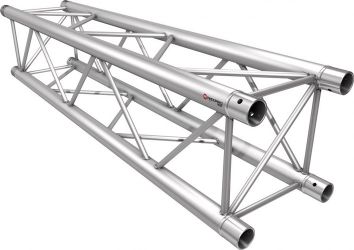
4-Point Trusses

4-Point Trusses – Maximum Stability for Professional Event Construction: 4-point trusses represent the professional standard for demanding stage, exhibition and rigging applications where maximum load capacity and torsional rigidity are essential. With four chord tubes arranged in a square profile, these box truss systems deliver exceptional structural performance for spans up to 20 metres and heavy equipment loads. At LTT, you will find certified Naxpro® truss systems manufactured in Germany, combining...
Read more »
4-Point Trusses
Close window
4-Point Trusses

4-Point Trusses – Maximum Stability for Professional Event Construction

4-point trusses represent the professional standard for demanding stage, exhibition and rigging applications where maximum load capacity and torsional rigidity are essential. With four chord tubes arranged in a square profile, these box truss systems deliver exceptional structural performance for spans up to 20 metres and heavy equipment loads. At LTT, you will find certified Naxpro® truss systems manufactured in Germany, combining precision engineering with outstanding value – your reliable foundation for impressive event constructions that set the scene perfectly.

What Are 4-Point Trusses and How Do They Work?

A 4-point truss – also known as square truss or box truss – is an aluminum structural system featuring four parallel chord tubes connected by diagonal bracing elements. This quadratic cross-section provides significantly higher torsional stiffness and load-bearing capacity compared to 3-point triangular trusses. The four chord tubes distribute forces evenly across all corners, preventing frame distortion even under asymmetric loads.

Typical 4-point truss systems use 50mm diameter chord tubes with wall thicknesses of 2mm (FD series) or 3mm (HD heavy-duty series). The diagonal struts, usually 20mm diameter, create a rigid lattice structure that resists bending and twisting. Modern systems employ conical spigot connectors that slide into the chord tube ends, secured with pins and safety clips for quick, tool-free assembly.

The key advantage over 3-point trusses lies in the additional fourth chord tube, which dramatically increases resistance to torsional forces – critical when hanging lighting rigs, LED walls or speaker arrays that create uneven load distribution. While 3-point trusses excel in lightweight decorative applications, 4-point systems are the professional choice when structural integrity, long spans and heavy loads define your project requirements.

Manufacturers like Naxpro®, Global Truss and Prolyte produce compatible systems based on standardised dimensions, though mixing brands within a single structure is never permitted due to variations in welding tolerances, connector geometry and certified load ratings.

Applications: Where 4-Point Truss Systems Deliver Professional Results

4-point trusses form the structural backbone of professional event production across multiple sectors. In concert and festival staging, they create ground support systems and overhead rigging grids capable of supporting heavy moving-head fixtures, line array speakers and video screens. The square profile allows lighting technicians to mount equipment on all four faces, maximising fixture density whilst maintaining safe working load limits.

Exhibition and trade show construction relies heavily on 4-point systems for building large-format display structures. A typical 6×6 metre exhibition stand frame uses corner blocks and straight sections to create ceiling constructions strong enough to support branding elements, product displays and integrated lighting – all whilst maintaining the clean sightlines that make your brand stand out.

Theatre and fixed installations benefit from the long-term reliability of certified aluminum trussing. Permanent rigging grids in venues, churches and conference centres use 4-point trusses rated to DGUV Vorschrift 17 (formerly BGV C1) standards, ensuring audience safety over decades of service. The modular nature allows facility managers to reconfigure layouts as production requirements evolve.

Ground support towers for mobile DJ setups, corporate events and touring productions combine vertical truss sections with horizontal spans, creating freestanding structures without venue rigging points. Base plates distribute floor loads safely, whilst the inherent stability of the square profile resists wind loading in outdoor applications far better than lighter truss geometries.

Quality Standards and Professional Buying Criteria for 4-Point Trusses

Professional-grade 4-point trusses carry EN 1090 certification, confirming compliance with European structural steelwork standards adapted for aluminum construction. This certification verifies weld quality, material specifications (typically EN-AW 6082 T6 alloy) and manufacturing tolerances – essential documentation for insurance approval and regulatory compliance under DGUV Vorschrift 17.

Working Load Limit (WLL) ratings define safe operating capacities and vary dramatically with span length and load distribution. A Naxpro® FD34 system with 50mm × 2mm chord tubes might safely support 400kg at a 3-metre span but only 150kg when extended to 8 metres – always consult manufacturer load tables before specifying equipment. The FD (standard-duty) series suits most touring and rental applications, whilst HD (heavy-duty) variants with 3mm wall thickness handle extreme loads in permanent installations.

Leading manufacturers including Naxpro®, Global Truss, Prolyte and Eurotruss maintain strict quality control, with TÜV certification and batch traceability. Naxpro® systems manufactured in Germany offer custom RAL powder-coating for architectural integration, whilst maintaining the precision tolerances that ensure connector compatibility across production runs.

Connection systems fall into two categories: quick-connect conical spigots for touring applications requiring fast rigging, and bolted connections for permanent installations demanding maximum joint strength. Quality connectors use hardened steel pins with R-clips or spring-loaded safety mechanisms – never rely on gravity alone to retain structural connections.

Price positioning reflects manufacturing origin and certification depth. Entry-level systems start around €80 per metre for 2-metre FD34 sections, mid-range certified European products range €120–180 per metre, whilst heavy-duty HD series and custom finishes command €200+ per metre. Factor in corner blocks (€150–400), base plates (€60–90) and rigging hardware when budgeting complete systems.

Understanding WLL Calculations and Safe Rigging Practice

Working Load Limit (WLL) represents the maximum safe load a truss section can support under defined conditions, incorporating safety factors typically between 5:1 and 7:1 relative to ultimate breaking strength. Calculating WLL for your specific configuration requires understanding three critical variables: span length, support configuration and load distribution.

Span length dramatically affects capacity – doubling the unsupported distance between support points reduces safe load to roughly one-quarter due to bending moment physics. A 2-metre FD34 section supported at both ends might safely carry 600kg uniformly distributed, but the same section at 4 metres drops to approximately 250kg. Manufacturer load tables provide exact values for standard configurations; never extrapolate beyond published data.

Support configuration matters equally. A truss section supported at both ends (simple span) carries significantly more than the same section cantilevered from a single support point. Ground support systems using vertical towers create simple spans, whilst truss extensions projecting beyond the last support point require careful cantilever calculations and often necessitate counterweighting.

Load distribution distinguishes between uniform loads (weight spread evenly along the truss) and point loads (concentrated equipment masses). Hanging ten 5kg fixtures evenly spaced creates a uniform 50kg load, whilst a single 50kg speaker at mid-span generates higher peak stresses. Point loads require additional safety margin and may necessitate local reinforcement.

DGUV Vorschrift 17 (formerly BGV C1) mandates that rigging calculations be performed by qualified personnel, with documented load plans for events exceeding defined thresholds. Professional riggers use specialised software to model complex structures, but understanding basic WLL principles helps you specify appropriate systems during the planning phase and communicate effectively with structural engineers.

Always apply the 5:1 safety factor as a minimum – if your actual equipment load totals 200kg, your truss system must be rated for at least 1,000kg under the same span and support conditions. This margin accounts for dynamic loads (movement, vibration), material degradation over time and unforeseen stress concentrations.

Naxpro® FD vs HD Series: Choosing the Right Wall Thickness

Naxpro® offers two primary 4-point truss families that share identical external dimensions but differ critically in structural performance. Understanding the FD versus HD distinction helps you specify the optimal solution for your application whilst avoiding over-engineering and unnecessary cost.

The FD series (standard-duty) uses 50mm diameter chord tubes with 2mm wall thickness, creating a versatile system suitable for 80% of professional touring, rental and temporary installation work. FD34 sections (290mm square profile) handle typical lighting rigs, small-to-medium speaker arrays and exhibition structures with excellent strength-to-weight ratio. A 3-metre FD34 section weighs approximately 18kg, making manual handling feasible for two-person crews.

The HD series (heavy-duty) upgrades to 3mm wall thickness whilst maintaining the same 50mm tube diameter and 290mm overall dimensions. This 50% increase in wall thickness delivers roughly 40% higher load capacity and significantly improved resistance to localised stress concentrations. HD systems excel in permanent installations, large-format LED walls, heavy motor rigging and applications where maximum safety margin justifies the weight penalty – a 3-metre HD34 section weighs around 26kg.

Both series use identical conical connectors, corner blocks and accessories, allowing mixed configurations where appropriate – for example, using HD sections for heavily loaded centre spans with FD sections for lightly loaded extensions. However, load calculations must account for the weakest component in the load path.

Price differential typically runs 30–40% between FD and HD series. For a 20-metre ground support system, choosing HD throughout might add €800–1,200 to project cost – worthwhile for permanent installations or extreme load scenarios, but unnecessary for standard mobile applications where FD systems provide ample capacity.

Material specification remains consistent: both series use EN-AW 6082 T6 aluminum alloy, offering excellent corrosion resistance and weldability. The T6 temper designation confirms solution heat treatment and artificial aging, delivering optimal strength properties for structural applications. All Naxpro® systems carry full EN 1090 certification with TÜV approval and comprehensive load documentation.

LTT – Your Specialist for Professional Truss Systems

As both retailer and manufacturer with over 25 years of experience in event technology, LTT combines product expertise with practical rigging knowledge. Our Naxpro® truss systems are manufactured in Germany to the highest quality standards, with every weld inspected and every batch certified. When you choose LTT, you benefit from comprehensive technical support, helping you specify the right system for your specific application – whether that is a touring production, permanent installation or exhibition project.

We maintain extensive stock of FD and HD series components for immediate dispatch, with free shipping on orders over €69 throughout Europe. Our 3-year warranty provides long-term confidence, whilst international shipping capabilities support projects worldwide. For large-scale installations or custom configurations, our engineering team can provide load calculations, CAD drawings and project-specific documentation to support your planning and approval processes.

Discover the complete range of professional rigging hardware and stage construction solutions that complement your truss investment – from certified rigging accessories to complete ground support systems designed to deliver impressive results for your next event.

FAQ – Questions & Answers

Why is the assembly of 4-point truss systems more complex than 3-point systems?

4-point truss assembly requires precise alignment of chord tubes in both horizontal and vertical planes to prevent frame distortion and stress concentrations. Unlike triangular 3-point trusses that are inherently self-aligning, the square geometry of 4-point systems means misalignment at connection points can introduce torsional forces that compromise structural integrity. Each connection uses four conical spigots rather than three, doubling the number of pins and safety clips that must be correctly installed. Professional riggers check alignment visually and by measuring diagonal distances across the square profile – both diagonals must be equal to confirm the frame is square. The additional mass of 4-point sections (typically 18–26kg for a 3-metre length versus 10–14kg for equivalent 3-point truss) also makes handling more physically demanding, often requiring two-person teams for safe installation.

When are 4-point trusses used in exhibition construction?

Exhibition construction employs 4-point trusses when stand designs require large unsupported ceiling spans, heavy branding elements or integrated lighting systems that exceed the capacity of lighter truss geometries. A typical application is a 6×6 metre or larger exhibition stand with a full ceiling structure supporting fabric graphics, product displays and spotlights – loads that commonly total 200–400kg. The square profile allows builders to create clean, architectural frameworks with equipment mounted on all four faces, maximising the usable rigging surface. 4-point systems also provide the torsional rigidity needed when asymmetric loads occur, such as a large LED screen mounted on one side of the stand. For smaller stands under 4×4 metres with minimal overhead load, 3-point trusses often suffice, but professional exhibition contractors default to 4-point construction for stands where structural performance and professional appearance are non-negotiable.

How do I attach lighting or speakers to a 4-point truss system?

Lighting fixtures and speakers attach to 4-point truss systems using specialised rigging clamps that grip the 50mm chord tubes. Half-coupler clamps (also called hook clamps) feature a curved jaw that wraps around the tube, secured by an M12 bolt that tightens against a load-bearing hook. The fixture yoke or speaker bracket then hangs from this hook, with a secondary safety cable mandatory for equipment above audience areas. Clamp capacity must match or exceed fixture weight – typical aluminum half-couplers are rated 100–150kg, whilst heavy-duty steel versions handle 300–500kg. For precise positioning, sliding clamps with adjustable positions along the chord tube offer flexibility, whilst fixed clamps provide maximum security for permanent installations. Always verify that both the clamp WLL and the truss section WLL at that specific point can safely support the equipment load, accounting for dynamic forces during transport and operation. Professional practice requires load documentation showing the cumulative weight and position of all attached equipment relative to the truss support points.

What is the difference between 3-point and 4-point trusses?

3-point trusses use a triangular cross-section with three chord tubes, creating a lightweight structure ideal for decorative applications, small lighting rigs and situations where load requirements are modest. 4-point trusses employ a square cross-section with four chord tubes, delivering significantly higher load capacity and torsional rigidity essential for heavy equipment, long spans and professional staging. The additional fourth chord tube in 4-point systems increases material cost and weight by approximately 40–60% but provides roughly double the load capacity and far superior resistance to twisting forces. Triangular 3-point geometry is inherently stable and self-aligning during assembly, whilst square 4-point frames require careful alignment to prevent distortion. For mobile DJ setups, small events and banner frames, 3-point trusses offer excellent value and easier handling. For concert touring, exhibition stands, permanent installations and any application involving heavy speakers, LED walls or complex rigging, 4-point trusses represent the professional standard that ensures structural safety and long-term reliability.

What does a professional 4-point truss system cost?

Professional 4-point truss pricing varies significantly based on series, certification level and manufacturer origin. Entry-level systems from Asian manufacturers start around €60–80 per metre for 2-metre sections, suitable for light-duty applications but often lacking full EN 1090 certification. Mid-range European systems like Naxpro® FD series typically cost €120–180 per metre with complete certification and TÜV approval, representing the sweet spot for professional touring and rental applications. Heavy-duty HD series with 3mm wall thickness range €180–250 per metre, justified for permanent installations and extreme load scenarios. Beyond straight sections, budget for corner blocks (€150–400 depending on complexity), base plates (€60–90), conical connectors (€8–12 per set) and rigging clamps (€15–40 each). A complete 6×6 metre ground support system with four vertical towers typically totals €2,500–4,500 depending on specification. Custom RAL powder-coating adds approximately 20–30% to base pricing but delivers architectural-quality finishes for permanent installations. At LTT, you will find transparent pricing on certified Naxpro® systems with the technical support needed to specify your project correctly from the start.

Which 4-point truss system should I buy for touring production?

Touring production demands 4-point truss systems that balance load capacity, transport efficiency and rapid assembly. Naxpro® FD34 series with 50mm × 2mm chord tubes represents the industry-standard choice, offering excellent strength-to-weight ratio with full EN 1090 and TÜV certification. The conical spigot connection system allows two-person crews to assemble structures quickly without tools beyond the supplied pins and clips. Prioritise systems with established spare-parts availability and cross-compatibility with rental stock – Global Truss F34, Prolyte H30V and Eurotruss FD34 all share similar dimensions, providing flexibility when augmenting your inventory on location. For transport efficiency, specify 2-metre and 3-metre sections as your standard lengths, supplemented by 1-metre and 0.5-metre sections for fine adjustment. Invest in quality flight cases designed for your specific truss profile, protecting both the aluminum structure and the conical connectors during repeated load-ins. Calculate your maximum span and load requirements, then verify against manufacturer load tables – if you regularly approach capacity limits, consider upgrading to HD series for the additional safety margin. At LTT, our touring specialists can review your typical production requirements and recommend the optimal configuration that balances performance, durability and total cost of ownership.

Are 4-point truss systems from different manufacturers compatible?

4-point truss systems from different manufacturers are never compatible and must never be mixed within a single structure, even when chord tube diameters appear identical. Whilst many systems use 50mm tubes and similar overall dimensions, critical differences exist in diagonal strut positioning, welding tolerances, conical connector taper angles and corner-block geometry. Mixing brands creates misaligned connection points that prevent proper spigot engagement, introducing dangerous stress concentrations and invalidating all load certifications. The structural integrity of a truss system depends on precise load transfer through correctly mated connections – forcing incompatible components together compromises safety and violates DGUV Vorschrift 17 requirements. Professional practice requires complete traceability of all structural components, with documentation proving every element comes from a single certified system. If you need to expand an existing inventory, identify your current manufacturer and purchase identical components, or retire the old system entirely and standardise on a new platform. At LTT, we maintain comprehensive records of Naxpro® system specifications and can verify compatibility for any expansion or replacement project, ensuring your rigging infrastructure remains safe and fully certified.

How do I calculate the safe load capacity for my 4-point truss configuration?

Calculating safe load capacity for 4-point truss configurations requires consulting manufacturer load tables that specify Working Load Limit (WLL) values for your exact span length, support configuration and load distribution. Start by measuring the unsupported span between support points – this distance is the primary variable affecting capacity. Locate your truss model (e.g., Naxpro® FD34) in the manufacturer's documentation and find the WLL value for your span length under the relevant support condition (simple span, cantilever, etc.). This WLL already incorporates a 5:1 safety factor, so your actual equipment load must remain below this published value. For complex configurations involving multiple spans, point loads or cantilevers, professional rigging software or consultation with a qualified structural engineer is mandatory under DGUV Vorschrift 17. Document all equipment weights and positions, sum the total load, then verify this remains within the WLL for every truss section in the load path. Remember that the weakest component determines overall system capacity – a structure is only as strong as its most heavily loaded section. At LTT, our technical team can review your specific configuration and provide guidance on safe loading, helping you achieve impressive results whilst maintaining the highest safety standards for your event production.

Categories
152 Articles
Close filters
 
  •  
from to
1 From 7 pages
No results were found for the filter!
Naxpro Truss Traversen Katalog
Naxpro Truss Catalog
Naxpro Truss catalog The Naxpro Truss catalog provides an overview of all versions of Naxpro Truss trusses and Naxpro Truss rigging accessories. Our new product catalog shows a wide range of...
€5.24 *
incl. tax, plus shipping costs
Availability:
Delivery time: 1-3 days
Naxpro-Truss ST 54 Strecke 200 cm
Naxpro-Truss ST 54 Straight
The TÜV certified massive 4 point truss system Naxpro Truss ST 54 is the ultimate power pack for extreme loads! 51 cm width and a wall thickness of 4 mm make the Naxpro Truss ST 54 the perfect...
from €755.00 *
incl. tax, free shipping to Germany
[International shipping costs]
Availability:
Delivery time: 1-3 days
Naxpro-Truss GS 94 Strecke 200 cm (6,56 ft)
Naxpro-Truss GS 94 Straight
Naxpro-Truss GS 94 Truss System The heavy-duty truss Naxpro-Truss GS 94 offers with a special combination of an extra strong connection system and a massive tube a maximum of load options. GS...
from €1,565.00 *
incl. tax, plus forwarding agency costs
Availability:
Delivery time: approx. 2-3 weeks

Bulky goods

  • Alu
  • Black
Naxpro-Truss LXD 340 Strecke 200cm - H90
Naxpro-Truss LXD 340 Straight - H90
LXD Truss – Maximum flexibility for every application The LXD truss sets new standards in terms of versatility and load capacity. Developed for the most demanding requirements, it enables...
from €699.00 *
incl. tax, plus forwarding agency costs
Availability:
Delivery time: 1-3 days

Bulky goods

  • Alu
  • Black
Naxpro-Truss FD 14 Strecke 200 cm
Naxpro-Truss FD 14 Straight
Naxpro FD 14 Truss System Small TÜV certified truss system in 4-point design: Due to its minimized design this small truss system might be used perfectly in the domestic environment. You...
from €109.00 *
incl. tax, free shipping to Germany
[International shipping costs]
Availability:
Delivery time: 1-3 days
Naxpro-Truss XD 340 Strecke 200 cm - D45
Naxpro-Truss XD 340 section - D45
The TÜV-certified rectangular Naxpro Truss XD 340 truss system combines the compact width of a 30 mm truss with the high load capacity of a 40 mm system. Thanks to its space-saving dimensions,...
from €335.00 *
incl. tax, plus forwarding agency costs
Availability:
Delivery time: approx. 2-3 weeks

Bulky goods

Naxpro-Truss GD 44 Strecke 200 cm
Naxpro-Truss GD 44 Straight
Naxpro Truss GD 44 is a TÜV certified high performance 4 point truss system, which was specially developed for high loads. Through concerted optimization adverse to the standard 40´s...
from €375.00 *
incl. tax, plus forwarding agency costs
Availability:
Delivery time: approx. 2-3 weeks

Bulky goods

Naxpro-Truss GS 64 Strecke 8 ft (243,84 cm)
Naxpro-Truss GS 64 Straight
Naxpro-Truss GS 64 Truss System The TÜV certified heavy-duty truss Naxpro-Truss GS 64 offers with a special combination of an extra strong connection system and a massive tube a maximum of...
from €1,075.00 *
incl. tax, plus forwarding agency costs
Availability:
Low stock; Delivery time: 1-3 days
Delivery time: 1-3 days

Bulky goods

Naxpro-Truss XD 340 Strecke 200 cm - H90
Naxpro-Truss XD 340 section - H90
The TÜV-certified rectangular Naxpro Truss XD 340 truss system combines the compact width of a 30 mm truss with the high load capacity of a 40 mm system. Thus, Naxpro Truss XD 340 creates a...
from €335.00 *
incl. tax, plus forwarding agency costs
Availability:
Delivery time: 1-3 days

Bulky goods

  • Alu
  • Black
Naxpro-Truss FD 34 Strecke 200 cm
Naxpro-Truss FD 34 Straight
Naxpro FD 34 Truss System TÜV certified truss system in 4-point design, especially suitable for exhibition stand and store construction, event technology, as well as a load bearing system for...
€131.50 * from €115.00 *
incl. tax, free shipping to Germany
[International shipping costs]
Availability:
Delivery time: 1-3 days
  • Alu
  • Black
Naxpro-Truss FD 24 Strecke 200 cm
Naxpro-Truss FD 24 Straight
Naxpro FD 24 Truss System TÜV certified truss system in 4-point design, which finds in spite of his low tubediameter of only 35 mm professional use in exhibition stand and store...
€129.00 * from €89.00 *
incl. tax, free shipping to Germany
[International shipping costs]
Availability:
Delivery time: 1-3 days
Naxpro-Truss FD 44 Strecke 200 cm
Naxpro-Truss FD 44 Straight
Naxpro FD 44 Truss System TÜV certified truss system in 4-point design, especially suitable for exhibition stand and store construction, event technology, as well as a load bearing system...
€215.00 * from €185.00 *
incl. tax, plus forwarding agency costs
Availability:
Delivery time: 1-3 days

Bulky goods

Naxpro-Truss HD 34 Strecke 200 cm
Naxpro-Truss HD 34 Straight
Naxpro HD 34 Truss System TÜV certified truss system in 4-point heavy duty design, especially suitable for exhibition stand and store construction, event technology, as well as a load...
from €147.50 *
incl. tax, free shipping to Germany
[International shipping costs]
Availability:
Delivery time: 3-5 days
Naxpro-Truss HD 44 Strecke 200 cm
Naxpro-Truss HD 44 Straight
Naxpro HD 44 Truss System TÜV certified truss system in 4-point heavy duty design, especially suitable for exhibition stand and store construction, event technology, as well as a load...
€209.00 * from €175.00 *
incl. tax, plus forwarding agency costs
Availability:
Low stock; Delivery time: 1-3 days
Delivery time: 1-3 days

Bulky goods

Naxpro-Truss GS 34 Strecke 8 ft (243,84 cm)
Naxpro-Truss GS 34 Straight
Naxpro-Truss GS 34 Truss System The heavy-duty TÜV certified truss Naxpro-Truss GS 34 offers a perfect combination of compact size and high load possibilities. GS stands for Gabelsystem (fork...
from €809.00 *
incl. tax, plus forwarding agency costs
Availability:
Low stock; Delivery time: 1-3 days
Delivery time: 1-3 days

Bulky goods

Naxpro-Truss GS 64  C21 90° 2 Weg Winkel Block
Naxpro-Truss GS 64 C21 90° 2 Way Corner Block
Naxpro-Truss GS 64 Truss System The heavy-duty truss Naxpro-Truss GS 64 offers with a special combination of an extra strong connection system and a massive tube a maximum of load options. GS...
€1,215.00 *
incl. tax, free shipping to Germany
[International shipping costs]
Availability:
Delivery time: approx. 2-3 weeks
Naxpro-Truss FD 14 Boxcorner mit 8 Halbverbinder
Naxpro-Truss FD 14 Boxcorner incl. 8 connectors
Naxpro FD 14 Truss System Small truss system in 4-point design: Due to its minimized design this small truss system might be used perfectly in the domestic environment. You are able to create...
€185.00 *
incl. tax, free shipping to Germany
[International shipping costs]
Availability:
Delivery time: 1-3 days
Naxpro-Truss GS 64  C35 3 Weg Winkel Block
Naxpro-Truss GS 64 C35 3 Way Corner Block
Naxpro-Truss GS 64 Truss System The heavy-duty truss Naxpro-Truss GS 64 offers with a special combination of an extra strong connection system and a massive tube a maximum of load options. GS...
€989.00 *
incl. tax, free shipping to Germany
[International shipping costs]
Availability:
Delivery time: approx. 2-3 weeks
Naxpro-Truss GS 94 Boxcorner
Naxpro-Truss GS 94 Truss System The heavy-duty truss Naxpro-Truss GS 94 offers with a special combination of an extra strong connection system and a massive tube a maximum of load options. GS...
€2,499.00 *
incl. tax, free shipping to Germany
[International shipping costs]
Availability:
Delivery time: approx. 2-3 weeks
Naxpro-Truss FD 14 Bodenplatte
Naxpro-Truss FD 14 Truss Base Plate
Naxpro FD 14 truss system Small truss system in a 4-point design, which is particularly well suited for use in the home thanks to its miniature design. It can be used to construct frames for...
€47.00 * €39.90 *
incl. tax, plus shipping costs
Availability:
Delivery time: 1-3 days
Naxpro-Truss GS 64  C36 3 Weg Winkel Block
Naxpro-Truss GS 64 C36 3 Way Corner Block
Naxpro-Truss GS 64 Truss System The heavy-duty truss Naxpro-Truss GS 64 offers with a special combination of an extra strong connection system and a massive tube a maximum of load options. GS...
€989.00 *
incl. tax, free shipping to Germany
[International shipping costs]
Availability:
Delivery time: approx. 2-3 weeks
Naxpro-Truss FD 14 Halbverbinder für Boxcorner
Naxpro-Truss FD 14 half connector for boxcorner
Naxpro FD 14 Truss System Small truss system in 4-point design: Due to its minimized design this small truss system might be used perfectly in the domestic environment. You are able to create...
€7.00 *
incl. tax, plus shipping costs
Availability:
Delivery time: 1-3 days
Naxpro-Truss GS 34 Boxcorner
Naxpro-Truss GS 34 Truss System The heavy-duty truss Naxpro-Truss GS 34 offers a perfect combination of compact size and high load possibilities. GS stands for Gabelsystem (fork system) and offers...
€949.00 *
incl. tax, free shipping to Germany
[International shipping costs]
Availability:
Delivery time: approx. 2-3 weeks
Naxpro-Truss FD 14 Verbinderset 4xKonus, 8xBolzen, 8xSplint
Naxpro-Truss FD 14 Connector set 4x cone, 8x bolt, 8x r-clip
Naxpro FD 14 Truss System Small truss system in 4-point design: Due to its minimized design this small truss system might be used perfectly in the domestic environment. You are able to create...
€12.25 *
incl. tax, plus shipping costs
Availability:
Delivery time: 1-3 days
1 From 7 pages
Facts
4-Point Trusses – Maximum Stability for Professional Event Construction: 4-point trusses represent the professional standard for demanding stage, exhibition and rigging applications where maximum load capacity and torsional rigidity are essential. With four chord tubes arranged in a square profile, these box truss systems deliver exceptional structural performance for spans up to 20 metres and heavy equipment loads. At LTT, you will find... Read more »
Viewed
Facts

4-Point Trusses – Maximum Stability for Professional Event Construction

4-point trusses represent the professional standard for demanding stage, exhibition and rigging applications where maximum load capacity and torsional rigidity are essential. With four chord tubes arranged in a square profile, these box truss systems deliver exceptional structural performance for spans up to 20 metres and heavy equipment loads. At LTT, you will find certified Naxpro® truss systems manufactured in Germany, combining precision engineering with outstanding value – your reliable foundation for impressive event constructions that set the scene perfectly.

What Are 4-Point Trusses and How Do They Work?

A 4-point truss – also known as square truss or box truss – is an aluminum structural system featuring four parallel chord tubes connected by diagonal bracing elements. This quadratic cross-section provides significantly higher torsional stiffness and load-bearing capacity compared to 3-point triangular trusses. The four chord tubes distribute forces evenly across all corners, preventing frame distortion even under asymmetric loads.

Typical 4-point truss systems use 50mm diameter chord tubes with wall thicknesses of 2mm (FD series) or 3mm (HD heavy-duty series). The diagonal struts, usually 20mm diameter, create a rigid lattice structure that resists bending and twisting. Modern systems employ conical spigot connectors that slide into the chord tube ends, secured with pins and safety clips for quick, tool-free assembly.

The key advantage over 3-point trusses lies in the additional fourth chord tube, which dramatically increases resistance to torsional forces – critical when hanging lighting rigs, LED walls or speaker arrays that create uneven load distribution. While 3-point trusses excel in lightweight decorative applications, 4-point systems are the professional choice when structural integrity, long spans and heavy loads define your project requirements.

Manufacturers like Naxpro®, Global Truss and Prolyte produce compatible systems based on standardised dimensions, though mixing brands within a single structure is never permitted due to variations in welding tolerances, connector geometry and certified load ratings.

Applications: Where 4-Point Truss Systems Deliver Professional Results

4-point trusses form the structural backbone of professional event production across multiple sectors. In concert and festival staging, they create ground support systems and overhead rigging grids capable of supporting heavy moving-head fixtures, line array speakers and video screens. The square profile allows lighting technicians to mount equipment on all four faces, maximising fixture density whilst maintaining safe working load limits.

Exhibition and trade show construction relies heavily on 4-point systems for building large-format display structures. A typical 6×6 metre exhibition stand frame uses corner blocks and straight sections to create ceiling constructions strong enough to support branding elements, product displays and integrated lighting – all whilst maintaining the clean sightlines that make your brand stand out.

Theatre and fixed installations benefit from the long-term reliability of certified aluminum trussing. Permanent rigging grids in venues, churches and conference centres use 4-point trusses rated to DGUV Vorschrift 17 (formerly BGV C1) standards, ensuring audience safety over decades of service. The modular nature allows facility managers to reconfigure layouts as production requirements evolve.

Ground support towers for mobile DJ setups, corporate events and touring productions combine vertical truss sections with horizontal spans, creating freestanding structures without venue rigging points. Base plates distribute floor loads safely, whilst the inherent stability of the square profile resists wind loading in outdoor applications far better than lighter truss geometries.

Quality Standards and Professional Buying Criteria for 4-Point Trusses

Professional-grade 4-point trusses carry EN 1090 certification, confirming compliance with European structural steelwork standards adapted for aluminum construction. This certification verifies weld quality, material specifications (typically EN-AW 6082 T6 alloy) and manufacturing tolerances – essential documentation for insurance approval and regulatory compliance under DGUV Vorschrift 17.

Working Load Limit (WLL) ratings define safe operating capacities and vary dramatically with span length and load distribution. A Naxpro® FD34 system with 50mm × 2mm chord tubes might safely support 400kg at a 3-metre span but only 150kg when extended to 8 metres – always consult manufacturer load tables before specifying equipment. The FD (standard-duty) series suits most touring and rental applications, whilst HD (heavy-duty) variants with 3mm wall thickness handle extreme loads in permanent installations.

Leading manufacturers including Naxpro®, Global Truss, Prolyte and Eurotruss maintain strict quality control, with TÜV certification and batch traceability. Naxpro® systems manufactured in Germany offer custom RAL powder-coating for architectural integration, whilst maintaining the precision tolerances that ensure connector compatibility across production runs.

Connection systems fall into two categories: quick-connect conical spigots for touring applications requiring fast rigging, and bolted connections for permanent installations demanding maximum joint strength. Quality connectors use hardened steel pins with R-clips or spring-loaded safety mechanisms – never rely on gravity alone to retain structural connections.

Price positioning reflects manufacturing origin and certification depth. Entry-level systems start around €80 per metre for 2-metre FD34 sections, mid-range certified European products range €120–180 per metre, whilst heavy-duty HD series and custom finishes command €200+ per metre. Factor in corner blocks (€150–400), base plates (€60–90) and rigging hardware when budgeting complete systems.

Understanding WLL Calculations and Safe Rigging Practice

Working Load Limit (WLL) represents the maximum safe load a truss section can support under defined conditions, incorporating safety factors typically between 5:1 and 7:1 relative to ultimate breaking strength. Calculating WLL for your specific configuration requires understanding three critical variables: span length, support configuration and load distribution.

Span length dramatically affects capacity – doubling the unsupported distance between support points reduces safe load to roughly one-quarter due to bending moment physics. A 2-metre FD34 section supported at both ends might safely carry 600kg uniformly distributed, but the same section at 4 metres drops to approximately 250kg. Manufacturer load tables provide exact values for standard configurations; never extrapolate beyond published data.

Support configuration matters equally. A truss section supported at both ends (simple span) carries significantly more than the same section cantilevered from a single support point. Ground support systems using vertical towers create simple spans, whilst truss extensions projecting beyond the last support point require careful cantilever calculations and often necessitate counterweighting.

Load distribution distinguishes between uniform loads (weight spread evenly along the truss) and point loads (concentrated equipment masses). Hanging ten 5kg fixtures evenly spaced creates a uniform 50kg load, whilst a single 50kg speaker at mid-span generates higher peak stresses. Point loads require additional safety margin and may necessitate local reinforcement.

DGUV Vorschrift 17 (formerly BGV C1) mandates that rigging calculations be performed by qualified personnel, with documented load plans for events exceeding defined thresholds. Professional riggers use specialised software to model complex structures, but understanding basic WLL principles helps you specify appropriate systems during the planning phase and communicate effectively with structural engineers.

Always apply the 5:1 safety factor as a minimum – if your actual equipment load totals 200kg, your truss system must be rated for at least 1,000kg under the same span and support conditions. This margin accounts for dynamic loads (movement, vibration), material degradation over time and unforeseen stress concentrations.

Naxpro® FD vs HD Series: Choosing the Right Wall Thickness

Naxpro® offers two primary 4-point truss families that share identical external dimensions but differ critically in structural performance. Understanding the FD versus HD distinction helps you specify the optimal solution for your application whilst avoiding over-engineering and unnecessary cost.

The FD series (standard-duty) uses 50mm diameter chord tubes with 2mm wall thickness, creating a versatile system suitable for 80% of professional touring, rental and temporary installation work. FD34 sections (290mm square profile) handle typical lighting rigs, small-to-medium speaker arrays and exhibition structures with excellent strength-to-weight ratio. A 3-metre FD34 section weighs approximately 18kg, making manual handling feasible for two-person crews.

The HD series (heavy-duty) upgrades to 3mm wall thickness whilst maintaining the same 50mm tube diameter and 290mm overall dimensions. This 50% increase in wall thickness delivers roughly 40% higher load capacity and significantly improved resistance to localised stress concentrations. HD systems excel in permanent installations, large-format LED walls, heavy motor rigging and applications where maximum safety margin justifies the weight penalty – a 3-metre HD34 section weighs around 26kg.

Both series use identical conical connectors, corner blocks and accessories, allowing mixed configurations where appropriate – for example, using HD sections for heavily loaded centre spans with FD sections for lightly loaded extensions. However, load calculations must account for the weakest component in the load path.

Price differential typically runs 30–40% between FD and HD series. For a 20-metre ground support system, choosing HD throughout might add €800–1,200 to project cost – worthwhile for permanent installations or extreme load scenarios, but unnecessary for standard mobile applications where FD systems provide ample capacity.

Material specification remains consistent: both series use EN-AW 6082 T6 aluminum alloy, offering excellent corrosion resistance and weldability. The T6 temper designation confirms solution heat treatment and artificial aging, delivering optimal strength properties for structural applications. All Naxpro® systems carry full EN 1090 certification with TÜV approval and comprehensive load documentation.

LTT – Your Specialist for Professional Truss Systems

As both retailer and manufacturer with over 25 years of experience in event technology, LTT combines product expertise with practical rigging knowledge. Our Naxpro® truss systems are manufactured in Germany to the highest quality standards, with every weld inspected and every batch certified. When you choose LTT, you benefit from comprehensive technical support, helping you specify the right system for your specific application – whether that is a touring production, permanent installation or exhibition project.

We maintain extensive stock of FD and HD series components for immediate dispatch, with free shipping on orders over €69 throughout Europe. Our 3-year warranty provides long-term confidence, whilst international shipping capabilities support projects worldwide. For large-scale installations or custom configurations, our engineering team can provide load calculations, CAD drawings and project-specific documentation to support your planning and approval processes.

Discover the complete range of professional rigging hardware and stage construction solutions that complement your truss investment – from certified rigging accessories to complete ground support systems designed to deliver impressive results for your next event.

FAQ – Questions & Answers

Why is the assembly of 4-point truss systems more complex than 3-point systems?

4-point truss assembly requires precise alignment of chord tubes in both horizontal and vertical planes to prevent frame distortion and stress concentrations. Unlike triangular 3-point trusses that are inherently self-aligning, the square geometry of 4-point systems means misalignment at connection points can introduce torsional forces that compromise structural integrity. Each connection uses four conical spigots rather than three, doubling the number of pins and safety clips that must be correctly installed. Professional riggers check alignment visually and by measuring diagonal distances across the square profile – both diagonals must be equal to confirm the frame is square. The additional mass of 4-point sections (typically 18–26kg for a 3-metre length versus 10–14kg for equivalent 3-point truss) also makes handling more physically demanding, often requiring two-person teams for safe installation.

When are 4-point trusses used in exhibition construction?

Exhibition construction employs 4-point trusses when stand designs require large unsupported ceiling spans, heavy branding elements or integrated lighting systems that exceed the capacity of lighter truss geometries. A typical application is a 6×6 metre or larger exhibition stand with a full ceiling structure supporting fabric graphics, product displays and spotlights – loads that commonly total 200–400kg. The square profile allows builders to create clean, architectural frameworks with equipment mounted on all four faces, maximising the usable rigging surface. 4-point systems also provide the torsional rigidity needed when asymmetric loads occur, such as a large LED screen mounted on one side of the stand. For smaller stands under 4×4 metres with minimal overhead load, 3-point trusses often suffice, but professional exhibition contractors default to 4-point construction for stands where structural performance and professional appearance are non-negotiable.

How do I attach lighting or speakers to a 4-point truss system?

Lighting fixtures and speakers attach to 4-point truss systems using specialised rigging clamps that grip the 50mm chord tubes. Half-coupler clamps (also called hook clamps) feature a curved jaw that wraps around the tube, secured by an M12 bolt that tightens against a load-bearing hook. The fixture yoke or speaker bracket then hangs from this hook, with a secondary safety cable mandatory for equipment above audience areas. Clamp capacity must match or exceed fixture weight – typical aluminum half-couplers are rated 100–150kg, whilst heavy-duty steel versions handle 300–500kg. For precise positioning, sliding clamps with adjustable positions along the chord tube offer flexibility, whilst fixed clamps provide maximum security for permanent installations. Always verify that both the clamp WLL and the truss section WLL at that specific point can safely support the equipment load, accounting for dynamic forces during transport and operation. Professional practice requires load documentation showing the cumulative weight and position of all attached equipment relative to the truss support points.

What is the difference between 3-point and 4-point trusses?

3-point trusses use a triangular cross-section with three chord tubes, creating a lightweight structure ideal for decorative applications, small lighting rigs and situations where load requirements are modest. 4-point trusses employ a square cross-section with four chord tubes, delivering significantly higher load capacity and torsional rigidity essential for heavy equipment, long spans and professional staging. The additional fourth chord tube in 4-point systems increases material cost and weight by approximately 40–60% but provides roughly double the load capacity and far superior resistance to twisting forces. Triangular 3-point geometry is inherently stable and self-aligning during assembly, whilst square 4-point frames require careful alignment to prevent distortion. For mobile DJ setups, small events and banner frames, 3-point trusses offer excellent value and easier handling. For concert touring, exhibition stands, permanent installations and any application involving heavy speakers, LED walls or complex rigging, 4-point trusses represent the professional standard that ensures structural safety and long-term reliability.

What does a professional 4-point truss system cost?

Professional 4-point truss pricing varies significantly based on series, certification level and manufacturer origin. Entry-level systems from Asian manufacturers start around €60–80 per metre for 2-metre sections, suitable for light-duty applications but often lacking full EN 1090 certification. Mid-range European systems like Naxpro® FD series typically cost €120–180 per metre with complete certification and TÜV approval, representing the sweet spot for professional touring and rental applications. Heavy-duty HD series with 3mm wall thickness range €180–250 per metre, justified for permanent installations and extreme load scenarios. Beyond straight sections, budget for corner blocks (€150–400 depending on complexity), base plates (€60–90), conical connectors (€8–12 per set) and rigging clamps (€15–40 each). A complete 6×6 metre ground support system with four vertical towers typically totals €2,500–4,500 depending on specification. Custom RAL powder-coating adds approximately 20–30% to base pricing but delivers architectural-quality finishes for permanent installations. At LTT, you will find transparent pricing on certified Naxpro® systems with the technical support needed to specify your project correctly from the start.

Which 4-point truss system should I buy for touring production?

Touring production demands 4-point truss systems that balance load capacity, transport efficiency and rapid assembly. Naxpro® FD34 series with 50mm × 2mm chord tubes represents the industry-standard choice, offering excellent strength-to-weight ratio with full EN 1090 and TÜV certification. The conical spigot connection system allows two-person crews to assemble structures quickly without tools beyond the supplied pins and clips. Prioritise systems with established spare-parts availability and cross-compatibility with rental stock – Global Truss F34, Prolyte H30V and Eurotruss FD34 all share similar dimensions, providing flexibility when augmenting your inventory on location. For transport efficiency, specify 2-metre and 3-metre sections as your standard lengths, supplemented by 1-metre and 0.5-metre sections for fine adjustment. Invest in quality flight cases designed for your specific truss profile, protecting both the aluminum structure and the conical connectors during repeated load-ins. Calculate your maximum span and load requirements, then verify against manufacturer load tables – if you regularly approach capacity limits, consider upgrading to HD series for the additional safety margin. At LTT, our touring specialists can review your typical production requirements and recommend the optimal configuration that balances performance, durability and total cost of ownership.

Are 4-point truss systems from different manufacturers compatible?

4-point truss systems from different manufacturers are never compatible and must never be mixed within a single structure, even when chord tube diameters appear identical. Whilst many systems use 50mm tubes and similar overall dimensions, critical differences exist in diagonal strut positioning, welding tolerances, conical connector taper angles and corner-block geometry. Mixing brands creates misaligned connection points that prevent proper spigot engagement, introducing dangerous stress concentrations and invalidating all load certifications. The structural integrity of a truss system depends on precise load transfer through correctly mated connections – forcing incompatible components together compromises safety and violates DGUV Vorschrift 17 requirements. Professional practice requires complete traceability of all structural components, with documentation proving every element comes from a single certified system. If you need to expand an existing inventory, identify your current manufacturer and purchase identical components, or retire the old system entirely and standardise on a new platform. At LTT, we maintain comprehensive records of Naxpro® system specifications and can verify compatibility for any expansion or replacement project, ensuring your rigging infrastructure remains safe and fully certified.

How do I calculate the safe load capacity for my 4-point truss configuration?

Calculating safe load capacity for 4-point truss configurations requires consulting manufacturer load tables that specify Working Load Limit (WLL) values for your exact span length, support configuration and load distribution. Start by measuring the unsupported span between support points – this distance is the primary variable affecting capacity. Locate your truss model (e.g., Naxpro® FD34) in the manufacturer's documentation and find the WLL value for your span length under the relevant support condition (simple span, cantilever, etc.). This WLL already incorporates a 5:1 safety factor, so your actual equipment load must remain below this published value. For complex configurations involving multiple spans, point loads or cantilevers, professional rigging software or consultation with a qualified structural engineer is mandatory under DGUV Vorschrift 17. Document all equipment weights and positions, sum the total load, then verify this remains within the WLL for every truss section in the load path. Remember that the weakest component determines overall system capacity – a structure is only as strong as its most heavily loaded section. At LTT, our technical team can review your specific configuration and provide guidance on safe loading, helping you achieve impressive results whilst maintaining the highest safety standards for your event production.

// Countdown for Black Deals