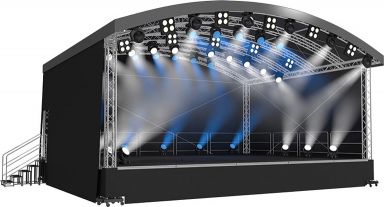
Arched roof stages
Round-Arch Roof Stages: Create Space and Impact Above Your Stage
Round-arch roof stages are simply impressive. When you want to address a large audience or stage a truly spectacular show, this stage shape is the right choice. Whether an open-air concert, a city festival or a major trade fair event — beneath a round-arch roof you gain generous headroom above your performers for lighting, sound and effect equipment.
As your specialist for event technology, LTT delivers Naxpro-Truss round-arch stages that combine elegant lines with genuine engineering. You get weather protection, high rigging capacity and modular expandability in one proven system — everything you need to put your event in the spotlight.
What Is a Round-Arch Roof Stage? Fundamentals and Function
A round-arch roof stage is a temporary stage structure whose roof is shaped as a curved arch rather than a flat or gabled surface. The arch is formed from four-point trusses (four-chord aluminium girders) that have been bent into circle segments and span across the stage area. Beneath this dome, artists, technology and decoration find a spacious, protected working zone.
The round-arch roof stage differs clearly from adjacent stage types. Unlike a flat roof stage, whose horizontal surface must actively channel rain and collects wind pressure, the arched dome deflects wind up and over the structure while draining rain in a controlled way to both sides. Unlike a gable (pitched) roof stage, the round-arch shape is the most spacious and most elegant of all stage roofs, offering an unobstructed view onto the stage right up to the back rows.
The roof is typically covered with a white PVC tarpaulin, while the sides and rear can be dressed with gauze sets (scrim) for a clean, professional look. The curved geometry also improves acoustics under the roof and gives lighting effects an ideal surface to work against. Because the whole structure is built from standardised Naxpro-Truss components, it is scalable, reusable and fully compatible with the wider truss system — a genuine professional solution for demanding event technicians.
Applications: Where Round-Arch Roof Stages Are Used
Round-arch roof stages are at home wherever a large audience meets a professional show. Typical applications include:
- Festivals and open-air concerts — generous headroom for a full lighting and sound rig
- City festivals (Stadtfeste) and public events — a representative, eye-catching stage silhouette
- Trade fair events and product presentations — a spacious stand stage with room for screens and branding
- Theatre, church and cultural events — protected performance area indoors and outdoors
- Rallies, ceremonies and corporate shows — reliable weather protection for people and technology
Because the roof deflects wind and drains rain to the sides, a round-arch roof stage is equally suited to demanding outdoor use and controlled indoor environments. You can dress the trusses with lighting, sound and effect equipment to achieve genuinely impressive results and give every performance a real wow effect.
Types and Variants of Round-Arch Roof Stages
Round-arch roof stages come in several sizes and configurations, so you can match the structure to your stage area, planned rigging load and audience size. The main variants scale from compact club stages up to large festival main stages.
Common model sizes
- RD 3020 — for stages up to 3 x 2 m, external dimensions approx. 3.11 x 2.6 x 3.0 m (L x W x H)
- RD 4030 — for stages up to 4 x 3 m, external dimensions approx. 5.25 x 3.6 x 3.39 m
- RD 6040 — for stages up to 6 x 4 m, external dimensions approx. 7.21 x 4.59 x 3.97 m
- RD 8060 — for large stages up to 8 x 6 m
- AR10 — a large-format round-arch stage, external dimensions approx. 10 x 8 x 4.88 m with a playing area of around 9 x 8 m and a maximum load of roughly 900–1200 kg depending on the configuration
Many variants offer a flexible, adjustable height so you can raise the eaves and ridge for a taller rig. Thanks to the modular Naxpro-Truss principle, a larger round-arch roof set can also be reduced to build the smaller sizes — an efficient choice for rental companies and touring users who want maximum flexibility from a single stock of components.
Construction and Truss Technology: Four-Point Trusses and Arched Segments
The engineering heart of every round-arch roof stage is its truss construction. Straight and curved four-point trusses (four-chord girders) are combined into circle segments that form the arch. These segments interlock via cone connections or half-cone connections, creating a stiff, self-supporting dome above a stable base frame.
Why modularity matters
Because the round-arch roof stage is built entirely from standardised Naxpro-Truss components, you gain several practical advantages:
- Scalability — combine additional trusses to reach the exact stage size you need, or reduce a large set to a smaller footprint
- Cross-compatibility — standard parts can be reused in other truss builds, so no special one-off fabrication is required
- Expandability — add podiums, side coverings, ballast points or extra height at any time
- Reusability — assemble and dismantle repeatedly for touring and rental fleets
Fast and safe assembly
Don't let the impressive shape intimidate you. The perfectly interlocking components are joined into a stable base structure with little tooling. With well-drilled crews and pre-sorted parts, a round-arch roof stage goes up quickly and safely — and the accompanying assembly instructions detail set-up, structural values and safe operation. This modular, aluminium-truss approach is exactly why professionals rely on the round-arch roof stage as their optimal solution for scalable stage building.
Technical Buying Criteria and Truss Material Specifications
For professional buyers, the round-arch roof stage stands or falls on its truss profiles. LTT builds and supplies Naxpro-Truss systems with clearly defined tube geometries, so you can size your stage against real load requirements rather than vague promises.
Naxpro-Truss profile specifications
The GS94 series additionally uses diagonal bracing tubes of 40 x 3 mm for maximum rigidity on large-span structures.
What to check before you buy
- Stage area — from around 3 x 2 m up to 8 x 6 m and beyond
- Roof load / rigging capacity — large formats such as the AR10 reach roughly 900–1200 kg total depending on the build
- Height — many models offer adjustable eaves and ridge height
- Roof cover — white PVC tarpaulin, with gauze/scrim sets for the sides and rear
- Certified aluminium — high-grade alloys from certified production
Match the truss series to your planned load reserve: choose HD31-44 or GS94 when you intend to hang a heavy lighting and sound rig, and keep a safety margin above your calculated distributed load.
Buying Guide: Choosing the Right Round-Arch Roof Stage
A structured buying guide saves you time and money. Work through these steps to select the round-arch roof stage that truly fits your event.
- Define your stage area — how many performers, instruments and backline need space? A 4 x 3 m footprint suits a club band; 8 x 6 m or larger suits a festival main stage.
- Estimate your rigging load — add up the weight of moving heads, wash lights, LED bars, line-array or point-source speakers and effect machines. This determines whether an FD31-44, HD31-44 or GS94-based roof is right.
- Add a load reserve — never plan to the maximum. Keep a comfortable safety margin above your calculated distributed roof load.
- Match the height — allow enough clearance for hanging fixtures, sightlines and any video screens above the performers.
- Consider outdoor demands — for open-air use, plan for wind load, ballast weights or ground stakes from the outset.
- Check structural proof — for permanent-looking outdoor builds in Germany, a proof of structural stability (Prüfstatik) is expected.
As a specialist and reliable partner, LTT helps you translate audience size and show concept into the correct model — so you invest in exactly the right round-arch roof stage rather than an over- or under-sized structure.
Comparison: Round-Arch vs. Flat and Gable Stage Roofs
Choosing the right roof shape is the biggest single decision in stage building. The comparison below shows how the round-arch roof stage differs from flat and gable (pitched) roof stages, so you can match the shape to your event.
In short: the round-arch roof stage is the most spacious and most elegant of the three shapes, making it the optimal solution for large audiences and demanding show productions. Flat roof stages suit compact or indoor set-ups, while gable roofs offer a classic look for mid-size events. If maximum headroom, weather deflection and a representative silhouette matter to you, the round-arch roof is the clear winner.
Safety, Standards and Structural Proof (DGUV V17, EN 1090, TÜV SÜD)
Stage roofs are load-bearing temporary structures, so safety and compliance are non-negotiable for professional buyers. Naxpro-Truss round-arch roof stages are engineered to meet the relevant requirements.
Relevant standards
- EN 1090 — the current standard for the execution of aluminium structures (formerly DIN 4113). LTT's high-grade aluminium alloys come from certified production and comply with this norm.
- DGUV Regulation 17 (formerly BGV C1) — the German accident-prevention rules for event and production venues, which govern the safe erection and operation of stage constructions.
- TÜV SÜD-inspected builds — Naxpro-Truss stages are structurally verified, TÜV-inspected temporary structures for maximum safety at your events.
Structural proof (Prüfstatik)
In Germany, roof constructions in stage building generally require a proof of structural stability (Prüfstatik) that documents the load-bearing capacity of the assembled structure. This proof is available as an option, so you can demonstrate compliance to inspectors without commissioning a separate external structural engineer.
The trusses are welded by hand exclusively by trained specialists — the guarantee of high load capacity in every single component. For a professional application, always follow the assembly instructions, respect the stated load limits and keep the structural documentation on site.
Setup, Weather Protection and Outdoor Operation (Wind Load and Ballast)
One of the strongest arguments for a round-arch roof stage is genuine weather protection. Does the round-arch roof protect against rain, wind and sun? Yes — a tarpaulin-covered arch shields sensitive technology and everyone on stage from rain, wind and sun. The dome-like shape guides wind up and over the structure, while rain drains in a controlled way to both sides.
Safe outdoor operation
Outdoor use demands a clear plan for wind load and ballasting:
- Ballast and ground fixing — secure the base frame with sufficient ballast weights, water tanks or ground stakes (Erdnägel) according to the manufacturer's specification and the local ground conditions.
- Guy-wires — use guying where required to stabilise taller builds.
- Wind monitoring — define wind-speed thresholds in advance. When limits are reached, reduce the sail area, remove side tarpaulins or lower and secure the structure.
- Roof tarpaulin management — an open or partially opened roof reduces wind attack in strong gusts.
Fast assembly
Thanks to precisely interlocking components, a round-arch roof stage is quick to erect with little tooling on a stable base frame. Always follow the assembly instructions for the correct sequence, and never operate a stage roof outside its documented load and wind limits.
Accessories: Tarpaulins, Gauze Sets, Podiums and Rigging
A round-arch roof stage reaches its full potential with the right accessories. Note that items such as stairs and lighting are often not included in a basic roof set, so plan your accessory list carefully.
Typical accessories and extensions
- PVC roof tarpaulins — the white weather-protection cover for the arch
- Gauze / scrim sets — for a clean look on the sides and rear
- Ground stakes (Erdnägel) and ballast weights — for safe outdoor fixing
- Stage podiums and platforms — to create a raised, level performance floor
- Stairs and railings — for safe access and fall protection
- Rigging accessories — clamps, hoists and safety cables to hang lighting and sound equipment
- Assembly tools — the correct tooling for fast, safe set-up
For rigging hardware and load-bearing accessories, LTT relies on its own Riggatec range alongside proven third-party brands, so you can suspend lighting, sound and effect equipment safely. Combine your round-arch roof stage with matching stage podiums, side coverings and rigging to complete a professional stage build.
Brands and Manufacturers for Round-Arch Roof Stages
The round-arch roof stage segment is dominated by a handful of specialist truss manufacturers. At LTT you benefit from a curated selection of high-quality branded products for stage building and rigging.
- Naxpro-Truss — LTT's own leading truss system, the backbone of our round-arch roof stages with FD, HD and GS profile series
- Riggatec — LTT's dedicated rigging and event-technology accessories brand for safe suspension
- Bullstage — stage podiums and platforms to build a level, load-bearing stage floor
- Global Truss and Alutruss — established aluminium-truss brands for compatible extensions
- Prolyte and Litec — professional truss systems widely used in large-format stage and roof builds
As a manufacturer with its own production in Germany, LTT combines in-house engineering expertise with a broad portfolio of leading brands. That means you get innovative solutions for professionals from a single, knowledgeable source — whether you are equipping a rental fleet, a touring rig or a permanent venue stage.
Related Categories and Further Stage Building Solutions
A round-arch roof stage is one part of a complete stage concept. To round out your build, explore the closely related categories in the LTT online shop.
Browse our flat roof stages and gable (pitched) roof stages to compare all three roof shapes side by side, and combine your structure with stage podiums for a stable, level performance floor. For everything that hangs beneath the arch, take a look at our truss systems, rigging and hoist accessories, and our lighting, sound and effect equipment ranges. Together, these categories let you plan a full stage — from the base frame to the last moving head — as one coherent, professional system.
LTT – Your Specialist for Event Technology
As your specialist for event technology, LTT has combined more than 25 years of experience with in-house manufacturing in Germany. Shipping from Bocholt, we supply round-arch roof stages, truss systems and complete stage-building solutions to event technicians, rental companies and international B2B customers worldwide.
When you order a round-arch roof stage from LTT, you benefit from a 3-year LTT warranty, free shipping from €69, express delivery on request and — for resellers — dedicated wholesale conditions through our international dealer network. Backed by over 100,000 positive customer reviews, we act as a reliable partner from planning to delivery.
Ready to put your event in the spotlight? Combine your round-arch roof stage with matching stage podiums, rigging and lighting from our range, and rely on LTT's specialist advice to achieve genuinely impressive results with your next show.
FAQ – Questions & Answers
Round-arch roof stages are available for stage areas from around 3 x 2 m up to 8 x 6 m and beyond. Common models include the RD 3020 (approx. 3.11 x 2.6 x 3.0 m external) for stages up to 3 x 2 m, the RD 4030 (approx. 5.25 x 3.6 x 3.39 m) for up to 4 x 3 m, the RD 6040 (approx. 7.21 x 4.59 x 3.97 m) for up to 6 x 4 m, and the RD 8060 for large 8 x 6 m stages. The large-format AR10 offers a playing area of around 9 x 8 m. Many round-arch roof stages also feature adjustable height.
Yes, a round-arch roof stage with a tarpaulin cover protects both the sensitive stage technology and everyone on stage against rain, wind and sun. The dome-like arch deflects wind up and over the structure, while rain drains in a controlled way to both sides rather than pooling on top. This makes the round-arch roof stage well suited to open-air concerts, festivals and city festivals. For safe outdoor operation you should still plan ballast weights or ground stakes, monitor wind speeds and be ready to reduce the sail area or lower the structure in strong gusts.
The load capacity of a round-arch stage roof depends on the model and the truss profile used. Smaller round-arch roof stages carry a moderate distributed rig, while large-format builds such as the Naxpro-Truss AR10 reach roughly 900–1200 kg total depending on the configuration. The truss series is decisive: FD31-44 (50 mm ⌀, 2 mm wall) suits standard loads, HD31-44 (50 mm ⌀, 3 mm) handles heavier rigs, and GS94 (60 mm ⌀, 5 mm) is built for large ground-support stages. Always keep a safety reserve above your calculated distributed roof load and respect the documented limits.
A round-arch stage roof goes up quickly because it is built from precisely interlocking standard components that require little tooling. With a well-drilled crew and pre-sorted parts, the base frame and arched segments are assembled efficiently into a stable structure. Compact round-arch systems can be ready in a very short time, and some ultralight festival roofs are designed to be set up in under 30 minutes. The exact time depends on the model size, crew experience and site conditions. Always follow the accompanying assembly instructions for the correct build sequence and safe operation.
In Germany, roof constructions in stage building generally require a proof of structural stability, known as a Prüfstatik, which documents the load-bearing capacity of the assembled round-arch stage roof. This proof is available as an option rather than being included by default, so you can demonstrate compliance to inspectors without commissioning a separate external structural engineer. The Naxpro-Truss round-arch roof stages are structurally verified, TÜV-inspected temporary structures built from EN 1090-compliant aluminium and welded by trained specialists. For professional outdoor use, always keep the structural documentation on site and operate the stage within the certified limits.
A basic round-arch roof stage set typically includes the trusses and connection parts, but accessories such as stairs and lighting are often not included and must be planned separately. Common accessories for a round-arch roof stage are white PVC roof tarpaulins, gauze/scrim sets for the sides and rear, ground stakes (Erdnägel) and ballast weights for outdoor fixing, stage podiums and platforms for a level floor, stairs and railings for safe access, and rigging hardware to hang lighting and sound equipment. Check the exact scope of delivery for your chosen model and add the extensions your event requires.
The three stage roof shapes differ mainly in geometry, wind behaviour and available space. A round-arch roof stage uses a curved dome that deflects wind up and over the structure, drains rain to both sides and offers the most spacious, most elegant result — ideal for large open-airs and festivals. A flat roof stage has a horizontal surface that is more compact and better suited to small or indoor set-ups, but faces higher wind pressure and needs active rain channelling. A gable (pitched) roof stage offers a classic, tent-like look with medium headroom for mid-size events. Choose the round-arch roof when maximum headroom and weather deflection matter.
For a festival or open-air event, select a round-arch roof stage by matching the stage area, planned rigging load and audience size. For a club-level band, a model for a 4 x 3 m stage such as the RD 4030 is usually sufficient. For larger crowds, choose an RD 6040, RD 8060 or the large-format AR10 with its 9 x 8 m playing area and up to roughly 900–1200 kg load. If you intend to hang a heavy lighting and sound rig, opt for a build based on HD31-44 or GS94 profiles and keep a load reserve. As your specialist, LTT helps you choose the optimal model for your show concept.