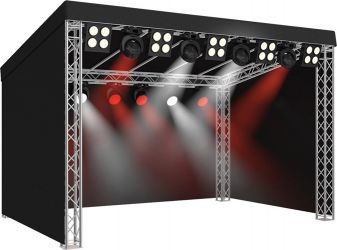
Flat roof stages

Flat Roof Stages from the Event Technology Specialist: Flat roof stages are the fastest and most cost-effective way to bring your event under a professional, weatherproof roof. At LTT you get robust stage systems in genuine Naxpro-Truss quality — scalable from compact 3 × 3 m setups to large open-air builds of 8 × 6 m and beyond. As your specialist for event technology and a manufacturer with our own production in Germany, we help you set every show in scene safely and reliably. Whether concert, city...
Read more »
Flat roof stages
Close window
Flat roof stages

Flat Roof Stages from the Event Technology Specialist

Flat roof stages are the fastest and most cost-effective way to bring your event under a professional, weatherproof roof. At LTT you get robust stage systems in genuine Naxpro-Truss quality — scalable from compact 3 × 3 m setups to large open-air builds of 8 × 6 m and beyond. As your specialist for event technology and a manufacturer with our own production in Germany, we help you set every show in scene safely and reliably. Whether concert, city festival, trade fair or open-air event: here you find the optimal solution to protect performers, technology and audience from wind and weather.

What Are Flat Roof Stages and Their Advantages? Fundamentals

A flat roof stage is a modular stage construction with a slightly pitched, flat top roof built from aluminium truss elements. The gentle roof pitch ensures rain and meltwater drain off in a controlled way, while the flat upper closure delivers maximum structural stability. Unlike gable or arched roof stages, the flat roof form uses a high proportion of standard truss elements, which makes it the most affordable stage roof type available.

Clear distinction from other stage types

Flat roof stages differ from pure stage podiums, which offer only a raised playing surface without any roof. They also differ from fully enclosed tent structures: a flat roof stage combines a load-bearing truss roof with rig points for lighting and sound, plus optional tarpaulins for weather protection. Compared with gable and arched roof stages, the flat roof needs fewer bespoke parts and is quicker to assemble.

Core advantages at a glance

  • Most cost-effective roof form thanks to many standard elements
  • High scalability — grow the stage with your event
  • Quick, safe assembly and dismantling
  • Slight roof pitch drains rain and meltwater reliably
  • Wind resistance up to force 8 with correct ballast and bracing
  • Rig points for integrated lighting, sound and video technology

This combination of low cost, flexibility and load-bearing capacity makes the flat roof stage the go-to choice for professionals and newcomers alike.

Building Flat Roof Stages with the Naxpro-Truss System

The heart of every LTT flat roof stage is the Naxpro-Truss system — a proven aluminium lattice-girder construction that assembles quickly and carries heavy loads. One-, two-, three- and four-point trusses form the framework, base plates anchor the uprights, and tarpaulin carriers create the flush upper and side closure for the roof plane.

Why build with a truss system?

Modern truss constructions are the standard for professional stage building. Four-point and single-point spans combine with base plates to form the load-bearing skeleton, while tarpaulin carriers hold the roof and side sheeting. Because the components are standardised, you can extend, adapt and reconfigure the stage for almost any venue. With Naxpro-Truss, spans of up to 12 metres are achievable — ideal for larger concerts and festivals.

Detailed Naxpro-Truss profile specifications

This is where LTT positions itself as a manufacturing specialist rather than a generalist. The exact profile data help you match the truss to the required load:

  • FD21–24: 35 mm tube diameter, 2 mm wall thickness — light, compact spans
  • FD31–44: 50 mm tube diameter, 2 mm wall thickness — the workhorse for most flat roof stages
  • HD31–44: 50 mm tube diameter, 3 mm wall thickness — heavier duty, higher load reserves
  • GS94: 60 mm tube diameter, 5 mm wall thickness with 40 × 3 mm diagonals — for the largest spans and roof loads

All Naxpro-Truss elements are made from high-strength aluminium alloys, welded exclusively by trained specialists, and comply with the current EN 1090 standard (formerly DIN 4113). The low weight of quality aluminium keeps transport and storage compact while delivering beautiful, stable results.

Technical Buying Criteria: Dimensions, Load and Weight

When choosing a flat roof stage, concrete technical figures matter more than marketing phrases. The following values give you a realistic frame for planning your setup and matching the stage to your equipment.

Typical technical specifications

  • Maximum roof load: approx. 300 kg, 600 kg, 800 kg or 1000 kg depending on model and size
  • System weight: approx. 450 kg to 1000 kg
  • Height: 2.5 m to 4 m
  • Width: 2 m to 7 m
  • Depth: 2 m to 5 m
  • Wind resistance: up to force 8 with correct ballast and bracing
  • Rig points: up to 250 kg per point for lighting and sound

What the load figures mean in practice

The maximum roof load defines how much lighting, sound and video technology you can suspend under the roof. A 300 kg model suits a compact club or corporate stage, while 800–1000 kg systems carry a full front-of-house lighting rig and line-array PA. The per-point figure of up to 250 kg is decisive for hanging PA wings and moving-head fixtures — always distribute loads across several rig points rather than overloading a single node.

Material quality as a buying criterion

High-strength aluminium keeps the structure light without sacrificing rigidity. Cast-zinc connectors and fast-lock systems allow tool-light assembly and a play-free, stable joint. Insist on documented load calculations and TÜV verification — the numbers on the data sheet are only worth as much as the certification behind them.

Safety, TÜV Certification and DGUV Vorschrift 17 Compliance

Safety is not optional on a load-bearing stage roof — it is a legal requirement. LTT flat roof stages are TÜV- and structural-engineer-tested products that comply with the current EN 1090 standard and the DGUV Vorschrift 17 (formerly BGV C1), which governs event and production venues.

Certification and documentation

  • EN 1090: the binding standard for the execution of aluminium load-bearing structures
  • TÜV certification: independent verification of the construction
  • Structural stability proof / Baubuch: documented statics you can present to authorities
  • DGUV Vorschrift 17: safety requirements for event and production sites, with regular inspection by a competent person

For professional and B2B buyers this paperwork is not bureaucracy — it is the basis for authority approval and insurance cover for your event. Every LTT stage ships with the relevant documentation.

Safety warnings for outdoor use

Outdoor flat roof stages must be correctly ballasted and braced. Typical setups require substantial counterweight — competitor references cite ballast of around 4 tonnes for larger stages. Stairs, railings and wind bracing are essential safety elements. Never exceed the specified wind force limit (up to force 8) and always follow the assembly manual supplied with the stage. When the wind rises beyond the rated limit, dismantle or evacuate the roof — no show is worth a collapsed structure.

Flat Roof vs. Gable and Arched Roof Stages: The Comparison

Choosing the right roof form is the first big decision in stage planning. The comparison below shows the key differences between the three common types so you can decide with confidence. In most cases the flat roof is the most economical and flexible option.

Criterion Flat Roof Stage Gable Roof Stage Arched Roof Stage
Cost Lowest — most standard elements Medium Higher
Assembly effort Fastest, fewest special parts Moderate More complex
Rain drainage Slight pitch drains water Steep pitch, very effective Curved run-off
Visual impression Clean, functional Classic festival look Striking wow-effect
Scalability Very high High High
Typical use Concerts, fairs, city festivals Festivals, open-air Prestige open-air events

How to read the comparison

The flat roof stage wins on cost and assembly speed because it relies on the largest share of standard Naxpro-Truss components. Gable and arched roofs shed heavy rain a little more aggressively and deliver a more dramatic silhouette, but they cost more and take longer to build. If budget, flexibility and quick turnaround matter most, the flat roof stage is the optimal solution. At LTT you also find gable and arched roof variants in the same Naxpro-Truss system if your event calls for a bigger visual statement.

Application Scenarios: Where Flat Roof Stages Are Used

Flat roof stages are remarkably versatile and appear across the whole event landscape wherever a stable, weatherproof roof is needed.

Typical applications

  • Open-air concerts: a load-bearing roof for the band plus rig points for lighting and line-array PA
  • City festivals and festivals: scalable stage sizes for varying audience numbers and stage programmes
  • Trade fairs and exhibition stands: raised presentation areas with a professional, branded roof
  • Outdoor corporate events: reliable weather protection for speakers, artists and sensitive technology

At festivals the flat roof stage protects both performers and equipment while providing suspension points for the entire show rig. On trade-fair grounds it doubles as an eye-catching, elevated presentation platform. Because you can extend the same standard components, one stage system can serve a small club gig one weekend and a large open-air the next. Complement your build with matching stage podiums and rigging accessories to create a complete, safe setup.

Buying Guide: Choosing Size, Ballast and Accessories

The right flat roof stage depends on your event type, audience size and venue. This buying guide walks you through the key decisions step by step.

Step 1 — Choose the size and height

As a rule of thumb: the larger the audience and the more technology you hang, the bigger the stage and the higher the roof needs to be. Compact events (club concerts, small corporate stages) work well around 3 × 3 × 3 m. Mid-size city festivals typically need 6 × 4 m footprints, while large open-air productions call for 8 × 6 × 4 m or more. Higher roofs improve sightlines and give more clearance for suspended fixtures.

Step 2 — Calculate ballast and wind load

Ballasting is the most safety-critical step for any outdoor flat roof stage. Wind acts on the roof plane and the tarpaulins like a sail, so counterweight must match the stage size and the rated wind force (up to force 8). Larger stages can require ballast in the region of several tonnes. Always follow the structural documentation and never improvise weights. Add wind bracing to stabilise the frame under gusts.

Step 3 — Complete your setup with accessories

Remember that tarpaulins, side sheeting, stage podiums, ballast and rigging are usually not included with the bare truss stage. Plan these in from the start so your setup is complete and compliant on show day.

Step 4 — Check certification

Only buy stages with EN 1090 compliance, TÜV verification and a structural stability proof. This documentation protects you legally and keeps your event insurable.

Brands and Manufacturers for Flat Roof Stages

The quality of a flat roof stage stands or falls with the truss system behind it. LTT relies on established brands and its own manufacturing to deliver dependable, certified structures.

Leading brands in this range

  • Naxpro-Truss — the core system for LTT flat roof stages, made in Germany with documented profile data and EN 1090 compliance
  • Global Truss — widely used FD34 profiles compatible with many stage builds
  • Bullstage — robust stage podiums to complete your stage floor
  • Riggatec — rigging hardware and accessories for safe load suspension
  • Litec and Prolyte — further professional truss brands for demanding productions

As a manufacturer with 25 years of experience in event technology and our own production in Germany, LTT can guarantee consistent quality across the Naxpro-Truss range. Naming genuine manufacturers matters: buying certified truss from a recognised system means your load figures, connectors and documentation all match — the foundation for beautiful, safe and repeatable results.

Accessories for Flat Roof Stages

A bare truss frame becomes a complete, weatherproof stage only with the right accessories. Because these parts are usually sold separately, plan them into your budget from the outset.

Essential accessories

  • Roof tarpaulins: flame-retardant, UV-stable sheeting for the roof plane
  • Side sheeting and stage gauze: flush side closure and clean visual finish
  • Stage podiums: Bullstage floor systems with loads up to 750 kg/m² for indoor and weatherproof outdoor decks
  • Wind bracing: stabilises the frame against gusts
  • Ballast / counterweights: the safety backbone of every outdoor build
  • Stairs and railings: barrier-free, safe access to the stage floor
  • Rigging hardware: shackles, hoists and clamps from brands like Riggatec for load suspension

Combine your flat roof stage with matching stage podiums to build a complete raised playing surface, and add lighting, sound and decoration to set the whole production in scene. Choosing coordinated accessories from proven brands avoids compatibility issues and keeps your setup certified and safe.

Care and Maintenance of Flat Roof Stages

Well-maintained aluminium truss lasts for many years and countless events. A little care between shows keeps your flat roof stage safe and good-looking.

Care and cleaning tips

  • Wipe aluminium profiles with a damp, non-abrasive cloth; avoid harsh solvents that attack surface finishes
  • Rinse road dirt, sand and salt off after outdoor and coastal events to prevent corrosion
  • Clean tarpaulins with mild soapy water and let them dry fully before folding to avoid mould
  • Store components dry and off the ground in flight cases or on racks

Maintenance and inspection

Before every build, inspect connectors, fast-lock pins and cast-zinc corners for wear, deformation or cracks. Check welds on the truss for hairline cracks and remove any bent element from service. Under DGUV Vorschrift 17, a competent person must inspect the stage regularly — document these checks in the Baubuch. Replace worn shackles, damaged pins and frayed lifting gear immediately; never repair load-bearing parts improvisationally. Consistent maintenance protects both your investment and everyone working on and under the stage.

Problems and Solutions: Common Pitfalls with Flat Roof Stages

Even experienced crews run into recurring issues when building flat roof stages. Knowing the typical problems in advance saves time and keeps the event safe.

Frequent problems and how to solve them

  • Problem: insufficient ballast on windy days. Solution: calculate counterweight for the full rated wind force before the build, and add wind bracing. If the wind exceeds the limit (force 8), dismantle the roof.
  • Problem: standing water on the roof tarpaulin. Solution: ensure the slight roof pitch is correctly set so rain and meltwater drain off; tension the tarpaulin properly to avoid pooling.
  • Problem: overloaded rig points. Solution: distribute lighting and PA across multiple points and stay within the per-point limit (up to 250 kg).
  • Problem: uneven ground causing an out-of-level frame. Solution: use adjustable base plates and stage podiums to compensate and keep the structure square.
  • Problem: missing documentation at an authority check. Solution: always carry the Baubuch, structural stability proof and EN 1090 certification on site.

Most pitfalls trace back to skipped planning steps. Following the assembly manual, respecting load and wind limits, and keeping documentation to hand solves nearly all of them.

Related Categories and Further Equipment

A flat roof stage is the centrepiece, but a professional production needs more. To complete your setup, explore closely related categories at LTT: stage podiums and Bullstage floor systems for the playing surface, Naxpro-Truss elements and rigging hardware for load suspension, plus lighting and sound technology to bring the show to life. Gable and arched roof stages in the same truss system are worth a look if your event calls for a bigger visual statement. Combining coordinated components from one specialist keeps everything compatible, certified and safe.

LTT – Your Specialist for Event Technology

From complete stage systems in high-grade truss to sound and lighting technology, LTT is your reliable partner for professional event technology. With over 25 years of experience and our own manufacturing in Germany, we deliver quality you can build on — every flat roof stage ships TÜV-tested, EN 1090-compliant and with full documentation.

As your specialist we back every purchase with a 3-year LTT warranty, free shipping from €69 and dispatch from Bocholt, Germany, with express delivery available on request. Reseller and wholesale customers benefit from dedicated trade conditions, and we ship worldwide through our international dealer network. Whether concert, festival, trade fair or corporate event: talk to us and set your next production in scene with confidence and genuine Naxpro-Truss quality.

FAQ – Questions & Answers

Which method is best suited for a flat roof?

For an event flat roof stage, the best method is a modular aluminium truss system such as Naxpro-Truss. The flat roof stage uses one-, two-, three- and four-point trusses combined with base plates and tarpaulin carriers, giving maximum stability with the slight pitch draining rain. This truss method is preferred because it uses a high share of standard elements, assembles quickly and safely, scales from compact to large builds, and complies with EN 1090 and DGUV Vorschrift 17. It is the most cost-effective and flexible way to roof a stage.

Which substructure for a flat roof stage?

The substructure of a flat roof stage consists of a load-bearing aluminium truss framework plus a stage floor. Four-point and single-point Naxpro-Truss spans combine with base plates to form the skeleton that carries the roof, while tarpaulin carriers hold the roof and side sheeting. The playing surface itself rests on stage podiums such as Bullstage systems with loads up to 750 kg/m². For outdoor use, the substructure must be correctly ballasted and braced against wind, and levelled with adjustable base plates on uneven ground.

What pitch does a low-slope flat roof stage have?

A flat roof stage has only a slight pitch — the roof plane is close to horizontal but tilted just enough for water to run off. This gentle roof pitch is deliberately shallow so the flat top closure delivers maximum structural stability while still draining rain and meltwater in a controlled way. Unlike a steep gable roof, the low-slope flat roof relies on correct tarpaulin tensioning to avoid pooling. Always set the pitch according to the assembly manual so no standing water collects on the tarpaulin during heavy rain.

What is a shallow-pitched flat roof stage?

A shallow-pitched flat roof stage is a modular event stage whose roof is almost horizontal, with only a small incline built from aluminium truss. The term describes the flat, gently tilted top closure that combines high rigidity with controlled water run-off. Because the shallow-pitched flat roof uses mostly standard Naxpro-Truss elements, it is the most affordable and quickest-to-assemble stage roof form. It is widely used for concerts, city festivals, trade fairs and outdoor corporate events where a stable, weatherproof roof with integrated rig points is needed.

What load capacity must a flat roof stage have?

A flat roof stage typically offers a maximum roof load of approximately 300 kg, 600 kg, 800 kg or 1000 kg, depending on the model and size. The required capacity depends on how much lighting, sound and video technology you suspend under the roof. A 300 kg stage suits a compact club or corporate setup, while 800–1000 kg systems carry a full lighting rig and line-array PA. Individual rig points at LTT hold up to 250 kg each — always distribute loads across several points and stay within the certified figures documented in the structural stability proof.

How much does a professional flat roof stage cost?

The price of a professional flat roof stage depends on size, load capacity and included components. Compact truss stage sets start in the lower four-figure range, while large open-air builds of 8 × 6 m with high load reserves reach the mid five-figure range. Because the flat roof form uses many standard Naxpro-Truss elements, it is the most cost-effective roof type. Remember that tarpaulins, side sheeting, stage podiums, ballast and rigging are usually priced separately. At LTT you also benefit from a 3-year warranty and free shipping from €69.

What is the difference between a flat roof stage and a gable roof stage?

A flat roof stage has an almost horizontal, gently pitched roof, while a gable roof stage has two sloped surfaces meeting at a ridge. The flat roof stage uses more standard truss elements, so it is cheaper and faster to assemble, making it the most economical option. The gable roof stage sheds heavy rain a little more aggressively and delivers the classic festival silhouette, but costs more and takes longer to build. Both use the same Naxpro-Truss system at LTT, so the choice comes down to budget, weather demands and the visual statement you want.

Which flat roof stage suits an open-air concert?

For an open-air concert, choose a flat roof stage sized to your audience and lighting rig — typically 6 × 4 m for mid-size events and 8 × 6 × 4 m or larger for big productions, with a roof load of 800–1000 kg. Prioritise strong Naxpro-Truss profiles such as FD31–44 or HD31–44, rig points up to 250 kg for PA wings and moving heads, and adequate ballast plus wind bracing for wind resistance up to force 8. Add roof tarpaulins, side gauze, stage podiums and rigging to complete a safe, weatherproof concert stage.

Top seller
Naxpro-Truss Flachdach-Bühne FR06 -  6,00 x 4,00  x 3,36/4,01 m (BxLxH)
Naxpro-Truss Flat Roof-Stage FR06 - 6,00 x 4,00 x 3,36/4,01 m (WxLxH)
€7,249.00 *
incl. tax, plus forwarding agency costs
Availability:
Delivery time: approx. 4-5 weeks

Bulky goods

Naxpro-Truss Flachdach-Bühne FR08 -  8,00 x 6,00  x 4,11/4,81 m (BxLxH)
Naxpro-Truss Flat Roof-Stage FR08 - 8,00 x 6,00 x 4,08/4,81 m (WxLxH)
€8,999.00 *
incl. tax, plus forwarding agency costs
Availability:
Delivery time: approx. 4-5 weeks

Bulky goods

Naxpro-Truss Flachdach-Bühne FR03 - 3,00 x 3,00  x 2,56/2,99 m (BxLxH)
Naxpro-Truss Flat Roof-Stage FR03 - 3,00 x 3,00 x 2,54/2,99 m (WxLxH)
€5,499.00 *
incl. tax, plus forwarding agency costs
Availability:
Delivery time: approx. 4-5 weeks

Bulky goods

Naxpro-Truss Flachdach-Bühne FR04 - 4,00 x 3,00  x 3,01/3,51 m (BxLxH)
Naxpro-Truss Flat Roof-Stage FR04 - 4,00 x 3,00 x 3,01/3,51 m (WxLxH)
€6,499.00 *
incl. tax, plus forwarding agency costs
Availability:
Delivery time: approx. 4-5 weeks

Bulky goods

4 Articles
Close filters
  •  
from to
No results were found for the filter!
Naxpro-Truss Flachdach-Bühne FR03 - 3,00 x 3,00  x 2,56/2,99 m (BxLxH)
Naxpro-Truss Flat Roof-Stage FR03 - 3,00 x 3,00 x 2,54/2,99 m (WxLxH)
Naxpro-Truss Flat Roof-Stage FR03 Flat roof structures are characterized by a simple and quick handling in the temporary operation. Due to the many standard elements used, this stage roof form...
€5,499.00 *
incl. tax, plus forwarding agency costs
Availability:
Delivery time: approx. 4-5 weeks

Bulky goods

Naxpro-Truss Flachdach-Bühne FR04 - 4,00 x 3,00  x 3,01/3,51 m (BxLxH)
Naxpro-Truss Flat Roof-Stage FR04 - 4,00 x 3,00 x 3,01/3,51 m (WxLxH)
Naxpro-Truss Flat Roof-Stage FR04 Flat roof structures are characterized by a simple and quick handling in the temporary operation. Due to the many standard elements used, this stage roof form...
€6,499.00 *
incl. tax, plus forwarding agency costs
Availability:
Delivery time: approx. 4-5 weeks

Bulky goods

Naxpro-Truss Flachdach-Bühne FR06 -  6,00 x 4,00  x 3,36/4,01 m (BxLxH)
Naxpro-Truss Flat Roof-Stage FR06 - 6,00 x 4,00 x 3,36/4,01 m (WxLxH)
Naxpro-Truss Flat Roof-Stage FR06 Flat roof structures are characterized by a simple and quick handling in the temporary operation. Due to the many standard elements used, this stage roof form...
€7,249.00 *
incl. tax, plus forwarding agency costs
Availability:
Delivery time: approx. 4-5 weeks

Bulky goods

Naxpro-Truss Flachdach-Bühne FR08 -  8,00 x 6,00  x 4,11/4,81 m (BxLxH)
Naxpro-Truss Flat Roof-Stage FR08 - 8,00 x 6,00 x 4,08/4,81 m (WxLxH)
Naxpro-Truss Flat Roof-Stage FR08 Flat roof structures are characterized by a simple and quick handling in the temporary operation. Due to the many standard elements used, this stage roof form...
€8,999.00 *
incl. tax, plus forwarding agency costs
Availability:
Delivery time: approx. 4-5 weeks

Bulky goods

Facts
Flat Roof Stages from the Event Technology Specialist: Flat roof stages are the fastest and most cost-effective way to bring your event under a professional, weatherproof roof. At LTT you get robust stage systems in genuine Naxpro-Truss quality — scalable from compact 3 × 3 m setups to large open-air builds of 8 × 6 m and beyond. As your specialist for event technology and a manufacturer with our own production in Germany, we help you set... Read more »
Viewed
Facts

Flat Roof Stages from the Event Technology Specialist

Flat roof stages are the fastest and most cost-effective way to bring your event under a professional, weatherproof roof. At LTT you get robust stage systems in genuine Naxpro-Truss quality — scalable from compact 3 × 3 m setups to large open-air builds of 8 × 6 m and beyond. As your specialist for event technology and a manufacturer with our own production in Germany, we help you set every show in scene safely and reliably. Whether concert, city festival, trade fair or open-air event: here you find the optimal solution to protect performers, technology and audience from wind and weather.

What Are Flat Roof Stages and Their Advantages? Fundamentals

A flat roof stage is a modular stage construction with a slightly pitched, flat top roof built from aluminium truss elements. The gentle roof pitch ensures rain and meltwater drain off in a controlled way, while the flat upper closure delivers maximum structural stability. Unlike gable or arched roof stages, the flat roof form uses a high proportion of standard truss elements, which makes it the most affordable stage roof type available.

Clear distinction from other stage types

Flat roof stages differ from pure stage podiums, which offer only a raised playing surface without any roof. They also differ from fully enclosed tent structures: a flat roof stage combines a load-bearing truss roof with rig points for lighting and sound, plus optional tarpaulins for weather protection. Compared with gable and arched roof stages, the flat roof needs fewer bespoke parts and is quicker to assemble.

Core advantages at a glance

  • Most cost-effective roof form thanks to many standard elements
  • High scalability — grow the stage with your event
  • Quick, safe assembly and dismantling
  • Slight roof pitch drains rain and meltwater reliably
  • Wind resistance up to force 8 with correct ballast and bracing
  • Rig points for integrated lighting, sound and video technology

This combination of low cost, flexibility and load-bearing capacity makes the flat roof stage the go-to choice for professionals and newcomers alike.

Building Flat Roof Stages with the Naxpro-Truss System

The heart of every LTT flat roof stage is the Naxpro-Truss system — a proven aluminium lattice-girder construction that assembles quickly and carries heavy loads. One-, two-, three- and four-point trusses form the framework, base plates anchor the uprights, and tarpaulin carriers create the flush upper and side closure for the roof plane.

Why build with a truss system?

Modern truss constructions are the standard for professional stage building. Four-point and single-point spans combine with base plates to form the load-bearing skeleton, while tarpaulin carriers hold the roof and side sheeting. Because the components are standardised, you can extend, adapt and reconfigure the stage for almost any venue. With Naxpro-Truss, spans of up to 12 metres are achievable — ideal for larger concerts and festivals.

Detailed Naxpro-Truss profile specifications

This is where LTT positions itself as a manufacturing specialist rather than a generalist. The exact profile data help you match the truss to the required load:

  • FD21–24: 35 mm tube diameter, 2 mm wall thickness — light, compact spans
  • FD31–44: 50 mm tube diameter, 2 mm wall thickness — the workhorse for most flat roof stages
  • HD31–44: 50 mm tube diameter, 3 mm wall thickness — heavier duty, higher load reserves
  • GS94: 60 mm tube diameter, 5 mm wall thickness with 40 × 3 mm diagonals — for the largest spans and roof loads

All Naxpro-Truss elements are made from high-strength aluminium alloys, welded exclusively by trained specialists, and comply with the current EN 1090 standard (formerly DIN 4113). The low weight of quality aluminium keeps transport and storage compact while delivering beautiful, stable results.

Technical Buying Criteria: Dimensions, Load and Weight

When choosing a flat roof stage, concrete technical figures matter more than marketing phrases. The following values give you a realistic frame for planning your setup and matching the stage to your equipment.

Typical technical specifications

  • Maximum roof load: approx. 300 kg, 600 kg, 800 kg or 1000 kg depending on model and size
  • System weight: approx. 450 kg to 1000 kg
  • Height: 2.5 m to 4 m
  • Width: 2 m to 7 m
  • Depth: 2 m to 5 m
  • Wind resistance: up to force 8 with correct ballast and bracing
  • Rig points: up to 250 kg per point for lighting and sound

What the load figures mean in practice

The maximum roof load defines how much lighting, sound and video technology you can suspend under the roof. A 300 kg model suits a compact club or corporate stage, while 800–1000 kg systems carry a full front-of-house lighting rig and line-array PA. The per-point figure of up to 250 kg is decisive for hanging PA wings and moving-head fixtures — always distribute loads across several rig points rather than overloading a single node.

Material quality as a buying criterion

High-strength aluminium keeps the structure light without sacrificing rigidity. Cast-zinc connectors and fast-lock systems allow tool-light assembly and a play-free, stable joint. Insist on documented load calculations and TÜV verification — the numbers on the data sheet are only worth as much as the certification behind them.

Safety, TÜV Certification and DGUV Vorschrift 17 Compliance

Safety is not optional on a load-bearing stage roof — it is a legal requirement. LTT flat roof stages are TÜV- and structural-engineer-tested products that comply with the current EN 1090 standard and the DGUV Vorschrift 17 (formerly BGV C1), which governs event and production venues.

Certification and documentation

  • EN 1090: the binding standard for the execution of aluminium load-bearing structures
  • TÜV certification: independent verification of the construction
  • Structural stability proof / Baubuch: documented statics you can present to authorities
  • DGUV Vorschrift 17: safety requirements for event and production sites, with regular inspection by a competent person

For professional and B2B buyers this paperwork is not bureaucracy — it is the basis for authority approval and insurance cover for your event. Every LTT stage ships with the relevant documentation.

Safety warnings for outdoor use

Outdoor flat roof stages must be correctly ballasted and braced. Typical setups require substantial counterweight — competitor references cite ballast of around 4 tonnes for larger stages. Stairs, railings and wind bracing are essential safety elements. Never exceed the specified wind force limit (up to force 8) and always follow the assembly manual supplied with the stage. When the wind rises beyond the rated limit, dismantle or evacuate the roof — no show is worth a collapsed structure.

Flat Roof vs. Gable and Arched Roof Stages: The Comparison

Choosing the right roof form is the first big decision in stage planning. The comparison below shows the key differences between the three common types so you can decide with confidence. In most cases the flat roof is the most economical and flexible option.

Criterion Flat Roof Stage Gable Roof Stage Arched Roof Stage
Cost Lowest — most standard elements Medium Higher
Assembly effort Fastest, fewest special parts Moderate More complex
Rain drainage Slight pitch drains water Steep pitch, very effective Curved run-off
Visual impression Clean, functional Classic festival look Striking wow-effect
Scalability Very high High High
Typical use Concerts, fairs, city festivals Festivals, open-air Prestige open-air events

How to read the comparison

The flat roof stage wins on cost and assembly speed because it relies on the largest share of standard Naxpro-Truss components. Gable and arched roofs shed heavy rain a little more aggressively and deliver a more dramatic silhouette, but they cost more and take longer to build. If budget, flexibility and quick turnaround matter most, the flat roof stage is the optimal solution. At LTT you also find gable and arched roof variants in the same Naxpro-Truss system if your event calls for a bigger visual statement.

Application Scenarios: Where Flat Roof Stages Are Used

Flat roof stages are remarkably versatile and appear across the whole event landscape wherever a stable, weatherproof roof is needed.

Typical applications

  • Open-air concerts: a load-bearing roof for the band plus rig points for lighting and line-array PA
  • City festivals and festivals: scalable stage sizes for varying audience numbers and stage programmes
  • Trade fairs and exhibition stands: raised presentation areas with a professional, branded roof
  • Outdoor corporate events: reliable weather protection for speakers, artists and sensitive technology

At festivals the flat roof stage protects both performers and equipment while providing suspension points for the entire show rig. On trade-fair grounds it doubles as an eye-catching, elevated presentation platform. Because you can extend the same standard components, one stage system can serve a small club gig one weekend and a large open-air the next. Complement your build with matching stage podiums and rigging accessories to create a complete, safe setup.

Buying Guide: Choosing Size, Ballast and Accessories

The right flat roof stage depends on your event type, audience size and venue. This buying guide walks you through the key decisions step by step.

Step 1 — Choose the size and height

As a rule of thumb: the larger the audience and the more technology you hang, the bigger the stage and the higher the roof needs to be. Compact events (club concerts, small corporate stages) work well around 3 × 3 × 3 m. Mid-size city festivals typically need 6 × 4 m footprints, while large open-air productions call for 8 × 6 × 4 m or more. Higher roofs improve sightlines and give more clearance for suspended fixtures.

Step 2 — Calculate ballast and wind load

Ballasting is the most safety-critical step for any outdoor flat roof stage. Wind acts on the roof plane and the tarpaulins like a sail, so counterweight must match the stage size and the rated wind force (up to force 8). Larger stages can require ballast in the region of several tonnes. Always follow the structural documentation and never improvise weights. Add wind bracing to stabilise the frame under gusts.

Step 3 — Complete your setup with accessories

Remember that tarpaulins, side sheeting, stage podiums, ballast and rigging are usually not included with the bare truss stage. Plan these in from the start so your setup is complete and compliant on show day.

Step 4 — Check certification

Only buy stages with EN 1090 compliance, TÜV verification and a structural stability proof. This documentation protects you legally and keeps your event insurable.

Brands and Manufacturers for Flat Roof Stages

The quality of a flat roof stage stands or falls with the truss system behind it. LTT relies on established brands and its own manufacturing to deliver dependable, certified structures.

Leading brands in this range

  • Naxpro-Truss — the core system for LTT flat roof stages, made in Germany with documented profile data and EN 1090 compliance
  • Global Truss — widely used FD34 profiles compatible with many stage builds
  • Bullstage — robust stage podiums to complete your stage floor
  • Riggatec — rigging hardware and accessories for safe load suspension
  • Litec and Prolyte — further professional truss brands for demanding productions

As a manufacturer with 25 years of experience in event technology and our own production in Germany, LTT can guarantee consistent quality across the Naxpro-Truss range. Naming genuine manufacturers matters: buying certified truss from a recognised system means your load figures, connectors and documentation all match — the foundation for beautiful, safe and repeatable results.

Accessories for Flat Roof Stages

A bare truss frame becomes a complete, weatherproof stage only with the right accessories. Because these parts are usually sold separately, plan them into your budget from the outset.

Essential accessories

  • Roof tarpaulins: flame-retardant, UV-stable sheeting for the roof plane
  • Side sheeting and stage gauze: flush side closure and clean visual finish
  • Stage podiums: Bullstage floor systems with loads up to 750 kg/m² for indoor and weatherproof outdoor decks
  • Wind bracing: stabilises the frame against gusts
  • Ballast / counterweights: the safety backbone of every outdoor build
  • Stairs and railings: barrier-free, safe access to the stage floor
  • Rigging hardware: shackles, hoists and clamps from brands like Riggatec for load suspension

Combine your flat roof stage with matching stage podiums to build a complete raised playing surface, and add lighting, sound and decoration to set the whole production in scene. Choosing coordinated accessories from proven brands avoids compatibility issues and keeps your setup certified and safe.

Care and Maintenance of Flat Roof Stages

Well-maintained aluminium truss lasts for many years and countless events. A little care between shows keeps your flat roof stage safe and good-looking.

Care and cleaning tips

  • Wipe aluminium profiles with a damp, non-abrasive cloth; avoid harsh solvents that attack surface finishes
  • Rinse road dirt, sand and salt off after outdoor and coastal events to prevent corrosion
  • Clean tarpaulins with mild soapy water and let them dry fully before folding to avoid mould
  • Store components dry and off the ground in flight cases or on racks

Maintenance and inspection

Before every build, inspect connectors, fast-lock pins and cast-zinc corners for wear, deformation or cracks. Check welds on the truss for hairline cracks and remove any bent element from service. Under DGUV Vorschrift 17, a competent person must inspect the stage regularly — document these checks in the Baubuch. Replace worn shackles, damaged pins and frayed lifting gear immediately; never repair load-bearing parts improvisationally. Consistent maintenance protects both your investment and everyone working on and under the stage.

Problems and Solutions: Common Pitfalls with Flat Roof Stages

Even experienced crews run into recurring issues when building flat roof stages. Knowing the typical problems in advance saves time and keeps the event safe.

Frequent problems and how to solve them

  • Problem: insufficient ballast on windy days. Solution: calculate counterweight for the full rated wind force before the build, and add wind bracing. If the wind exceeds the limit (force 8), dismantle the roof.
  • Problem: standing water on the roof tarpaulin. Solution: ensure the slight roof pitch is correctly set so rain and meltwater drain off; tension the tarpaulin properly to avoid pooling.
  • Problem: overloaded rig points. Solution: distribute lighting and PA across multiple points and stay within the per-point limit (up to 250 kg).
  • Problem: uneven ground causing an out-of-level frame. Solution: use adjustable base plates and stage podiums to compensate and keep the structure square.
  • Problem: missing documentation at an authority check. Solution: always carry the Baubuch, structural stability proof and EN 1090 certification on site.

Most pitfalls trace back to skipped planning steps. Following the assembly manual, respecting load and wind limits, and keeping documentation to hand solves nearly all of them.

Related Categories and Further Equipment

A flat roof stage is the centrepiece, but a professional production needs more. To complete your setup, explore closely related categories at LTT: stage podiums and Bullstage floor systems for the playing surface, Naxpro-Truss elements and rigging hardware for load suspension, plus lighting and sound technology to bring the show to life. Gable and arched roof stages in the same truss system are worth a look if your event calls for a bigger visual statement. Combining coordinated components from one specialist keeps everything compatible, certified and safe.

LTT – Your Specialist for Event Technology

From complete stage systems in high-grade truss to sound and lighting technology, LTT is your reliable partner for professional event technology. With over 25 years of experience and our own manufacturing in Germany, we deliver quality you can build on — every flat roof stage ships TÜV-tested, EN 1090-compliant and with full documentation.

As your specialist we back every purchase with a 3-year LTT warranty, free shipping from €69 and dispatch from Bocholt, Germany, with express delivery available on request. Reseller and wholesale customers benefit from dedicated trade conditions, and we ship worldwide through our international dealer network. Whether concert, festival, trade fair or corporate event: talk to us and set your next production in scene with confidence and genuine Naxpro-Truss quality.

FAQ – Questions & Answers

Which method is best suited for a flat roof?

For an event flat roof stage, the best method is a modular aluminium truss system such as Naxpro-Truss. The flat roof stage uses one-, two-, three- and four-point trusses combined with base plates and tarpaulin carriers, giving maximum stability with the slight pitch draining rain. This truss method is preferred because it uses a high share of standard elements, assembles quickly and safely, scales from compact to large builds, and complies with EN 1090 and DGUV Vorschrift 17. It is the most cost-effective and flexible way to roof a stage.

Which substructure for a flat roof stage?

The substructure of a flat roof stage consists of a load-bearing aluminium truss framework plus a stage floor. Four-point and single-point Naxpro-Truss spans combine with base plates to form the skeleton that carries the roof, while tarpaulin carriers hold the roof and side sheeting. The playing surface itself rests on stage podiums such as Bullstage systems with loads up to 750 kg/m². For outdoor use, the substructure must be correctly ballasted and braced against wind, and levelled with adjustable base plates on uneven ground.

What pitch does a low-slope flat roof stage have?

A flat roof stage has only a slight pitch — the roof plane is close to horizontal but tilted just enough for water to run off. This gentle roof pitch is deliberately shallow so the flat top closure delivers maximum structural stability while still draining rain and meltwater in a controlled way. Unlike a steep gable roof, the low-slope flat roof relies on correct tarpaulin tensioning to avoid pooling. Always set the pitch according to the assembly manual so no standing water collects on the tarpaulin during heavy rain.

What is a shallow-pitched flat roof stage?

A shallow-pitched flat roof stage is a modular event stage whose roof is almost horizontal, with only a small incline built from aluminium truss. The term describes the flat, gently tilted top closure that combines high rigidity with controlled water run-off. Because the shallow-pitched flat roof uses mostly standard Naxpro-Truss elements, it is the most affordable and quickest-to-assemble stage roof form. It is widely used for concerts, city festivals, trade fairs and outdoor corporate events where a stable, weatherproof roof with integrated rig points is needed.

What load capacity must a flat roof stage have?

A flat roof stage typically offers a maximum roof load of approximately 300 kg, 600 kg, 800 kg or 1000 kg, depending on the model and size. The required capacity depends on how much lighting, sound and video technology you suspend under the roof. A 300 kg stage suits a compact club or corporate setup, while 800–1000 kg systems carry a full lighting rig and line-array PA. Individual rig points at LTT hold up to 250 kg each — always distribute loads across several points and stay within the certified figures documented in the structural stability proof.

How much does a professional flat roof stage cost?

The price of a professional flat roof stage depends on size, load capacity and included components. Compact truss stage sets start in the lower four-figure range, while large open-air builds of 8 × 6 m with high load reserves reach the mid five-figure range. Because the flat roof form uses many standard Naxpro-Truss elements, it is the most cost-effective roof type. Remember that tarpaulins, side sheeting, stage podiums, ballast and rigging are usually priced separately. At LTT you also benefit from a 3-year warranty and free shipping from €69.

What is the difference between a flat roof stage and a gable roof stage?

A flat roof stage has an almost horizontal, gently pitched roof, while a gable roof stage has two sloped surfaces meeting at a ridge. The flat roof stage uses more standard truss elements, so it is cheaper and faster to assemble, making it the most economical option. The gable roof stage sheds heavy rain a little more aggressively and delivers the classic festival silhouette, but costs more and takes longer to build. Both use the same Naxpro-Truss system at LTT, so the choice comes down to budget, weather demands and the visual statement you want.

Which flat roof stage suits an open-air concert?

For an open-air concert, choose a flat roof stage sized to your audience and lighting rig — typically 6 × 4 m for mid-size events and 8 × 6 × 4 m or larger for big productions, with a roof load of 800–1000 kg. Prioritise strong Naxpro-Truss profiles such as FD31–44 or HD31–44, rig points up to 250 kg for PA wings and moving heads, and adequate ballast plus wind bracing for wind resistance up to force 8. Add roof tarpaulins, side gauze, stage podiums and rigging to complete a safe, weatherproof concert stage.