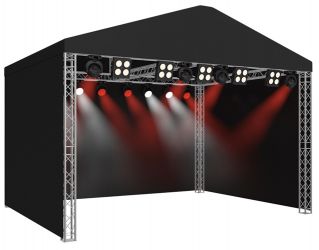
Pitched roof stages
Saddle Roof Stages: A Stable Stage for Every Event
Saddle roof stages let you put every performance in the spotlight — safely sheltered from wind, rain and snow. A saddle roof stage combines a stable stage podium area with a pointed truss roof that protects performers and sensitive equipment while carrying lighting, speakers and backdrops overhead.
At LTT you buy saddle roof stages built from genuine Naxpro-Truss FD 34 four-point truss, engineered for reliable statics, high load reserves and fast modular assembly. Whether city festival, open-air concert or trade fair appearance, the same modular kit scales from compact 5-metre setups to expansive stage areas beyond 100 m².
As your specialist for event technology, LTT delivers TÜV-tested, EN 1090 certified constructions with the accessories and expert advice you need to achieve impressive results.
What Is a Saddle Roof Stage and How Does It Work? Fundamentals
A saddle roof stage is a stage podium area spanned by a pointed, gable-shaped truss roof. The term "saddle roof" describes the two roof surfaces that slope down from a central ridge, forming a triangular cross-section — much like the roof of a house. This shape is what gives the construction its defining structural and functional properties.
The truss framework fulfils two jobs at once. First, it acts as a rigging structure: floodlights, moving heads, line arrays, backdrops and tarpaulins are attached directly to the aluminium truss. Second, it provides weather protection, keeping both performers and expensive technology dry when the next downpour arrives.
How the saddle roof differs from other stage types
Unlike a flat roof, which collects rainwater and debris, the saddle roof sheds rain, snow and falling leaves down its sloping surfaces. This prevents dangerous accumulations that would add weight and compromise safety. Compared with an arched (round-bow) roof, the saddle roof offers a smaller wind attack surface and a higher usable load thanks to its triangular geometry. Compared with a pult (mono-pitch) roof, the saddle roof gains structural stiffness and superior acoustics from the ridge.
A saddle roof stage is a mobile structure — legally a "flying structure" (fliegender Bau) — designed to be assembled temporarily and dismantled again after the event. That flexibility makes it the standard choice for festivals, open-air concerts, trade fair stands and touring productions.
Saddle Roof Stages from the Naxpro-Truss Series: Truss Construction and Modular Build-Up
The saddle roof stages at LTT are based on the Naxpro-Truss FD 34 four-point truss system — a proven aluminium truss with a 50 mm ⌀ tube and 2 mm wall thickness. The four-point profile provides the torsional stiffness a self-supporting roof needs, while the low weight of the aluminium keeps every component easy to transport.
Modular kit assembly
Naxpro-Truss works almost like a modular building set. Standard components — straight sections, two-, three- and four-way corner blocks, base plates and canopy carriers (Planenträger) — are connected with minimal tooling. In a short time you stand up a complete saddle roof for your stage. A typical SR06 configuration, for example, combines 90° corner angles (C21, C30sp, C40sp), FD 34 straight sections from 50 cm to 300 cm, four base plates, Riggatec Cornerbrake corner bracing and inner and outer canopy carriers.
Freely expandable dimensions
Because the system is fully modular, you are never locked into fixed dimensions. By combining additional FD 34 truss sections you reach exactly the stage width and depth your event demands — from around 5 m wide up to 11 m and beyond, with stage areas realisable up to roughly 120 m².
Tube and profile specifications
Knowing the tube specs lets you judge load reserves for your event size. The Naxpro-Truss range spans several series:
- FD21-24: 35 mm ⌀ tube, 2 mm wall thickness
- FD31-44 (incl. FD 34): 50 mm ⌀ tube, 2 mm wall thickness
- HD31-44: 50 mm ⌀ tube, 3 mm wall thickness
- GS94: 60 mm ⌀ tube, 5 mm wall thickness, with 40 x 3 mm diagonal tubes
For most saddle roof stages the FD 34 series delivers the ideal balance of load capacity and manageable weight.
Statics, Load Capacity and Certification: EN 1090, TÜV and DGUV Vorschrift 17
Stability and statics are non-negotiable for any stage roof. Every Naxpro-Truss saddle roof stage from LTT is manufactured in certified production facilities and complies with the current standard EN 1090 (formerly DIN 4113). The statics and material processing are TÜV-tested, and the high load capacity of the truss stems from high-end aluminium alloys.
Load capacity in practice
As a concrete example, the SR06 saddle roof stage (approx. 700 x 400 x 471 cm, width x length x height) offers a maximum load of roughly 800 kg at a self-weight of around 550 kg. All standard offers refer to the basic truss construction with simple base plates, including statics up to wind zone 2 (below wind force 8).
Wind zone 2 and ballasting
As a mobile flying structure, a saddle roof stage must be professionally ballasted so its light aluminium frame resists wind loads. The roof and side tarpaulins create additional wind loads that have to be factored into planning. Depending on the wind permeability of the tarpaulin or gaze, vertical and horizontal wind loads are calculated, and ballast is planned accordingly. As a rule, a flying structure of this type must be dismantled from wind force 8 onwards.
DGUV Vorschrift 17 and documentation
Professional operation of temporary stage roofs falls under DGUV Vorschrift 17 (formerly BGV C1). The included assembly manual contains all essential information on load capacity, statics, correct assembly and safe use of the saddle roof stage. Keeping the statics documentation and assembly instructions on site is part of responsible, compliant setup — and part of the reason LTT products are trusted by professionals.
Saddle Roof vs. Arched, Pult and Flat Roof: The Comparison
Choosing the right roof type is the first decision in stage planning. Each construction has clear strengths depending on wind load, achievable height, budget and assembly effort. The comparison table below puts the four common stage roof types side by side so you can see the differences at a glance.
The saddle roof is the all-rounder: it combines strong weather protection, a small wind attack surface and a high usable load, which makes it the go-to choice for demanding open-air productions. The pult roof is the budget alternative for smaller events, while the arched roof shines on wide festival stages. A flat roof is only suitable where water pooling is not a concern.
Buying Guide: Choosing the Right Stage Size and Configuration
The right saddle roof stage depends on your audience size, indoor or outdoor use, ceiling clearance and budget. Use the following buying guide to narrow down the ideal Naxpro-Truss configuration before you order.
Match stage size to event size
- Small events, DJ sets, walking-act stages: around 5 x 4 m to 6 x 5 m
- Club concerts, city festivals, corporate stages: around 7 x 4 m to 8 x 6 m
- Larger open-air concerts and touring productions: 10 x 6 m up to 14 x 10 m and beyond
Watch the total height
With a saddle roof, the ridge and truss height add to your clear working height. If a local building code or venue limits the total structure to under 5 m, factor in the tower and gable height so your usable clearance still meets the rider requirements of your acts.
Indoor vs. outdoor
Indoors, wind and snow loads are not a concern, so the focus is on rigging capacity and clean sightlines. Outdoors, ballasting, wind zone rating and tarpaulin choice become decisive. For outdoor use, always plan for the wind zone 2 statics and appropriate ballast.
Budget and expandability
Because Naxpro-Truss is modular, a saddle roof stage is a reusable, long-term investment. You can set it up indoors and outdoors, expand it with additional truss sections and reconfigure it for different events — which is exactly what makes it the optimal solution for busy rental and production companies. If you are unsure which configuration fits your event, our team is happy to advise you.
Accessories, Expansion and Scope of Delivery
The standard offer for a saddle roof stage covers the basic truss construction with simple base plates, including statics up to wind zone 2. Accessories such as roof tarpaulins, side walls, wind bracing, ballast, stage podiums, decoration and event technology are not included — but LTT supplies them separately so you can equip the stage exactly for your project.
Essential accessories for a complete stage
- Roof tarpaulin and side gaze — weather protection and clean visual framing, available in different colours for roof, side and rear tarpaulins
- Wind bracing (Windverbände) and Riggatec Cornerbrake corner bracing — added rigidity against horizontal wind loads
- Ballasting — weights that anchor the flying structure safely to the ground
- Canopy carriers (Planenträger) — inner and outer carriers that tension the roof tarpaulin
- Stage podiums — a level, load-bearing performance area to build the roof over
- Rigging accessories — clamps, hoists and adapters for hanging lighting and sound
Full LTT product world
For the stage platform itself, Bullstage podiums integrate cleanly under a Naxpro-Truss roof, while Riggatec rigging accessories cover clamps, corner bracing and safety hardware. This lets you assemble a complete, coordinated system from a single specialist rather than sourcing parts from many suppliers.
Brands and Manufacturers for Saddle Roof Stages
The heart of every LTT saddle roof stage is the Naxpro-Truss FD 34 four-point truss system — designed and manufactured in Germany for reliable statics and high load reserves. Beyond the truss itself, several manufacturers round out a professional saddle roof setup:
- Naxpro-Truss — the four-point aluminium truss that forms the roof and support structure
- Riggatec — Cornerbrake corner bracing, clamps and rigging accessories
- Bullstage — robust stage podiums for the performance platform
- Alutruss and Global Truss — compatible truss components and extensions in the wider market
- Prolyte — professional truss and ground support systems used in touring rigs
For competitor and cross-brand systems, series such as Eurotruss ST50, TD44, FD33 and FD34 appear in large ground support builds. As a manufacturer with its own production and 25 years of experience in event technology, LTT combines its premium in-house brands with leading trade brands so you always find the optimal solution for your stage.
Safety, Assembly and Care: Maintenance of Your Saddle Roof Stage
A stage roof is only as safe as its setup and upkeep. Following the safety and assembly rules protects performers, crew and audience alike.
Safety and warnings
Always follow the included assembly manual and observe DGUV Vorschrift 17 (formerly BGV C1) for flying structures. Never exceed the specified maximum load, ballast the structure correctly and dismantle the stage before wind force 8 is reached. Keep the statics documentation on site for inspections.
Assembly essentials
Assemble the truss on level ground, verify every corner block and safety pin, and fit the wind bracing and corner bracing before tensioning the tarpaulins. Load lighting and sound only within the certified usable load.
Care and maintenance
After each event, clean the aluminium truss of dirt and moisture and store it dry to prevent corrosion. Inspect connectors, pins and base plates for wear before every reuse, check tarpaulins for tears and store components in a dry, space-saving way. Regular care keeps a Naxpro-Truss saddle roof stage safe and serviceable for many years of use.
Related Categories and Further Reading
A saddle roof stage rarely stands alone. To complete your setup, explore the closely related product worlds at LTT: Naxpro-Truss straight and corner truss for expanding the frame, Bullstage stage podiums for the performance platform, Riggatec rigging accessories for hanging your lighting and sound, and stage roof tarpaulins and side gaze for weather protection and a clean look. Combining these categories with your saddle roof stage lets you build a fully coordinated, professional event structure from one specialist source.
LTT – Your Expert for Event Technology
As your specialist for event technology, LTT is more than a retailer — we are a manufacturer with our own production in Germany and 25 years of experience in stage building, truss systems and show technology. Every saddle roof stage from the Naxpro-Truss series is TÜV-tested and EN 1090 certified, so you set your productions in the spotlight on a foundation you can trust.
We ship from Bocholt in Germany with free shipping from €69, express delivery on request and worldwide dispatch through our international dealer network. On top of that, you benefit from our 3-year LTT warranty and, as a reseller, from dedicated wholesale conditions. More than 100,000 positive customer reviews confirm that we deliver as a reliable partner.
Browse the saddle roof stages in our shop, add the matching podiums, tarpaulins and rigging accessories, and get in touch whenever you need advice — we are here to help you achieve impressive results.
FAQ – Questions & Answers
A saddle roof is a pointed, gable-shaped roof made of two surfaces that slope down from a central ridge, forming a triangular cross-section — the same shape you see on a classic house roof. On a saddle roof stage, this shape is built from aluminium truss and serves two purposes: it carries lighting, speakers and backdrops as a rigging structure, and it protects performers and technology from rain, snow and wind. The sloping surfaces shed water and debris efficiently, which prevents dangerous accumulations and keeps the structure safe during an event.
The pitch angle of a saddle roof stage depends on the specific truss configuration and the span between the two support towers. In practice, a saddle roof is built with a clear slope on both sides of the ridge so that rain, snow and leaves run off rather than collecting on the surface. On modular Naxpro-Truss constructions the exact angle results from the chosen gable height and stage width. A steeper pitch improves water and snow shedding, while a shallower pitch keeps the total structure height lower — an important factor when local building limits cap the stage at under 5 metres.
A saddle roof offers several advantages over a pult (mono-pitch) roof on a stage. Its triangular geometry provides a higher usable load, so you can rig more lighting and sound overhead. The two sloping surfaces shed rain and snow to both sides and reduce the wind attack surface, and the central ridge improves acoustics. A pult roof, by contrast, is the more cost-effective and simplest alternative: it drains to a single side and lets you raise the front truss higher within a given height limit. The saddle roof is the stronger all-rounder for demanding open-air events, while the pult roof suits tighter budgets and smaller setups.
The load capacity of a saddle roof stage depends on its size and truss series. As a concrete example, the Naxpro-Truss SR06 saddle roof stage (approx. 700 x 400 x 471 cm) offers a maximum load of roughly 800 kg at a self-weight of around 550 kg, with statics certified up to wind zone 2 (below wind force 8). The high load capacity of the FD 34 four-point truss comes from high-end aluminium alloys and its 50 mm tube with 2 mm wall thickness. Always stay within the certified usable load and consult the included statics documentation before rigging lighting and sound.
A saddle roof stage from LTT is supplied as the basic truss construction with simple base plates. To make it event-ready you need several accessories that are not included in the standard scope of delivery: a roof tarpaulin and side gaze for weather protection, wind bracing and Riggatec Cornerbrake corner bracing for rigidity, ballasting to anchor the flying structure, canopy carriers (Planenträger) to tension the tarpaulin, and stage podiums for the performance platform. For the technical fit-out you add rigging clamps and hoists for your lighting and sound. LTT supplies all of these accessories separately so you can configure the stage precisely for your project.
A saddle roof stage is a mobile flying structure, and Naxpro-Truss saddle roof stages from LTT are certified with statics up to wind zone 2, which corresponds to conditions below wind force 8. As a general rule for temporary stage roofs, the structure must be dismantled or the tarpaulins dropped once wind force 8 is reached. The pointed saddle shape helps by presenting a smaller wind attack surface than an arched roof, but correct ballasting remains essential. Because the roof and side tarpaulins add wind loads, professional operators plan ballast and wind bracing in line with DGUV Vorschrift 17.
The price of a saddle roof stage depends mainly on its size, the truss series and the accessories you add. A compact Naxpro-Truss saddle roof around 5 metres wide sits at the entry level, while larger configurations up to 7 metres and beyond cost more as the truss quantity and roof area increase. Keep in mind that the base offer covers the truss construction with statics up to wind zone 2, while tarpaulins, wind bracing, ballast, podiums and rigging are priced separately. Because the modular system is reusable indoors and outdoors and freely expandable, a saddle roof stage is a long-term investment that quickly pays off for regular use. Contact LTT for a configuration and quote tailored to your event.
For an open-air concert, the right saddle roof stage is sized to your audience and technical rider while meeting outdoor safety requirements. Club concerts and city-festival stages are typically well served by configurations from around 7 x 4 m to 8 x 6 m, whereas larger open-air productions call for 10 x 6 m up to 14 x 10 m ground support builds. Outdoors, prioritise a construction with certified wind zone 2 statics, sufficient rigging load for your lighting and line arrays, and proper ballasting. A Naxpro-Truss FD 34 saddle roof stage combines strong weather protection, a small wind attack surface and high usable load, making it the optimal solution for demanding open-air events.