Switching panels

Professional Switch Panels for Stage and Event Technology: Switch panels are the central control hubs for professional stage and event lighting systems, enabling technicians to manage multiple lighting circuits, dimmer packs, and power distribution units from a single interface. Unlike marine or automotive switch panels, professional event switch panels integrate seamlessly with DMX512 control protocols, support high-amperage loads (typically 16 A to 63 A per circuit), and feature robust construction designed...
Read more »
Switching panels
Close window
Switching panels

Professional Switch Panels for Stage and Event Technology

Switch panels are the central control hubs for professional stage and event lighting systems, enabling technicians to manage multiple lighting circuits, dimmer packs, and power distribution units from a single interface. Unlike marine or automotive switch panels, professional event switch panels integrate seamlessly with DMX512 control protocols, support high-amperage loads (typically 16 A to 63 A per circuit), and feature robust construction designed for touring and permanent installations. At LTT, you will find a comprehensive range of control panels from leading manufacturers including Eurolite, Showtec, American DJ, and Omnitronic, all engineered to meet the demanding requirements of live events, theatre productions, and concert tours.

Modern switch panels combine traditional mechanical switching with digital control interfaces, offering LED status indicators, integrated voltmeters, and USB charging ports for mobile control devices. Whether you are managing a small club installation or a large-scale festival rig, the right switch panel ensures reliable operation, quick troubleshooting, and safe power sequencing. Professional-grade panels feature thermal circuit breakers, overload protection, and clearly labelled circuits to prevent operator error during high-pressure live situations.

Types of Control Panels for Event Lighting

Event lighting control panels fall into several distinct categories, each optimised for specific applications and power requirements. Manual switch panels provide direct on/off control for individual circuits, typically featuring 4 to 12 gang switches with integrated 15 A or 20 A thermal breakers. These panels are ideal for smaller venues, mobile DJ setups, and backup control systems where immediate physical access to power switching is essential.

DMX-integrated control panels combine power distribution with digital lighting control, allowing operators to manage both circuit switching and DMX signal routing from a single unit. These panels typically include XLR5 or RJ45 connectors for DMX input/output, OLED displays for channel monitoring, and programmable scene recall functions. Professional models support DMX512-A protocol with up to 512 channels per universe and feature galvanic isolation to prevent ground loops and signal interference.

Rack-mounted power distribution panels are designed for 19-inch touring racks and permanent installations, offering modular circuit configurations with CEE (Commando), Powercon, or Schuko outlets. These panels integrate seamlessly with lighting consoles and dimmer racks, providing centralised power management for complex lighting rigs. High-end models feature remote monitoring via Ethernet, allowing technicians to check load status and circuit health from front-of-house positions.

Mobile control panels are lightweight, portable units with built-in handles and protective covers, perfect for mobile DJs, bands, and rental companies. These panels typically combine 6 to 8 switched circuits with USB charging ports, voltmeters, and emergency stop buttons, all housed in impact-resistant ABS or polycarbonate enclosures rated to IP54 or higher for outdoor use.

DMX Integration and Digital Control Systems

The integration of DMX512 control into modern switch panels represents a significant evolution in stage lighting management, enabling technicians to automate power sequencing, synchronise lighting cues with audio triggers, and monitor system health in real time. Professional DMX-enabled panels feature dual-universe support (1024 channels total), allowing operators to control both conventional dimmers and intelligent fixtures from a single interface. These systems use industry-standard XLR5 connectors with 120 Ω termination and support RDM (Remote Device Management) for bidirectional communication with compatible fixtures.

Advanced panels incorporate Ethernet-based control protocols such as Art-Net and sACN (Streaming ACN), enabling integration with modern lighting consoles, media servers, and show control systems. This network-based approach allows multiple operators to access the same control infrastructure simultaneously, with priority management ensuring that critical commands always take precedence. Many professional installations now use PoE (Power over Ethernet) switch panels, which draw their own operating power from the network infrastructure, eliminating the need for separate power supplies and simplifying cable management.

For touring applications, DMX switch panels with built-in scene storage offer invaluable flexibility, allowing technicians to programme and recall complex lighting states without requiring a full lighting console. These standalone controllers typically store 100 to 500 scenes with fade times ranging from 0.1 to 99 seconds, and feature MIDI input for synchronisation with audio playback systems. The ability to trigger lighting changes via MIDI timecode is particularly valuable for theatrical productions and corporate events where precise timing is critical.

Safety features in professional DMX panels include automatic DMX signal detection, which prevents accidental fixture activation during setup, and emergency blackout functions that override all DMX commands to ensure immediate shutdown when required. High-quality panels also feature optical isolation on DMX inputs and outputs, protecting sensitive control electronics from voltage spikes and ground potential differences that can occur in large-scale installations.

Power Distribution and Safety Standards

Professional switch panels for stage and event lighting must comply with stringent electrical safety standards, including IEC 60204-1 for industrial machinery control and IEC 61439 for low-voltage switchgear assemblies. In Germany, installations must also meet DGUV Vorschrift 17 (formerly BGV C1) requirements for electrical equipment in entertainment venues, which mandate regular inspection intervals and documentation of all electrical modifications.

Load capacity calculations are fundamental to safe panel selection. A typical 16 A circuit at 230 V can supply 3,680 W, sufficient for approximately 36 conventional 100 W PAR cans or 12 moving heads drawing 300 W each. However, inrush current from capacitive loads (such as LED fixtures with switching power supplies) can be 10 to 20 times higher than steady-state current, requiring panels with high-speed circuit breakers rated for C-curve or D-curve characteristics to prevent nuisance tripping during power-on sequences.

Professional panels use a combination of protective devices: thermal-magnetic circuit breakers provide overload and short-circuit protection, residual current devices (RCDs) detect earth leakage faults, and surge protection devices (SPDs) guard against transient overvoltages from lightning strikes or grid switching events. For touring applications, panels with universal voltage inputs (100–240 V AC, 50/60 Hz) and automatic phase detection ensure reliable operation across international venues without manual reconfiguration.

Connector standards vary by region and application. European installations predominantly use CEE (Commando) connectors for three-phase distribution, with 16 A, 32 A, and 63 A ratings colour-coded blue (230 V) or red (400 V). North American and international touring rigs often specify Powercon connectors, which provide secure locking and are rated for 20 A at 250 V. High-current panels may incorporate cam-lock connectors for feeder cables, supporting currents up to 400 A per phase for large-scale festival power distribution.

Grounding and bonding are critical safety considerations. All metal enclosures must be connected to protective earth with conductors sized according to IEC 60364-5-54, and all circuits must maintain continuity to the main earthing terminal. Professional panels feature clearly marked earth studs with star washers to ensure reliable connections, and many include built-in earth continuity monitors that alert operators to dangerous fault conditions.

Installation and Rack Mounting Options

Rack-mounted switch panels are the industry standard for professional touring and permanent installations, offering modular scalability and standardised dimensions that integrate seamlessly with existing infrastructure. Standard 19-inch rack panels are available in heights from 1U (44 mm) to 6U (266 mm), with deeper units (up to 600 mm) accommodating complex power distribution networks and integrated dimmer modules.

Installation begins with proper rack selection. Touring racks require shock-mounted rails to protect sensitive electronics during transport, while fixed installations can use simpler wall-mounted or floor-standing cabinets. All racks must provide adequate ventilation, with a minimum of 100 mm clearance above and below high-power panels to prevent thermal buildup. For panels dissipating more than 500 W, forced-air cooling with temperature-controlled fans is essential to maintain component reliability.

Cable management is critical for both safety and maintainability. Professional installations use colour-coded cables with heat-shrink labels at both ends, documenting circuit numbers, load types, and maximum current ratings. Vertical cable managers with D-rings or horizontal finger ducts keep cables organised and prevent strain on connectors. For touring applications, cases and racks with integrated cable storage compartments ensure that all components remain together during transport.

Panel mounting hardware must be rated for the combined weight of the panel and connected cables. Standard M6 cage nuts and screws are suitable for panels up to 10 kg, while heavier units require reinforced mounting rails or through-bolted connections to the rack frame. Always verify that the rack's load rating exceeds the total installed weight, including a safety factor of at least 50% to account for dynamic loads during transport.

For mobile applications, quick-release mounting systems allow rapid panel swapping without tools, enabling technicians to reconfigure systems between shows. These systems use spring-loaded latches or quarter-turn fasteners and are particularly valuable for rental companies managing multiple simultaneous events. Proper labelling of all panels and cables using a consistent numbering scheme (e.g., "Panel A – Circuits 1–12") is essential for efficient troubleshooting and reduces setup time significantly.

Switch Panel Selection Guide for Events

Selecting the optimal switch panel for your event lighting system requires careful analysis of power requirements, control protocols, and operational environment. Begin by calculating total load: sum the wattage of all connected fixtures, add 20% for inrush current and future expansion, then divide by supply voltage to determine required amperage. For example, a rig with 8,000 W of LED fixtures at 230 V requires 34.8 A continuous, suggesting a panel with at least 40 A capacity distributed across multiple circuits for redundancy.

For small to medium venues (clubs, theatres, corporate events): A 6 to 12-circuit panel with 16 A breakers per circuit provides sufficient capacity for 20 to 40 conventional fixtures or 10 to 20 moving heads. Look for panels with integrated DMX control if you plan to automate lighting sequences, or choose manual panels with clear LED indicators if you prefer hands-on control. Brands such as Eurolite and Showtec offer excellent value in this category, with street prices ranging from €150 to €450 depending on features.

For touring and rental applications: Prioritise durability and quick setup. Rack-mounted panels with Powercon or CEE connectors reduce connection time and eliminate the risk of accidental disconnection during shows. Models with built-in RCD protection and surge suppression provide additional safety margins when working in unfamiliar venues with unknown electrical infrastructure. Expect to invest €600 to €1,500 for professional touring-grade panels from manufacturers such as Litec, Doughty, or Showtec Pro series.

For large-scale festivals and concerts: Modular power distribution systems with remote monitoring capabilities are essential. These systems typically combine multiple 63 A three-phase panels with centralised control via Ethernet, allowing power management teams to monitor load distribution, detect faults, and implement emergency shutdowns from a single location. High-end systems from brands such as Litecraft or Prolyte can exceed €3,000 per panel but provide the reliability and scalability required for events with hundreds of fixtures.

Key features to evaluate include: circuit labelling (backlit, customisable labels improve visibility in dark environments), indicator lights (bi-colour LEDs showing both power and fault status), connector types (ensure compatibility with your existing cable inventory), and mounting options (rack ears, surface mount, or portable enclosure). Always verify that the panel's IP rating matches your installation environment – IP20 is adequate for indoor use, while outdoor applications require IP54 or higher to protect against dust and water ingress.

Finally, consider future expansion. Panels with modular circuit boards or empty slots for additional breakers allow you to scale capacity as your lighting inventory grows, protecting your initial investment and avoiding costly panel replacements. For guidance on system design and panel selection, the LTT team offers expert consulting and planning services to ensure your installation meets both current needs and future requirements.

LTT – Your Specialist for Event Technology

At LTT, we understand that reliable power distribution and control systems are the foundation of every successful event. Our extensive range of switch panels and control systems spans from compact mobile units for DJs and bands to sophisticated rack-mounted distribution systems for large-scale touring productions. With over 25 years of experience in professional event technology, we provide not just products but complete solutions, backed by expert technical advice and comprehensive after-sales support.

Every switch panel in our portfolio is carefully selected from leading manufacturers known for quality and reliability. Whether you choose a compact Eurolite control panel for your mobile rig or a professional Showtec distribution system for permanent installation, you benefit from our rigorous quality standards and our commitment to supplying only equipment that meets professional industry requirements. Our team has extensive hands-on experience with these products in real-world applications, from club installations to international festival tours, and we are always available to share that knowledge with you.

When you order from LTT, you enjoy free shipping on orders over €69, with express delivery options available for urgent projects. All products are covered by our comprehensive 3-year LTT warranty, providing peace of mind for your investment. Our warehouse in Bocholt, Germany, maintains extensive stock levels, ensuring rapid dispatch and minimal downtime for your projects. For larger installations or custom configurations, our technical team can assist with system design, load calculations, and compliance verification to ensure your installation meets all relevant safety standards.

Explore our complete range of light controllers and power distributors to build a comprehensive control system tailored to your specific requirements. Whether you are upgrading an existing installation or building a new lighting rig from scratch, LTT is your reliable partner for professional event technology solutions.

FAQ – Questions & Answers

What is the difference between a switch panel for marine use and one for stage lighting?

Switch panels for stage lighting are specifically designed for high-power entertainment applications and typically integrate DMX512 control protocols, support loads from 16 A to 63 A per circuit, and feature professional connectors such as CEE, Powercon, or Schuko outlets. Marine switch panels, in contrast, are optimised for 12 V or 24 V DC systems with waterproof ratings (IP65 or higher) and focus on controlling pumps, navigation equipment, and onboard lighting. Stage lighting panels prioritise rapid circuit switching, thermal overload protection, and compatibility with dimmer packs and intelligent fixtures, while marine panels emphasise corrosion resistance and low-voltage operation. Professional event panels also comply with entertainment industry safety standards such as DGUV Vorschrift 17, which are not applicable to marine installations.

How do I calculate the required amperage for my lighting switch panel?

To calculate required amperage for a lighting switch panel, first sum the wattage of all fixtures you plan to connect (for example, 20 LED PAR cans at 150 W each equals 3,000 W total). Add 20% to account for inrush current and future expansion (3,000 W × 1.2 = 3,600 W). Divide this total by your supply voltage to determine continuous current draw (3,600 W ÷ 230 V = 15.7 A). Select a panel with capacity exceeding this value, distributed across multiple circuits for redundancy and flexibility. For example, a 6-circuit panel with 16 A breakers provides 96 A total capacity, allowing safe operation of your 15.7 A load with substantial headroom. Always verify that individual circuit loads do not exceed breaker ratings, and consult manufacturer specifications for fixtures with high inrush currents such as discharge lamps or large LED arrays.

Can I integrate DMX control with my existing switch panel?

Integration of DMX control with existing switch panels depends on the panel's design and available expansion options. Standalone DMX controllers can be added to manual switch panels by connecting DMX-controlled relay packs or dimmer modules to individual circuits, allowing automated switching without replacing the entire panel. However, this approach requires additional equipment and cabling. Purpose-built DMX-integrated panels offer superior functionality, combining power switching with native DMX512-A protocol support, scene storage, and remote monitoring capabilities. If you are planning a system upgrade, investing in a DMX-native panel provides better long-term value and eliminates the complexity of external control interfaces. For existing installations where panel replacement is not feasible, consult with the LTT technical team to evaluate retrofit options that maintain compatibility with your current infrastructure while adding automation capabilities.

What safety features should a professional switch panel include?

Professional switch panels for stage and event lighting must include multiple layers of safety protection. Essential features include thermal-magnetic circuit breakers rated for C-curve or D-curve characteristics to handle inrush currents from capacitive loads, residual current devices (RCDs) to detect earth leakage faults, and surge protection devices (SPDs) to guard against transient overvoltages. Panels should feature clearly labelled circuits with LED status indicators showing both power and fault conditions, emergency stop buttons for immediate shutdown, and proper grounding with marked earth terminals. High-quality panels also incorporate overload protection that prevents damage to connected fixtures, optical isolation on DMX connections to prevent ground loops, and thermal monitoring to alert operators before critical temperature thresholds are exceeded. For touring applications, panels should meet IP54 rating or higher to protect against dust and moisture ingress, and comply with DGUV Vorschrift 17 standards for electrical equipment in entertainment venues.

Which switch panel is best for mobile DJ and band applications?

For mobile DJ and band applications, compact portable switch panels with 6 to 8 circuits rated at 16 A each provide optimal balance between capacity and portability. Look for panels with integrated handles, protective covers, and impact-resistant ABS or polycarbonate enclosures rated to IP54 for outdoor use. Essential features include LED status indicators for quick visual confirmation of circuit status, USB charging ports for mobile devices and tablets, and built-in voltmeters to monitor supply voltage. Brands such as Eurolite and Showtec offer excellent mobile panels in the €150 to €350 price range, with models featuring DMX integration for automated lighting control. Ensure the panel includes thermal circuit breakers rather than replaceable fuses, as breakers can be reset immediately after an overload without requiring spare parts. For bands with larger lighting rigs, consider rack-mounted panels that integrate into existing equipment cases, providing better cable management and protection during transport.

What is the difference between 12 V and 24 V switch panels?

The primary difference between 12 V and 24 V switch panels lies in their voltage rating and typical application context. In professional stage and event lighting, switch panels operate at mains voltage (230 V AC in Europe, 120 V AC in North America) rather than low-voltage DC systems. However, 12 V and 24 V panels are common in mobile applications such as vehicle-mounted lighting rigs, battery-powered emergency systems, and off-grid installations. The 24 V systems offer advantages for higher-power applications, as they draw half the current of equivalent 12 V systems for the same wattage, reducing cable size requirements and voltage drop over long cable runs. For professional event lighting, mains-voltage AC panels are standard, providing the power capacity required for high-intensity discharge lamps, LED arrays, and moving head fixtures. If you require low-voltage control for specific applications, consult with LTT technical advisors to ensure proper system design and component selection.

How many gang switches do I need for my lighting installation?

The number of gang switches required for a lighting installation depends on the number of independent control zones you need and the total fixture count. A basic rule is to allocate one circuit per fixture type or control zone – for example, separate circuits for front wash, back wash, moving heads, and special effects. Small installations (clubs, small theatres) typically require 6 to 12 circuits, medium venues (concert halls, corporate events) need 12 to 24 circuits, and large-scale productions (festivals, arena shows) may require 48 or more circuits distributed across multiple panels. Consider future expansion when selecting panel size; choosing a panel with 20% more circuits than your current requirement provides flexibility for additional fixtures without requiring panel replacement. For complex installations with multiple fixture types, group similar loads on the same circuit to simplify cable management and troubleshooting. The LTT team can assist with circuit planning and load distribution calculations to ensure your panel configuration meets both current and future requirements.

What connector types are standard for professional switch panels?

Professional switch panels for stage and event lighting use several standardised connector types depending on region and application. In European installations, CEE connectors (also known as Commando connectors) are the industry standard for three-phase power distribution, available in 16 A, 32 A, and 63 A ratings with colour coding – blue for 230 V single-phase and red for 400 V three-phase. Powercon connectors, developed by Neutrik, are widely used in international touring applications, providing secure locking connections rated for 20 A at 250 V and available in blue (input) and grey (output) variants to prevent mis-wiring. Schuko (Type F) outlets are common for lower-power circuits and provide compatibility with standard European equipment. High-current feeder connections often use cam-lock connectors, supporting currents up to 400 A per phase for large-scale festival distribution. For DMX control, XLR5 connectors are the professional standard, offering superior reliability compared to XLR3 and supporting RDM (Remote Device Management) for bidirectional communication. When selecting a panel, ensure connector types match your existing cable inventory to avoid costly adapter purchases and potential connection reliability issues.

Top seller
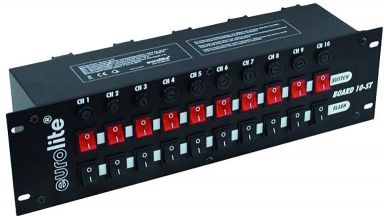
EUROLITE Board 10-ST 10x Schutzkontakt
EUROLITE Board 10-ST with 10x Safety-Plug
€99.00 *
incl. tax, free shipping to Germany
[International shipping costs]
Availability:
Delivery time: 1-3 days
EUROLITE Board 6-S mit 6x Schutzkontakt
EUROLITE Board 6-S with 6x Safety-Plugs
€59.90 *
incl. tax, plus shipping costs
Availability:
Delivery time: 3-5 days
Showtec DJ-Switch 8
SHOWGEAR DJSwitch 8
€89.00 *
incl. tax, free shipping to Germany
[International shipping costs]
Availability:
Delivery time: 3-5 days
EUROLITE Board 6 mit 6x Schutzkontakt
EUROLITE Board 6 with 6x Safety-Outlets
€49.90 *
incl. tax, plus shipping costs
Availability:
Delivery time: 3-5 days
EUROLITE Board 8-S 8x Kaltgerätebuchse
EUROLITE Board 8-S with 8x IEC Outputs
€54.90 *
incl. tax, plus shipping costs
Availability:
Delivery time: 3-5 days
IMG STAGE LINE MCS-180 Steckdosenleiste
MONACOR MCS-180 Rack-mount power strip
€142.59 *
incl. tax, free shipping to Germany
[International shipping costs]
Availability:
Delivery time: 3-5 days
6 Articles
Close filters
 
  •  
  •  
  •  
from to
No results were found for the filter!
EUROLITE Board 10-ST 10x Schutzkontakt
EUROLITE Board 10-ST with 10x Safety-Plug
10-fold switching panel, (10 x flash buttons), for separate switching of 10 safety sockets Fully cabled housing with 10 safety-sockets • 10 switches with flash-buttons • 10 manually...
€99.00 *
incl. tax, free shipping to Germany
[International shipping costs]
Availability:
Delivery time: 1-3 days
EUROLITE Board 6-S mit 6x Schutzkontakt
EUROLITE Board 6-S with 6x Safety-Plugs
6-fold switching panel for separate switching of 6 safety sockets Fully cabled housing with 6 safety sockets • 6 switches • Control via on/off switch on device • With profile rails...
€59.90 *
incl. tax, plus shipping costs
Availability:
Delivery time: 3-5 days
EUROLITE Board 8-S 8x Kaltgerätebuchse
EUROLITE Board 8-S with 8x IEC Outputs
8-fold switching panel for separate switching of 8 IEC outputs Fully cabled housing with 8 IEC outputs • 8 illuminated switches • 10 A breaker on the front panel • Control via on/off...
€54.90 *
incl. tax, plus shipping costs
Availability:
Delivery time: 3-5 days
Showtec DJ-Switch 8
SHOWGEAR DJSwitch 8
SHOWGEAR DJSwitch 8
Engaged switches are lit • Fuse on front panel • 8 IEC sockets • Maximum 10 A per channel • 8-channel switchboard. IEC outlets on backside 10 A per channel. 15 A total load....
€89.00 *
incl. tax, free shipping to Germany
[International shipping costs]
Availability:
Delivery time: 3-5 days
EUROLITE Board 6 mit 6x Schutzkontakt
EUROLITE Board 6 with 6x Safety-Outlets
Power distributor with switching panel with 6 safety sockets Fully cabled housing with 6 safety sockets • Control via on/off switch on device • Package contents 1 x device, 1 x user...
€49.90 *
incl. tax, plus shipping costs
Availability:
Delivery time: 3-5 days
IMG STAGE LINE MCS-180 Steckdosenleiste
MONACOR MCS-180 Rack-mount power strip
Rack-mount power strip, with 8 earthed sockets. Sockets can be switched individually via illuminated switches • Black sheet steel housing • 1.8 m connection cable with earthed plug...
€142.59 *
incl. tax, free shipping to Germany
[International shipping costs]
Availability:
Delivery time: 3-5 days
Facts
Professional Switch Panels for Stage and Event Technology: Switch panels are the central control hubs for professional stage and event lighting systems, enabling technicians to manage multiple lighting circuits, dimmer packs, and power distribution units from a single interface. Unlike marine or automotive switch panels, professional event switch panels integrate seamlessly with DMX512 control protocols, support high-amperage loads... Read more »
Viewed
Facts

Professional Switch Panels for Stage and Event Technology

Switch panels are the central control hubs for professional stage and event lighting systems, enabling technicians to manage multiple lighting circuits, dimmer packs, and power distribution units from a single interface. Unlike marine or automotive switch panels, professional event switch panels integrate seamlessly with DMX512 control protocols, support high-amperage loads (typically 16 A to 63 A per circuit), and feature robust construction designed for touring and permanent installations. At LTT, you will find a comprehensive range of control panels from leading manufacturers including Eurolite, Showtec, American DJ, and Omnitronic, all engineered to meet the demanding requirements of live events, theatre productions, and concert tours.

Modern switch panels combine traditional mechanical switching with digital control interfaces, offering LED status indicators, integrated voltmeters, and USB charging ports for mobile control devices. Whether you are managing a small club installation or a large-scale festival rig, the right switch panel ensures reliable operation, quick troubleshooting, and safe power sequencing. Professional-grade panels feature thermal circuit breakers, overload protection, and clearly labelled circuits to prevent operator error during high-pressure live situations.

Types of Control Panels for Event Lighting

Event lighting control panels fall into several distinct categories, each optimised for specific applications and power requirements. Manual switch panels provide direct on/off control for individual circuits, typically featuring 4 to 12 gang switches with integrated 15 A or 20 A thermal breakers. These panels are ideal for smaller venues, mobile DJ setups, and backup control systems where immediate physical access to power switching is essential.

DMX-integrated control panels combine power distribution with digital lighting control, allowing operators to manage both circuit switching and DMX signal routing from a single unit. These panels typically include XLR5 or RJ45 connectors for DMX input/output, OLED displays for channel monitoring, and programmable scene recall functions. Professional models support DMX512-A protocol with up to 512 channels per universe and feature galvanic isolation to prevent ground loops and signal interference.

Rack-mounted power distribution panels are designed for 19-inch touring racks and permanent installations, offering modular circuit configurations with CEE (Commando), Powercon, or Schuko outlets. These panels integrate seamlessly with lighting consoles and dimmer racks, providing centralised power management for complex lighting rigs. High-end models feature remote monitoring via Ethernet, allowing technicians to check load status and circuit health from front-of-house positions.

Mobile control panels are lightweight, portable units with built-in handles and protective covers, perfect for mobile DJs, bands, and rental companies. These panels typically combine 6 to 8 switched circuits with USB charging ports, voltmeters, and emergency stop buttons, all housed in impact-resistant ABS or polycarbonate enclosures rated to IP54 or higher for outdoor use.

DMX Integration and Digital Control Systems

The integration of DMX512 control into modern switch panels represents a significant evolution in stage lighting management, enabling technicians to automate power sequencing, synchronise lighting cues with audio triggers, and monitor system health in real time. Professional DMX-enabled panels feature dual-universe support (1024 channels total), allowing operators to control both conventional dimmers and intelligent fixtures from a single interface. These systems use industry-standard XLR5 connectors with 120 Ω termination and support RDM (Remote Device Management) for bidirectional communication with compatible fixtures.

Advanced panels incorporate Ethernet-based control protocols such as Art-Net and sACN (Streaming ACN), enabling integration with modern lighting consoles, media servers, and show control systems. This network-based approach allows multiple operators to access the same control infrastructure simultaneously, with priority management ensuring that critical commands always take precedence. Many professional installations now use PoE (Power over Ethernet) switch panels, which draw their own operating power from the network infrastructure, eliminating the need for separate power supplies and simplifying cable management.

For touring applications, DMX switch panels with built-in scene storage offer invaluable flexibility, allowing technicians to programme and recall complex lighting states without requiring a full lighting console. These standalone controllers typically store 100 to 500 scenes with fade times ranging from 0.1 to 99 seconds, and feature MIDI input for synchronisation with audio playback systems. The ability to trigger lighting changes via MIDI timecode is particularly valuable for theatrical productions and corporate events where precise timing is critical.

Safety features in professional DMX panels include automatic DMX signal detection, which prevents accidental fixture activation during setup, and emergency blackout functions that override all DMX commands to ensure immediate shutdown when required. High-quality panels also feature optical isolation on DMX inputs and outputs, protecting sensitive control electronics from voltage spikes and ground potential differences that can occur in large-scale installations.

Power Distribution and Safety Standards

Professional switch panels for stage and event lighting must comply with stringent electrical safety standards, including IEC 60204-1 for industrial machinery control and IEC 61439 for low-voltage switchgear assemblies. In Germany, installations must also meet DGUV Vorschrift 17 (formerly BGV C1) requirements for electrical equipment in entertainment venues, which mandate regular inspection intervals and documentation of all electrical modifications.

Load capacity calculations are fundamental to safe panel selection. A typical 16 A circuit at 230 V can supply 3,680 W, sufficient for approximately 36 conventional 100 W PAR cans or 12 moving heads drawing 300 W each. However, inrush current from capacitive loads (such as LED fixtures with switching power supplies) can be 10 to 20 times higher than steady-state current, requiring panels with high-speed circuit breakers rated for C-curve or D-curve characteristics to prevent nuisance tripping during power-on sequences.

Professional panels use a combination of protective devices: thermal-magnetic circuit breakers provide overload and short-circuit protection, residual current devices (RCDs) detect earth leakage faults, and surge protection devices (SPDs) guard against transient overvoltages from lightning strikes or grid switching events. For touring applications, panels with universal voltage inputs (100–240 V AC, 50/60 Hz) and automatic phase detection ensure reliable operation across international venues without manual reconfiguration.

Connector standards vary by region and application. European installations predominantly use CEE (Commando) connectors for three-phase distribution, with 16 A, 32 A, and 63 A ratings colour-coded blue (230 V) or red (400 V). North American and international touring rigs often specify Powercon connectors, which provide secure locking and are rated for 20 A at 250 V. High-current panels may incorporate cam-lock connectors for feeder cables, supporting currents up to 400 A per phase for large-scale festival power distribution.

Grounding and bonding are critical safety considerations. All metal enclosures must be connected to protective earth with conductors sized according to IEC 60364-5-54, and all circuits must maintain continuity to the main earthing terminal. Professional panels feature clearly marked earth studs with star washers to ensure reliable connections, and many include built-in earth continuity monitors that alert operators to dangerous fault conditions.

Installation and Rack Mounting Options

Rack-mounted switch panels are the industry standard for professional touring and permanent installations, offering modular scalability and standardised dimensions that integrate seamlessly with existing infrastructure. Standard 19-inch rack panels are available in heights from 1U (44 mm) to 6U (266 mm), with deeper units (up to 600 mm) accommodating complex power distribution networks and integrated dimmer modules.

Installation begins with proper rack selection. Touring racks require shock-mounted rails to protect sensitive electronics during transport, while fixed installations can use simpler wall-mounted or floor-standing cabinets. All racks must provide adequate ventilation, with a minimum of 100 mm clearance above and below high-power panels to prevent thermal buildup. For panels dissipating more than 500 W, forced-air cooling with temperature-controlled fans is essential to maintain component reliability.

Cable management is critical for both safety and maintainability. Professional installations use colour-coded cables with heat-shrink labels at both ends, documenting circuit numbers, load types, and maximum current ratings. Vertical cable managers with D-rings or horizontal finger ducts keep cables organised and prevent strain on connectors. For touring applications, cases and racks with integrated cable storage compartments ensure that all components remain together during transport.

Panel mounting hardware must be rated for the combined weight of the panel and connected cables. Standard M6 cage nuts and screws are suitable for panels up to 10 kg, while heavier units require reinforced mounting rails or through-bolted connections to the rack frame. Always verify that the rack's load rating exceeds the total installed weight, including a safety factor of at least 50% to account for dynamic loads during transport.

For mobile applications, quick-release mounting systems allow rapid panel swapping without tools, enabling technicians to reconfigure systems between shows. These systems use spring-loaded latches or quarter-turn fasteners and are particularly valuable for rental companies managing multiple simultaneous events. Proper labelling of all panels and cables using a consistent numbering scheme (e.g., "Panel A – Circuits 1–12") is essential for efficient troubleshooting and reduces setup time significantly.

Switch Panel Selection Guide for Events

Selecting the optimal switch panel for your event lighting system requires careful analysis of power requirements, control protocols, and operational environment. Begin by calculating total load: sum the wattage of all connected fixtures, add 20% for inrush current and future expansion, then divide by supply voltage to determine required amperage. For example, a rig with 8,000 W of LED fixtures at 230 V requires 34.8 A continuous, suggesting a panel with at least 40 A capacity distributed across multiple circuits for redundancy.

For small to medium venues (clubs, theatres, corporate events): A 6 to 12-circuit panel with 16 A breakers per circuit provides sufficient capacity for 20 to 40 conventional fixtures or 10 to 20 moving heads. Look for panels with integrated DMX control if you plan to automate lighting sequences, or choose manual panels with clear LED indicators if you prefer hands-on control. Brands such as Eurolite and Showtec offer excellent value in this category, with street prices ranging from €150 to €450 depending on features.

For touring and rental applications: Prioritise durability and quick setup. Rack-mounted panels with Powercon or CEE connectors reduce connection time and eliminate the risk of accidental disconnection during shows. Models with built-in RCD protection and surge suppression provide additional safety margins when working in unfamiliar venues with unknown electrical infrastructure. Expect to invest €600 to €1,500 for professional touring-grade panels from manufacturers such as Litec, Doughty, or Showtec Pro series.

For large-scale festivals and concerts: Modular power distribution systems with remote monitoring capabilities are essential. These systems typically combine multiple 63 A three-phase panels with centralised control via Ethernet, allowing power management teams to monitor load distribution, detect faults, and implement emergency shutdowns from a single location. High-end systems from brands such as Litecraft or Prolyte can exceed €3,000 per panel but provide the reliability and scalability required for events with hundreds of fixtures.

Key features to evaluate include: circuit labelling (backlit, customisable labels improve visibility in dark environments), indicator lights (bi-colour LEDs showing both power and fault status), connector types (ensure compatibility with your existing cable inventory), and mounting options (rack ears, surface mount, or portable enclosure). Always verify that the panel's IP rating matches your installation environment – IP20 is adequate for indoor use, while outdoor applications require IP54 or higher to protect against dust and water ingress.

Finally, consider future expansion. Panels with modular circuit boards or empty slots for additional breakers allow you to scale capacity as your lighting inventory grows, protecting your initial investment and avoiding costly panel replacements. For guidance on system design and panel selection, the LTT team offers expert consulting and planning services to ensure your installation meets both current needs and future requirements.

LTT – Your Specialist for Event Technology

At LTT, we understand that reliable power distribution and control systems are the foundation of every successful event. Our extensive range of switch panels and control systems spans from compact mobile units for DJs and bands to sophisticated rack-mounted distribution systems for large-scale touring productions. With over 25 years of experience in professional event technology, we provide not just products but complete solutions, backed by expert technical advice and comprehensive after-sales support.

Every switch panel in our portfolio is carefully selected from leading manufacturers known for quality and reliability. Whether you choose a compact Eurolite control panel for your mobile rig or a professional Showtec distribution system for permanent installation, you benefit from our rigorous quality standards and our commitment to supplying only equipment that meets professional industry requirements. Our team has extensive hands-on experience with these products in real-world applications, from club installations to international festival tours, and we are always available to share that knowledge with you.

When you order from LTT, you enjoy free shipping on orders over €69, with express delivery options available for urgent projects. All products are covered by our comprehensive 3-year LTT warranty, providing peace of mind for your investment. Our warehouse in Bocholt, Germany, maintains extensive stock levels, ensuring rapid dispatch and minimal downtime for your projects. For larger installations or custom configurations, our technical team can assist with system design, load calculations, and compliance verification to ensure your installation meets all relevant safety standards.

Explore our complete range of light controllers and power distributors to build a comprehensive control system tailored to your specific requirements. Whether you are upgrading an existing installation or building a new lighting rig from scratch, LTT is your reliable partner for professional event technology solutions.

FAQ – Questions & Answers

What is the difference between a switch panel for marine use and one for stage lighting?

Switch panels for stage lighting are specifically designed for high-power entertainment applications and typically integrate DMX512 control protocols, support loads from 16 A to 63 A per circuit, and feature professional connectors such as CEE, Powercon, or Schuko outlets. Marine switch panels, in contrast, are optimised for 12 V or 24 V DC systems with waterproof ratings (IP65 or higher) and focus on controlling pumps, navigation equipment, and onboard lighting. Stage lighting panels prioritise rapid circuit switching, thermal overload protection, and compatibility with dimmer packs and intelligent fixtures, while marine panels emphasise corrosion resistance and low-voltage operation. Professional event panels also comply with entertainment industry safety standards such as DGUV Vorschrift 17, which are not applicable to marine installations.

How do I calculate the required amperage for my lighting switch panel?

To calculate required amperage for a lighting switch panel, first sum the wattage of all fixtures you plan to connect (for example, 20 LED PAR cans at 150 W each equals 3,000 W total). Add 20% to account for inrush current and future expansion (3,000 W × 1.2 = 3,600 W). Divide this total by your supply voltage to determine continuous current draw (3,600 W ÷ 230 V = 15.7 A). Select a panel with capacity exceeding this value, distributed across multiple circuits for redundancy and flexibility. For example, a 6-circuit panel with 16 A breakers provides 96 A total capacity, allowing safe operation of your 15.7 A load with substantial headroom. Always verify that individual circuit loads do not exceed breaker ratings, and consult manufacturer specifications for fixtures with high inrush currents such as discharge lamps or large LED arrays.

Can I integrate DMX control with my existing switch panel?

Integration of DMX control with existing switch panels depends on the panel's design and available expansion options. Standalone DMX controllers can be added to manual switch panels by connecting DMX-controlled relay packs or dimmer modules to individual circuits, allowing automated switching without replacing the entire panel. However, this approach requires additional equipment and cabling. Purpose-built DMX-integrated panels offer superior functionality, combining power switching with native DMX512-A protocol support, scene storage, and remote monitoring capabilities. If you are planning a system upgrade, investing in a DMX-native panel provides better long-term value and eliminates the complexity of external control interfaces. For existing installations where panel replacement is not feasible, consult with the LTT technical team to evaluate retrofit options that maintain compatibility with your current infrastructure while adding automation capabilities.

What safety features should a professional switch panel include?

Professional switch panels for stage and event lighting must include multiple layers of safety protection. Essential features include thermal-magnetic circuit breakers rated for C-curve or D-curve characteristics to handle inrush currents from capacitive loads, residual current devices (RCDs) to detect earth leakage faults, and surge protection devices (SPDs) to guard against transient overvoltages. Panels should feature clearly labelled circuits with LED status indicators showing both power and fault conditions, emergency stop buttons for immediate shutdown, and proper grounding with marked earth terminals. High-quality panels also incorporate overload protection that prevents damage to connected fixtures, optical isolation on DMX connections to prevent ground loops, and thermal monitoring to alert operators before critical temperature thresholds are exceeded. For touring applications, panels should meet IP54 rating or higher to protect against dust and moisture ingress, and comply with DGUV Vorschrift 17 standards for electrical equipment in entertainment venues.

Which switch panel is best for mobile DJ and band applications?

For mobile DJ and band applications, compact portable switch panels with 6 to 8 circuits rated at 16 A each provide optimal balance between capacity and portability. Look for panels with integrated handles, protective covers, and impact-resistant ABS or polycarbonate enclosures rated to IP54 for outdoor use. Essential features include LED status indicators for quick visual confirmation of circuit status, USB charging ports for mobile devices and tablets, and built-in voltmeters to monitor supply voltage. Brands such as Eurolite and Showtec offer excellent mobile panels in the €150 to €350 price range, with models featuring DMX integration for automated lighting control. Ensure the panel includes thermal circuit breakers rather than replaceable fuses, as breakers can be reset immediately after an overload without requiring spare parts. For bands with larger lighting rigs, consider rack-mounted panels that integrate into existing equipment cases, providing better cable management and protection during transport.

What is the difference between 12 V and 24 V switch panels?

The primary difference between 12 V and 24 V switch panels lies in their voltage rating and typical application context. In professional stage and event lighting, switch panels operate at mains voltage (230 V AC in Europe, 120 V AC in North America) rather than low-voltage DC systems. However, 12 V and 24 V panels are common in mobile applications such as vehicle-mounted lighting rigs, battery-powered emergency systems, and off-grid installations. The 24 V systems offer advantages for higher-power applications, as they draw half the current of equivalent 12 V systems for the same wattage, reducing cable size requirements and voltage drop over long cable runs. For professional event lighting, mains-voltage AC panels are standard, providing the power capacity required for high-intensity discharge lamps, LED arrays, and moving head fixtures. If you require low-voltage control for specific applications, consult with LTT technical advisors to ensure proper system design and component selection.

How many gang switches do I need for my lighting installation?

The number of gang switches required for a lighting installation depends on the number of independent control zones you need and the total fixture count. A basic rule is to allocate one circuit per fixture type or control zone – for example, separate circuits for front wash, back wash, moving heads, and special effects. Small installations (clubs, small theatres) typically require 6 to 12 circuits, medium venues (concert halls, corporate events) need 12 to 24 circuits, and large-scale productions (festivals, arena shows) may require 48 or more circuits distributed across multiple panels. Consider future expansion when selecting panel size; choosing a panel with 20% more circuits than your current requirement provides flexibility for additional fixtures without requiring panel replacement. For complex installations with multiple fixture types, group similar loads on the same circuit to simplify cable management and troubleshooting. The LTT team can assist with circuit planning and load distribution calculations to ensure your panel configuration meets both current and future requirements.

What connector types are standard for professional switch panels?

Professional switch panels for stage and event lighting use several standardised connector types depending on region and application. In European installations, CEE connectors (also known as Commando connectors) are the industry standard for three-phase power distribution, available in 16 A, 32 A, and 63 A ratings with colour coding – blue for 230 V single-phase and red for 400 V three-phase. Powercon connectors, developed by Neutrik, are widely used in international touring applications, providing secure locking connections rated for 20 A at 250 V and available in blue (input) and grey (output) variants to prevent mis-wiring. Schuko (Type F) outlets are common for lower-power circuits and provide compatibility with standard European equipment. High-current feeder connections often use cam-lock connectors, supporting currents up to 400 A per phase for large-scale festival distribution. For DMX control, XLR5 connectors are the professional standard, offering superior reliability compared to XLR3 and supporting RDM (Remote Device Management) for bidirectional communication. When selecting a panel, ensure connector types match your existing cable inventory to avoid costly adapter purchases and potential connection reliability issues.

// Countdown for Black Deals