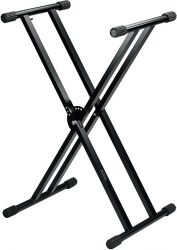
Mixer stands
Mixer Stands – The Stable Foundation for Your Audio Control Centre
A professional mixer stand is the backbone of every well-organised audio setup. Whether you're mixing at front-of-house, operating a monitor console, or managing sound for theatre productions, your mixing console deserves a stable, ergonomic platform. At LTT, we offer a comprehensive range of mixer stands that combine robust construction with intelligent design – from lightweight scissor stands for mobile DJs to heavy-duty four-leg constructions for permanent installations. Every stand in our portfolio is selected to meet the demanding requirements of professional event technology, ensuring your equipment stays secure whilst you focus on delivering outstanding sound.
What Is a Mixer Stand and Why Do You Need One?
A mixer stand is a specialised support structure designed to hold mixing consoles, DJ controllers, keyboards, and similar equipment at an ergonomic working height. Unlike improvised solutions such as tables or flight cases stacked on the floor, a dedicated mixer stand provides several critical advantages: it positions your equipment at the optimal height to prevent back strain during long mixing sessions, it offers a stable platform that resists vibrations and accidental knocks, and it typically features adjustable width and height to accommodate different console sizes.
The most common designs include scissor stands (also called X-stands), which fold flat for transport and offer stepless or multi-level height adjustment, and Z-stands, which provide a wider footprint and often include a lower shelf for laptops or additional gear. Four-leg table-style stands offer maximum stability for heavy consoles and permanent installations. Most professional mixer stands feature rubber-coated contact surfaces to prevent scratches and provide vibration damping, whilst non-slip feet ensure the stand stays firmly in place even on smooth stage floors.
Compared to keyboard stands, mixer stands typically offer greater load capacity – often between 40 kg and 80 kg – and wider adjustment ranges to accommodate the larger footprint of mixing consoles. Many models are also compatible with standard 19-inch rack equipment, making them versatile additions to your DJ Tables & Stands setup. The key difference from generic equipment tables lies in the portability: professional mixer stands fold or collapse to a fraction of their working size, making them indispensable for mobile event technicians who need to transport their entire rig between venues.
Applications – Where Mixer Stands Prove Indispensable
Mixer stands find their place across the entire spectrum of professional audio applications. Mobile DJs and live sound engineers rely on foldable scissor stands that set up in seconds and pack into the boot alongside speaker boxes and cables. The height adjustability ensures comfortable operation whether you're standing or seated, whilst the compact footprint fits into tight DJ booths or crowded backstage areas.
Theatre and fixed installation venues often opt for heavier four-leg stands or Z-stands with additional shelving. These provide a permanent home for the mixing console at front-of-house or monitor positions, with enough stability to support consoles weighing 60 kg or more. The lower shelf accommodates laptops running playback software, effects processors, or wireless microphone receivers, creating a complete mixing workstation.
Festival and outdoor event technicians appreciate stands with locking mechanisms and reinforced construction that can withstand the rigours of outdoor use. When integrated with Speakerbox stands / tripods and professional rigging systems, mixer stands become part of a cohesive stage setup that meets safety standards whilst maintaining ergonomic working conditions.
Beyond traditional mixing applications, these stands serve double duty as keyboard stands for musicians, laptop stands for VJs and lighting operators, and even as elevated platforms for studio monitors in temporary recording setups. The versatility makes them a cost-effective investment for anyone working in event technology, where adaptability is as important as reliability.
Quality Criteria and Professional Standards for Mixer Stands
When selecting a mixer stand for professional use, several technical specifications separate adequate solutions from truly reliable equipment. Load capacity is paramount: entry-level stands typically support 40 kg, sufficient for compact digital mixers and DJ controllers, whilst professional-grade models handle 60–80 kg to accommodate large-format analogue consoles or multiple pieces of rack-mounted equipment. Always verify the manufacturer's stated capacity and add a safety margin – a stand rated for 40 kg should ideally carry no more than 30 kg in regular use.
Height adjustment range directly impacts ergonomics. Most scissor stands adjust from approximately 61 cm to 98 cm, covering both seated and standing operation. Look for models with at least seven adjustment positions or, better still, stepless adjustment via a locking collar. Width adjustment is equally important: professional stands accommodate consoles from 300 mm to 550 mm wide, with some extending to 700 mm for extra-large mixing desks.
Construction material determines both weight and durability. Aluminium stands offer the best strength-to-weight ratio, typically weighing 2.5–3.5 kg whilst maintaining excellent rigidity. Steel constructions are heavier (4–6 kg) but provide superior stability for permanent installations. Premium manufacturers such as König & Meyer, Gravity, and Manfrotto use aircraft-grade aluminium with reinforced welds at stress points, ensuring longevity even under daily professional use.
Surface treatment and accessories matter more than many users realise. Rubber-coated support bars prevent console scratches and provide vibration damping – essential when the stand is positioned near speaker systems. Adjustable rubber feet with at least 50 mm diameter prevent floor damage and compensate for uneven surfaces. Some models include integrated cable management clips or hooks, keeping Microphone Cables and power leads organised.
Price brackets reflect these quality differences: budget stands start around €30–50, mid-range professional models cost €80–150, and premium heavy-duty stands reach €200–300. For event professionals, investing in the mid-to-premium range pays dividends through reduced setup time, greater reliability, and longer service life.
Integration with Professional Rigging and Stage Systems
One aspect rarely discussed by consumer-focused retailers is how mixer stands integrate into professional stage and rigging environments – a critical consideration for event technicians working with complex setups. When your mixing position is part of a larger stage construction involving truss systems, proper weight distribution and floor loading become essential safety factors.
Professional mixer stands designed for touring and festival use often feature triangular base plates or outrigger feet that distribute point loads across a wider area. This matters particularly when working on elevated platforms such as Bullstage systems or temporary staging, where concentrated loads can exceed the deck's rated capacity. A 60 kg console on a stand with a 300 mm × 300 mm footprint creates a point load of approximately 6.5 kN/m² – well within most stage specifications – but a poorly designed stand with narrow feet might double that figure.
When positioning mixer stands near Lifting tackle or under truss structures, clearance and escape routes must be considered. DGUV Vorschrift 17 (formerly BGV C1) mandates minimum clearances around rigging points, and your mixing position must not obstruct emergency egress. Professional stands with foldable designs allow rapid repositioning if the stage layout changes during load-in.
Cable management becomes critical in integrated setups. Runs of Multicore Cables & Stage Boxes from stage to FOH must be secured and protected, whilst Power Strips and 19" power strips need stable mounting points. Some professional mixer stands include accessory rails or threaded mounting points compatible with standard M6 or M8 hardware, allowing you to attach cable trays, power distribution units, or even small equipment shelves.
For permanent installations in theatres or clubs, consider stands that can be bolted to the floor or integrated with custom-built FOH platforms. This transforms the mixer stand from a portable accessory into a structural component of your venue's technical infrastructure, meeting building safety codes whilst providing the stability demanded by large-format consoles.
Transport, Storage, and Roadcase Compatibility
For mobile event technicians, a mixer stand's value extends beyond its performance at the venue – how it packs, transports, and stores determines whether it's a practical tool or a logistical burden. Professional scissor stands fold to dimensions of approximately 900 mm × 400 mm × 100 mm, allowing them to slide into the back of a van alongside flight cases or fit into overhead storage in tour buses. Weight matters: a 2.6 kg aluminium stand can be carried in one hand along with a Mic stands bag, whilst a 6 kg steel model requires dedicated handling.
Many manufacturers supply padded transport bags with shoulder straps, protecting the stand during transit and preventing scratches to other equipment. For touring professionals, consider stands that fit into standard flight case dimensions. A folded scissor stand typically fits a 1000 mm × 500 mm × 150 mm case, which can be stacked with other gear in the truck. Some heavy-duty Z-stands disassemble into two or three components, reducing packed length to under 800 mm.
Quick-release mechanisms dramatically reduce setup time. Premium stands feature spring-loaded pins or cam-lock levers that allow height and width adjustment without tools, cutting setup from five minutes to under one minute. This matters when you're working multiple events per day or facing tight changeover windows at festivals. Look for stands with clearly marked adjustment positions and positive locking – there should be no doubt when the stand is correctly secured.
Storage considerations include corrosion resistance (especially for stands used in outdoor or high-humidity environments) and spare parts availability. Reputable manufacturers such as König & Meyer and Gravity offer replacement feet, adjustment collars, and locking pins, extending the stand's service life. A professional mixer stand should deliver five to ten years of regular use before requiring replacement, making it one of the most cost-effective investments in your equipment inventory.
LTT – Your Specialist for Event Technology
At LTT, we understand that every component of your event technology setup must work together seamlessly. That's why our mixer stand range includes models from leading manufacturers such as König & Meyer, Gravity, Manfrotto, and Adam Hall – brands trusted by professional sound engineers and event technicians worldwide. Whether you need a lightweight scissor stand for mobile DJ work or a heavy-duty four-leg construction for permanent installation, our specialists help you select the optimal solution for your specific requirements.
With over 25 years of experience in professional event technology, we don't just supply equipment – we provide complete system solutions. Our mixer stands integrate perfectly with our comprehensive range of Miscellaneous stands and Laptop stands, creating cohesive workstations that meet the demands of modern event production. Every product ships from our warehouse in Bocholt, Germany, with free delivery on orders over €69 and express shipping available when you need equipment urgently.
Our commitment to quality extends beyond the products themselves: every mixer stand carries a three-year LTT warranty, giving you peace of mind whether you're investing in your first mobile setup or expanding a professional touring inventory. As both a specialist retailer and manufacturer with our own production facilities, we understand the real-world demands of event technology and select only equipment that meets professional standards. Discover the LTT difference – where technical expertise meets reliable service.
FAQ – Questions & Answers
Yes, most professional mixer stands are fully compatible with keyboards and synthesizers. The typical width adjustment range of 300–550 mm accommodates keyboards from 54 to 88 keys, whilst the load capacity of 40–80 kg easily supports even heavy stage pianos. The height adjustment (usually 61–98 cm) allows comfortable playing whether seated or standing. However, verify that the stand's support bars are wide enough to prevent the keyboard from tipping – some narrow mixer stands may require additional support for full-length 88-key instruments. Many musicians specifically choose mixer stands over dedicated keyboard stands because they offer greater stability and adjustability.
Professional mixer stands typically offer load capacities between 40 kg and 80 kg, depending on construction and design. Entry-level scissor stands usually support 40 kg, which is sufficient for compact digital mixers, DJ controllers, and small keyboards. Mid-range professional models handle 50–60 kg, accommodating most analogue mixing consoles and heavier equipment. Heavy-duty four-leg stands and reinforced Z-stands reach 70–80 kg capacity, suitable for large-format consoles or multiple pieces of rack-mounted equipment. Always maintain a safety margin: a stand rated for 40 kg should carry no more than 30 kg in regular professional use to ensure long-term reliability and safety.
Yes, virtually all professional mixer stands feature height adjustment, typically ranging from 61 cm to 98 cm. This range covers both seated operation (61–75 cm) and standing operation (80–98 cm), allowing you to maintain ergonomic posture during long mixing sessions. Entry-level stands usually offer seven fixed adjustment positions using spring-loaded pins, whilst premium models provide stepless adjustment via locking collars or cam-lock mechanisms. Some heavy-duty four-leg stands use threaded height adjustment for precise positioning. When selecting a stand, verify that the adjustment mechanism locks positively – there should be no doubt when the stand is correctly secured at your desired height.
X-stands (scissor stands) and Z-stands represent two distinct approaches to mixer stand design, each with specific advantages. X-stands feature a scissor mechanism that folds completely flat, making them extremely portable – they typically pack to 900 mm × 400 mm × 100 mm and weigh 2.5–3.5 kg. They're ideal for mobile DJs and event technicians who transport equipment frequently. Z-stands use a side-profile design that resembles the letter Z, offering a wider footprint for greater stability and often including a lower shelf for laptops or additional gear. Z-stands are heavier (4–6 kg) and don't fold as compactly, but they provide superior stability for permanent installations and heavier consoles. Choose X-stands for maximum portability, Z-stands for maximum stability and workspace.
Selecting the right mixer stand requires matching four key specifications to your console's requirements. First, verify the load capacity: weigh your console and add 25% as a safety margin – a 30 kg console needs a stand rated for at least 40 kg. Second, check width compatibility: measure your console's width and ensure the stand adjusts to at least 50 mm wider than that dimension. Third, consider height requirements: if you'll be standing, you need adjustment to at least 90 cm; seated operation requires 70–75 cm. Finally, assess portability needs: mobile applications demand foldable scissor stands under 3.5 kg, whilst permanent installations benefit from heavier four-leg or Z-stand designs. For professional touring use, prioritise stands from manufacturers such as König & Meyer, Gravity, or Manfrotto that offer spare parts and proven reliability.
Mixer stands used in professional event environments must comply with general equipment safety principles outlined in DGUV Vorschrift 17 (formerly BGV C1), which governs the use of event technology equipment in Germany. Whilst mixer stands themselves aren't typically subject to specific load-bearing certifications like truss systems, they must be suitable for their intended purpose and regularly inspected for damage. Key safety considerations include: verifying that the stand's load capacity exceeds your console's weight by at least 25%, ensuring all locking mechanisms engage positively, checking that rubber feet are intact and provide adequate grip, and confirming that the stand's footprint provides sufficient stability (a general rule is that the base should extend at least 40% of the console's width on each side). When positioning stands on elevated platforms or near rigging points, consider point loads and maintain clearances specified in venue safety documentation.
Many professional mixer stands accommodate additional equipment through various mounting options. Z-stands typically include a lower shelf (usually supporting 10–20 kg) suitable for laptops, effects processors, or wireless microphone receivers. Some premium models feature accessory rails with M6 or M8 threaded mounting points, allowing you to attach cable trays, power distribution units, or small equipment shelves. Four-leg table-style stands often provide enough surface area to position a laptop alongside your console. However, always verify that adding equipment doesn't exceed the stand's total load capacity, and ensure that additional weight is distributed evenly to maintain stability. For complex setups requiring multiple equipment tiers, consider dedicated DJ tables or custom-built workstations rather than overloading a standard mixer stand.
Professional mixer stands require minimal but regular maintenance to ensure longevity and safety. After each use, wipe down all surfaces to remove dust, moisture, and residue from fog or haze effects, which can corrode metal components over time. Inspect rubber feet and contact pads every few months, replacing them if they show signs of hardening, cracking, or loss of grip – most manufacturers supply replacement feet for €5–15. Check all adjustment mechanisms and locking pins for smooth operation; if they become stiff, apply a small amount of silicone spray (never oil, which attracts dust). Examine welds and joints for cracks or deformation, particularly on stands that carry heavy loads regularly. Store stands in a dry environment, ideally in their transport bags, to prevent corrosion. With proper care, a professional mixer stand should deliver 5–10 years of reliable service.