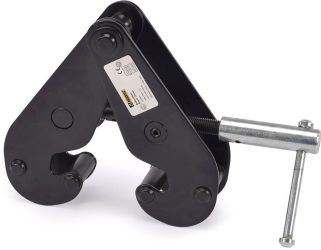
Beam clamps
Professional Beam Clamps for Event Technology – Your Specialist LTT
Beam clamps are essential rigging hardware for professional event technology, stage construction and temporary installations. They enable fast, secure attachment of loads to steel beams, I-beams and truss systems without drilling or welding. Whether you're rigging lighting fixtures, hanging speakers, mounting cable runs or installing sprinkler systems — beam clamps deliver reliable load attachment points with working load limits (WLL) from 1 to 5 tonnes. LTT supplies professional-grade beam clamps from leading manufacturers including Riggatec®, Doughty, Litec and Manfrotto, engineered for the demanding requirements of live events, theatre productions and touring applications.
What Are Beam Clamps and How Do They Work?
Beam clamps — also known as girder clamps, mounting clamps or flange clamps — are force-transmitting fastening elements that create secure attachment points on steel beams, H-beams, I-beams and similar structural profiles. Unlike traditional methods that require drilling holes or welding brackets, beam clamps use mechanical clamping force to grip the beam flange.
The working principle is straightforward yet highly effective: the clamp body is positioned on the beam flange, and a threaded spindle or bolt is tightened to generate clamping pressure. This creates a friction-locked connection capable of withstanding substantial vertical and horizontal loads. Modern beam clamps feature hardened steel contact surfaces and precisely engineered thread geometry to distribute clamping forces evenly across the beam flange.
Types of Beam Clamps for Event Applications
In professional event technology, three main types dominate:
Standard beam clamps with threaded holes or through-holes accept threaded rods, shackles or eye bolts for vertical suspension. These are ideal for hanging lighting fixtures, speakers or decorative elements from overhead beams.
T-beam clamps are specifically designed for narrow-flange T-section beams commonly found in older venues and industrial buildings. Their compact profile allows installation in confined spaces where standard clamps cannot fit.
Cross-connection clamps (MTH-type) join two intersecting beams at right angles, creating rigid structural connections for truss grids, temporary roof structures and stage canopies. These systems typically combine a clamp plate with two or more beam clamps to form a complete cross joint.
All professional beam clamps for event rigging must comply with DGUV Vorschrift 17 (formerly BGV C1) — the German statutory accident insurance regulation governing temporary structures in entertainment venues. This standard mandates minimum safety factors, material specifications and regular inspection intervals.
Applications in Stage Construction and Event Rigging
Beam clamps are indispensable in virtually every aspect of professional event production. Their ability to create secure attachment points without permanent modification to venue infrastructure makes them the preferred solution for temporary installations.
Stage and truss rigging represents the most common application. Beam clamps attach truss systems to building steelwork, creating overhead grids for lighting, video screens and scenic elements. Riggers use clamps rated for the combined dead load of the truss structure plus the dynamic loads from moving fixtures and wind forces. For touring productions, the speed of installation is critical — a skilled rigger can install and torque a beam clamp in under two minutes, compared to 15–20 minutes for a drilled and bolted connection.
Cable management and pipe runs benefit from beam clamps in both temporary and semi-permanent installations. Electrical contractors use T-beam clamps to support cable trays, conduit runs and festoon systems along building steelwork. The adjustability of beam clamps allows precise positioning even when beam spacing is irregular.
Lifting and hoisting operations in venues without fixed rigging points rely on beam clamps as temporary lifting attachments. Chain hoists, wire rope hoists and manual lever hoists can be shackled directly to appropriately rated beam clamps, provided the beam itself has adequate structural capacity. Always verify beam load capacity with a structural engineer before suspending significant loads.
Theatre and studio installations use beam clamps for scenery suspension, curtain tracks and acoustic treatment. The non-destructive nature of clamp mounting preserves historic building fabric — a critical consideration in listed theatres and heritage venues.
Cross-connection clamps create rigid structural joints in temporary roof structures, exhibition stands and outdoor festival stages, where welded connections are impractical and bolted connections would require extensive drilling.
Quality Standards and Professional Selection Criteria
Selecting the correct beam clamp requires careful consideration of load requirements, beam geometry and environmental conditions. Professional riggers evaluate multiple technical parameters before specifying equipment.
Working Load Limit and Safety Factors
The working load limit (WLL) is the maximum load a beam clamp may support in normal service. Professional beam clamps for event rigging typically offer WLL ratings from 1 tonne (10 kN) to 5 tonnes (50 kN). The WLL already incorporates a safety factor — typically 4:1 for static loads and 5:1 for dynamic loads — meaning a 2-tonne WLL clamp has an ultimate breaking strength of 8–10 tonnes.
Critical consideration: the WLL applies only when the clamp is correctly matched to the beam flange width and properly torqued. A 2-tonne clamp on an undersized beam may slip at loads well below its rated capacity. Always verify that your beam flange width falls within the clamp's specified range — typically 75–230 mm for standard clamps, 80–320 mm for heavy-duty models.
Material Specifications and Corrosion Protection
Professional beam clamps from manufacturers such as Riggatec®, Doughty and Litec use hot-dip galvanized steel (DIN EN ISO 1461) for the clamp body and spheroidal graphite cast iron (GGG-40 or GGG-50) for high-stress components. Hot-dip galvanizing provides superior corrosion protection compared to electro-galvanizing, essential for outdoor festivals and marine environments.
For permanent installations in corrosive atmospheres, stainless steel beam clamps (grade A4/316) are available. These cost 3–4 times more than galvanized steel equivalents but offer indefinite service life in coastal or chemical environments.
Torque Specifications and Installation
Correct installation torque is critical for achieving the rated WLL. Under-torquing results in insufficient clamping force and potential slippage; over-torquing can damage threads or crack the clamp body. Manufacturers specify torque values for each clamp model — typically 40–60 Nm for 1-tonne clamps, 80–120 Nm for 2-tonne models, and 150–200 Nm for 5-tonne heavy-duty clamps.
Professional riggers use calibrated torque wrenches and mark each clamp with inspection tape after installation. DGUV Vorschrift 17 requires documented torque verification for all load-bearing rigging hardware.
Leading brands in the LTT range include Riggatec® beam clamps (German-engineered with TÜV certification), Doughty clamps (the industry standard in UK theatre), Litec and Manfrotto clamps for lightweight applications, and heavy-duty models from Prolyte and Global Truss for large-scale touring productions.
Beam Clamps vs Traditional Rigging Methods — Technical Comparison
The choice between beam clamps and traditional fastening methods depends on load requirements, installation duration and structural considerations. Understanding the technical trade-offs enables informed specification decisions.
Beam Clamps vs Welded Brackets
Welded brackets offer the highest load capacity and the most compact profile, but require hot-work permits, certified welders and permanent modification to the beam. Welding alters the metallurgical structure of the beam and may require structural engineering approval. In listed buildings or rented venues, welding is often prohibited entirely.
Beam clamps install in minutes without hot work, require no structural modification and can be relocated as production needs change. The trade-off is lower load capacity per attachment point — a welded lug might support 10 tonnes in a compact footprint, whereas achieving the same capacity with beam clamps requires multiple attachment points or heavy-duty models.
Beam Clamps vs Drilled and Bolted Connections
Drilling through beam flanges creates permanent holes that weaken the beam section and may violate building codes. Each drilled hole removes material from the tension or compression zone of the beam, reducing its bending capacity. Structural engineers must approve all drilled connections and specify maximum hole sizes and spacing.
Beam clamps avoid these complications entirely. They can be installed and removed without affecting the beam's structural integrity, making them ideal for temporary events and touring productions. Installation time is 5–10 times faster than drilling and bolting.
Load Distribution and Beam Capacity
A critical but often overlooked consideration: the beam itself must have adequate capacity to support the applied loads. Beam clamps transfer concentrated loads into the beam flange, creating local bending stresses. Older I-beams with thin flanges may not tolerate the concentrated loads from heavy beam clamps, even if the clamp itself is adequately rated.
Professional riggers consult structural drawings or engage a structural engineer to verify beam capacity before installing heavy loads. The beam's section modulus, material grade and span length all affect its load-carrying capacity. A 200 mm I-beam might safely support 2 tonnes at mid-span or 5 tonnes near a column — the attachment location matters as much as the clamp rating.
For maximum versatility and safety, many production companies maintain an inventory of beam clamps in multiple WLL ratings, allowing them to adapt to varying beam sizes and load requirements across different venues.
Installation Guide for Professional Riggers — Best Practices
Correct installation technique is essential for achieving the rated working load limit and ensuring safe operation throughout the event. Follow this systematic procedure for every beam clamp installation.
Pre-Installation Inspection
Before installation, inspect each beam clamp for damage, deformation or excessive wear. Check that:
- Thread engagement is clean and undamaged
- Contact surfaces are free from paint, rust or debris
- Spindle or bolt rotates smoothly without binding
- Clamp body shows no cracks, especially around thread bosses
- Identification markings (WLL rating, manufacturer, serial number) are legible
Inspect the beam flange for:
- Flange width within the clamp's specified range
- Surface cleanliness (remove loose rust, paint or oil)
- Flange thickness adequate for the clamp design
- No excessive corrosion that would reduce flange strength
Installation Procedure
Step 1: Position the clamp body on the beam flange, ensuring the clamp sits squarely with full contact across the flange width. Misalignment reduces clamping force and can cause the clamp to walk along the beam under vibration.
Step 2: Insert the threaded spindle or bolt and hand-tighten until the clamp grips the flange firmly. For clamps with separate top and bottom plates, ensure both plates are parallel to the beam flange.
Step 3: Using a calibrated torque wrench, tighten the spindle to the manufacturer's specified torque value. Apply torque in a smooth, steady motion — impact wrenches are not suitable for this application as they can over-torque and damage threads.
Step 4: Mark the installation with inspection tape or paint pen, noting the installation date and rigger's initials. This provides visual confirmation that the clamp has been properly torqued and allows tracking of inspection intervals.
Load Attachment
Attach loads using appropriately rated hardware — shackles, eye bolts or threaded rods. Ensure that:
- Shackle pins are fully engaged and moused (safety-wired)
- Eye bolts are torqued to the manufacturer's specification
- Threaded rods use lock nuts or thread-locking compound
- Load direction is vertical or within the clamp's rated angular tolerance
Many beam clamps are rated for vertical loads only. Side-loading or angular loading can dramatically reduce the safe working load. If angled loads are unavoidable, consult the manufacturer's load angle de-rating chart.
Inspection and Maintenance
DGUV Vorschrift 17 requires regular inspection of all load-bearing rigging hardware. For beam clamps in regular use:
- Daily: Visual check for obvious damage or loosening
- Weekly: Verify torque on critical attachments
- Annually: Detailed inspection by a competent person, with documentation
Clamps showing wear, deformation or corrosion must be withdrawn from service and replaced. Never attempt to repair damaged beam clamps — the cost of replacement is trivial compared to the consequences of failure.
LTT – Your Specialist for Event Technology Rigging Hardware
LTT has supplied professional rigging hardware to the event technology industry for over 25 years. As both distributor and manufacturer, we understand the technical demands of touring productions, permanent installations and one-off events.
Our beam clamp range includes professional-grade products from Riggatec® — our own German-engineered brand with TÜV certification — alongside industry-standard models from Doughty, Litec, Manfrotto, Prolyte and Global Truss. Every product meets or exceeds DGUV Vorschrift 17 requirements, with full technical documentation and certification supplied as standard.
When you order from LTT, you benefit from free shipping on orders over €69, express delivery options for urgent productions, and our 3-year guarantee on all rigging hardware. Our technical sales team can advise on clamp selection, load calculations and compliance with German rigging standards — call us before your next installation.
Explore our complete range of rigging hardware, truss systems and stage construction equipment. LTT — setting the stage for your success.
FAQ – Questions & Answers
Electrical beam clamps are designed for supporting cable trays, conduit and light-duty electrical installations, typically with working load limits under 500 kg. They often feature quick-release mechanisms for fast installation and removal. Structural beam clamps for event rigging are engineered for heavy-duty load attachment with WLL ratings from 1 to 5 tonnes. They use high-strength materials (hot-dip galvanized steel and spheroidal cast iron), require torque-controlled installation, and must comply with DGUV Vorschrift 17 for temporary structures. Structural clamps undergo rigorous testing and certification, whereas electrical clamps follow different standards (VDE, IEC). Never use electrical-grade clamps for rigging loads — the safety margins and material specifications are completely different.
Standard beam clamps work on both H-beams and I-beams provided the flange width falls within the clamp's specified range (typically 75–230 mm for light-duty models, 80–320 mm for heavy-duty versions). H-beams and I-beams have similar flange geometry, so the same clamp fits both profiles. The critical dimension is flange width, not beam designation. T-beam clamps are specifically designed for T-section beams with narrower flanges and limited clearance above the flange. Always measure the actual flange width before selecting a clamp — beam designations (e.g. IPE 200, HEB 240) indicate overall height, not flange width. Consult the beam's dimensional specifications or measure directly on site to ensure correct clamp selection.
Torque specifications vary by clamp model and working load limit. Typical values are: 1-tonne WLL clamps require 40–60 Nm, 2-tonne clamps need 80–120 Nm, 3-tonne models specify 120–150 Nm, and 5-tonne heavy-duty clamps demand 150–200 Nm. Always follow the manufacturer's exact specification printed on the clamp body or provided in the technical documentation. Use a calibrated torque wrench — never estimate torque by feel or use impact tools. Under-torquing results in insufficient clamping force and potential slippage under load; over-torquing can strip threads or crack the clamp body. Re-check torque after the first load cycle and periodically during extended installations, as settling and vibration can reduce clamping force over time.
Yes, beam clamps can be used in ATEX-classified explosive atmosphere zones (Zone 0, 1, 2 for gases; Zone 20, 21, 22 for dusts) because their installation requires no hot work, grinding or drilling that could generate ignition sources. This is a significant advantage over welding or drilling, which are prohibited in explosive atmospheres without extensive safety measures. However, the beam clamps themselves must be manufactured from non-sparking materials if there is any risk of impact during installation or service. Standard galvanized steel clamps are acceptable for most applications; stainless steel or bronze clamps are preferred in highly sensitive environments. Always consult the venue's ATEX risk assessment and follow the designated safe systems of work. The ability to install rigging points without hot-work permits makes beam clamps the preferred solution in chemical plants, fuel storage facilities and similar hazardous locations.
Calculate the total static load (dead weight of all suspended equipment), then add dynamic factors for movement, vibration or wind loading. For static installations (fixed lighting, speakers), use the total equipment weight. For moving loads (chain hoists, flying effects), multiply the static load by 1.5–2.0 to account for dynamic forces. Add a safety factor: DGUV Vorschrift 17 requires minimum 5:1 for entertainment rigging. Therefore, to suspend a 400 kg lighting truss, calculate: 400 kg static + 200 kg dynamic allowance = 600 kg total load. With 5:1 safety factor: 600 kg × 5 = 3000 kg (3 tonnes) minimum breaking strength required. Select a beam clamp with WLL ≥ 600 kg, which will have a breaking strength of 3 tonnes or more. Always round up to the next available WLL rating — never operate rigging hardware at or near its maximum rated capacity.
Beam clamps attach to structural steel beams (I-beams, H-beams, T-beams) in buildings or temporary structures, creating load attachment points on the beam flange. They are designed for flange widths of 75–320 mm and use threaded spindles to generate clamping force. Truss clamps (also called truss hooks or half-couplers) attach to the tubes of aluminium or steel truss systems, typically 48–51 mm diameter. Truss clamps use a different clamping mechanism optimized for round or triangular tube sections and have much lower working load limits (typically 100–500 kg). The applications are complementary: beam clamps attach truss systems to building steelwork, while truss clamps attach lighting fixtures and accessories to the truss itself. Never use a truss clamp on a structural beam or a beam clamp on truss tubing — each is engineered for specific geometry and load conditions.
DGUV Vorschrift 17 (formerly BGV C1) requires inspection of all load-bearing rigging equipment before each use, with detailed documented inspections at regular intervals. For beam clamps in regular service: daily visual inspection for obvious damage or loosening; weekly torque verification on critical attachments; annual detailed inspection by a competent person (sachkundige Person) with written documentation. The annual inspection must verify that the clamp shows no deformation, cracks, excessive wear or corrosion, that all markings remain legible, and that the clamp still meets the manufacturer's specifications. Any clamp showing damage or wear must be immediately withdrawn from service. Keep inspection records for the lifetime of the equipment plus one year. For touring productions, many companies inspect rigging hardware after every show or weekly, whichever is more frequent, to catch damage early.
MTH (Multi-Träger-Halter, or multi-beam holder) clamps are specialized systems for creating rigid cross-connections between two intersecting steel beams at right angles. An MTH connection uses two beam clamps plus an intermediate clamp plate to join the beams without drilling or welding. This creates a structural node capable of transferring shear and moment forces between the beams. MTH clamps are essential for temporary roof structures, truss grids, exhibition stands and outdoor festival stages where intersecting beams must act as a unified structural system. They offer significantly higher rigidity than simple overlapping beams and allow adjustment during installation to accommodate irregular beam spacing. Typical MTH systems use C45 heat-treated steel components with hot-dip galvanizing or stainless steel (A4 grade) for permanent installations. Always follow the manufacturer's assembly sequence and torque specifications — incorrect installation can result in eccentric loading and premature failure.