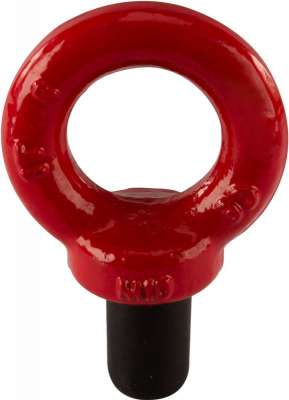
Eyelets, ring nuts and suspension links
Professional Eye Bolts, Eye Nuts and Suspension Links for Stage Rigging
Eye bolts, eye nuts and suspension links are essential rigging hardware components for professional stage and event technology. These threaded fasteners create secure lifting points for truss systems, lighting rigs, PA equipment and stage decorations. At LTT, you will find high-quality eye bolts and eye nuts from leading manufacturers such as Riggatec, RUD and other premium brands — all certified to DIN 580, DIN 582 and EN 1677 standards. Whether you need fixed eye bolts for permanent installations or swivel eye bolts for flexible load direction, our range covers every professional application in event technology.
Our selection includes galvanised steel, stainless steel A2 and A4 variants, as well as powder-coated options in Grade 8 and Grade 10 quality. Each product is 100% crack-tested and designed with a minimum 4-fold safety factor, ensuring reliable performance even under dynamic loads. With thread sizes from M6 to M48 and working load limits (WLL) ranging from 0.4 tonnes to 32 tonnes, you can specify the exact rigging hardware your project demands.
What Are Eye Bolts, Eye Nuts and Suspension Links?
Eye bolts are threaded fasteners with an integrated ring or eye at the head, designed to be screwed into a base material to create a secure lifting point. Eye nuts serve the same purpose but thread onto an existing bolt or stud rather than into a tapped hole. Suspension links are closed-loop connectors that integrate into chain assemblies or connect multiple rigging components, often featuring a master link or coupling link design.
In event technology, these components form the critical interface between fixed structures — such as truss, stage frames or ceiling mounts — and movable loads like lighting fixtures, speakers or decorative elements. DIN 580 specifies the dimensions and load ratings for standard eye bolts, while DIN 582 covers eye nuts. Both standards mandate a 6-fold safety factor for general-purpose applications. For professional stage rigging, however, EN 1677 Grade 8 and Grade 10 components are preferred, offering a 4-fold safety factor combined with higher material strength, 100% electromagnetic crack testing and clear WLL markings.
Unlike shackles or carabiners, eye bolts and eye nuts are semi-permanent: once installed, they remain in place for the duration of a tour, season or installation. This makes them ideal for fixed rigging points in theatres, concert halls, exhibition stands and touring rigs. Swivel eye bolts add 360° rotation, allowing the load to self-align and preventing the bolt from unscrewing under dynamic or angled loads — a crucial feature for compliance with DGUV Vorschrift 17 (formerly BGV C1), the German regulation governing stage rigging safety.
Suspension links, by contrast, are used to connect chains, extend rigging assemblies or integrate shortening devices. They are typically forged from high-strength alloy steel and feature a symmetrical design that distributes load evenly across both legs of the link. In combination with eye bolts and eye nuts, suspension links enable modular rigging configurations that can be adapted quickly on-site.
Applications: Where Eye Bolts, Eye Nuts and Suspension Links Are Used
Eye bolts, eye nuts and suspension links are indispensable in any scenario where loads must be suspended safely and reliably. In stage and event rigging, they serve as the primary attachment points for truss systems, chain hoists, lighting bars and PA clusters. A typical touring rig might use dozens of swivel eye bolts mounted into truss chords, each rated for 1–2 tonnes WLL, to suspend moving heads, LED panels and effect units.
In exhibition and trade-show construction, eye nuts are often threaded onto vertical posts or frame tubes to create flexible hanging points for banners, signage and decorative elements. Because eye nuts do not require a tapped hole, they are faster to install and can be repositioned as the stand layout evolves. Suspension links are used to connect multiple chain legs in bridle configurations, distributing the load of a large overhead structure across several lifting points.
Theatrical rigging demands the highest safety standards. Fixed eye bolts are installed into steel beams or concrete ceilings to create permanent grid points, while swivel eye bolts are used on flying bars and counterweight systems where the load direction changes as scenery moves. Compliance with DGUV Vorschrift 17 requires that all rigging hardware is inspected annually by a qualified person and that every component carries a traceable serial number or batch code.
In mobile DJ and band setups, smaller eye bolts (M8–M12) are often used to attach lighting bars to portable truss stands or to secure speaker clusters to overhead frames. Even at these smaller scales, proper load calculation and torque specifications are essential: an under-tightened eye bolt can rotate under load, while an over-tightened one may strip the threads in softer base materials like aluminium.
Beyond entertainment, eye bolts and suspension links are also used in industrial lifting, maritime rigging and construction hoisting. In these contexts, stainless steel A4 variants are preferred for their superior corrosion resistance in saltwater or chemically aggressive environments.
Quality and Professional Standards: Choosing the Right Eye Bolt or Eye Nut
Selecting the correct eye bolt, eye nut or suspension link is not simply a matter of thread size — material grade, load rating, certification and installation method all play critical roles in ensuring safe and compliant rigging. At LTT, we stock only components that meet or exceed the requirements of DIN 580, DIN 582, EN 1677 and DGUV Vorschrift 17.
Material and corrosion resistance are the first considerations. Standard galvanised steel eye bolts (DIN 580/582) are suitable for indoor use and offer a cost-effective solution for permanent installations. For outdoor events, touring rigs or coastal venues, stainless steel A2 provides reliable corrosion resistance in humid or mildly aggressive environments. Where saltwater, chemical exposure or food-processing hygiene is a concern, stainless steel A4 (also known as marine-grade or 316 stainless) is the material of choice. Powder-coated eye bolts, often finished in red or yellow, combine corrosion protection with high-visibility marking, making them easy to identify during rigging inspections.
Grade 8 and Grade 10 components, manufactured to EN 1677, represent the professional standard in event rigging. Unlike DIN 580/582 products, which are designed for general lifting, Grade 8 and 10 eye bolts are forged from high-strength alloy steel, heat-treated to precise hardness specifications and subjected to 100% electromagnetic crack testing. This process detects microscopic flaws that could lead to catastrophic failure under dynamic loads. Grade 8 components offer a 4-fold safety factor and are rated for working load limits up to 32 tonnes (M48 thread). Grade 10 components provide even higher ultimate tensile strength, making them suitable for extreme-duty applications such as heavy motor hoists or large-format LED walls.
Thread sizes and WLL ratings must be matched to the actual load, including dynamic factors. A 500 kg lighting rig suspended on a single point may experience peak loads of 1000 kg or more during rapid acceleration or braking. For this reason, professional riggers apply a load angle factor: a bridle with two legs at 45° to the vertical increases the load on each eye bolt by approximately 1.4 times. A four-point bridle at 60° can double the load per point. Always consult the manufacturer's load tables and, when in doubt, specify the next size up.
Swivel versus fixed eye bolts is another key decision. Fixed eye bolts (DIN 580) are lighter and more compact, but they must be loaded in the plane of the eye — side loading or angled pulls can cause the bolt to rotate and unscrew. Swivel eye bolts (such as the RUD VRS or Riggatec models) feature a ball-bearing or plain-bearing swivel that allows 360° rotation under load. This self-aligning behaviour prevents accidental loosening and is now mandatory under the revised DIN 580:2018 for any application involving side loads or dynamic movement. At LTT, we stock swivel eye bolts from Riggatec and RUD, including models with integrated star-profile keys for tool-free installation and torque verification.
Leading manufacturers in our range include Riggatec, RUD, Doughty and other brands trusted by professional riggers worldwide. Each product is supplied with a certificate of conformity, load tables and installation instructions. For large projects or touring productions, we can provide batch-specific test reports and RFID-tagged components for digital traceability.
Load Ratings, Safety Standards and DGUV Vorschrift 17 Compliance
Understanding load ratings and safety factors is fundamental to safe rigging practice. Every eye bolt, eye nut and suspension link carries a Working Load Limit (WLL), which is the maximum load that may be applied in normal service. This figure is derived from the component's ultimate tensile strength divided by a safety factor — typically 4:1 for Grade 8/10 components (EN 1677) and 6:1 for standard DIN 580/582 products.
The 4-fold safety factor means that a Grade 8 eye bolt with a 1-tonne WLL has been tested to failure at 4 tonnes or more. This margin accounts for dynamic loads (shock, vibration, acceleration), material degradation over time and minor installation errors. However, it does not permit overloading: exceeding the WLL, even briefly, can cause permanent deformation or hidden crack propagation, rendering the component unsafe for future use.
DIN 580 and DIN 582 are the baseline standards for general-purpose eye bolts and eye nuts. The 2018 revision of DIN 580 introduced an important change: side loading is now explicitly prohibited unless the eye bolt is of a swivel type. This reflects growing awareness that fixed eye bolts can rotate under angled loads, loosening the thread and leading to sudden failure. For event rigging, where loads are rarely perfectly vertical, this means swivel eye bolts are now the default choice.
EN 1677 is the European standard for high-grade forged steel components used in lifting and lashing. It specifies material composition, heat treatment, dimensional tolerances and testing protocols. All EN 1677 components must be individually marked with the manufacturer's logo, the grade (8 or 10), the WLL and a traceability code. At LTT, every Grade 8 and Grade 10 eye bolt and suspension link we supply is EN 1677 certified and carries these markings.
DGUV Vorschrift 17 (formerly BGV C1) is the German regulation governing the use of rigging equipment in entertainment venues and events. It mandates that all load-bearing components must be inspected by a qualified person at least once per year, and more frequently if used in touring or high-cycle applications. Inspection records must be kept for the lifetime of the equipment. DGUV also requires that rigging hardware is installed with the correct torque: under-tightening allows the bolt to rotate, while over-tightening can strip threads or crack the base material. Torque specifications vary by thread size and base material — typical values range from 10 Nm (M8) to 200 Nm (M36) for steel substrates.
Base material requirements are equally important. Eye bolts should only be screwed into materials with a minimum tensile strength of St 37 (mild steel) or equivalent. Softer materials such as aluminium or wood require larger thread engagement lengths or the use of threaded inserts. When installing into truss chords, ensure the wall thickness and chord diameter provide adequate thread engagement — as a rule of thumb, the threaded depth should be at least 1.5 times the nominal thread diameter.
For critical applications, consider specifying proof-load tested components. These have been individually loaded to 2.5 times the WLL and inspected for permanent deformation. While more expensive, proof-loaded hardware provides an additional layer of assurance for high-value or high-risk rigging scenarios.
Swivel Eye Bolts and Self-Aligning Features: When and Why to Use Them
Swivel eye bolts represent a significant evolution in rigging hardware design. Unlike fixed eye bolts, which must be loaded strictly in the plane of the eye, swivel eye bolts incorporate a rotating joint — either a plain bearing or a ball-bearing assembly — that allows the eye to pivot freely through 360°. This self-aligning capability addresses one of the most common failure modes in rigging: the loosening of a fixed eye bolt under angled or dynamic loads.
When a fixed eye bolt is subjected to a side load, the force creates a torque that attempts to unscrew the bolt from its threads. Even a small angle — as little as 15° from vertical — can generate sufficient rotational force to loosen the bolt over time, especially under vibration or repeated load cycles. The 2018 revision of DIN 580 now explicitly states that side loading "must not be applied" to fixed eye bolts, effectively mandating the use of swivel types for any application where the load direction is not perfectly aligned with the bolt axis.
Swivel eye bolts eliminate this risk by decoupling the eye from the threaded shank. The eye rotates freely on a bearing surface, so any side load is absorbed by the bearing rather than transmitted to the threads. This makes swivel eye bolts ideal for:
- Bridle rigging, where multiple chain legs converge at a single point and the load direction changes as the suspended object moves.
- Touring rigs, where equipment is repeatedly rigged and de-rigged, and the exact load angle may vary from venue to venue.
- Dynamic loads, such as moving heads, video walls or flying performers, where acceleration and deceleration create constantly shifting force vectors.
- Multi-point suspensions, where slight misalignments in the rigging grid can introduce side loads on individual attachment points.
At LTT, we stock swivel eye bolts from Riggatec and RUD, including the popular RUD VRS series. These components feature a star-profile head for tool-free installation and a fluorescent pink powder coating for high visibility during inspections. The VRS series is available in thread sizes from M8 to M48, with WLL ratings from 0.75 tonnes to 32 tonnes. Each bolt is supplied with a torque specification chart and installation instructions.
Ball-bearing swivel eye bolts take the concept further by incorporating sealed ball bearings into the swivel joint. This reduces friction and allows the eye to rotate smoothly even under full load — a critical feature for applications such as rotating trusses, turntables or flying effects where the load must spin freely. Ball-bearing models are more expensive than plain-bearing types, but they offer superior performance and longer service life in high-cycle applications.
One important consideration: swivel eye bolts are typically not suitable for permanent overhead installations where the bolt remains in place for months or years without movement. In these scenarios, the swivel joint can seize due to corrosion or contamination, negating the self-aligning benefit. For permanent grid points, a fixed eye bolt installed with the correct alignment and torque is often the better choice.
When specifying swivel eye bolts, always check the load angle limits in the manufacturer's documentation. Most swivel eye bolts are rated for angles up to 90° from vertical (i.e., horizontal pull), but some models have reduced WLL ratings at extreme angles. For bridle configurations with steep angles, you may need to de-rate the WLL or specify a larger thread size.
LTT – Your Specialist for Event Technology
At LTT, we have been supplying professional event technology for over 25 years, combining the expertise of a specialist retailer with the capabilities of a manufacturer. Our own production facility in Germany manufactures Naxpro-Truss aluminium truss systems and Riggatec rigging hardware, ensuring that every component meets the exacting standards demanded by professional riggers, lighting designers and event technicians.
Our range of eye bolts, eye nuts and suspension links includes everything from compact M6 eye bolts for lightweight applications to heavy-duty M48 Grade 10 components for large-format LED walls and motor hoists. Every product is certified to DIN 580, DIN 582 or EN 1677, and we provide full documentation including load tables, torque specifications and material certificates. For touring productions and large-scale events, we can supply RFID-tagged components that integrate with digital asset-management systems, enabling traceability and automated inspection scheduling.
We ship worldwide from our warehouse in Bocholt, Germany, with free shipping on orders over €69 within Germany and competitive international rates. Express delivery is available for urgent projects, and we offer 3-year LTT warranty on all our own-brand products. For trade customers and hire companies, we provide wholesale pricing and dedicated account management.
Whether you are rigging a festival main stage, installing a permanent theatre grid or building a touring production, LTT is your reliable partner for high-quality rigging hardware and innovative solutions for professionals.
FAQ – Questions & Answers
Eye bolts and eye nuts are available in metric thread sizes ranging from M6 to M48. Smaller sizes (M6–M12) are typically used for lightweight applications such as DJ lighting bars and small decorative elements, with WLL ratings from 0.08 tonnes to 0.75 tonnes. Medium sizes (M16–M24) are the workhorses of event rigging, suitable for truss attachment points, speaker clusters and moving-head fixtures, with WLL ratings from 1.5 tonnes to 8 tonnes. Large sizes (M30–M48) are reserved for heavy-duty applications such as motor hoists, large LED walls and structural steelwork, with WLL ratings up to 32 tonnes. At LTT, we stock the full range in both DIN 580/582 and EN 1677 Grade 8/10 variants, as well as fine-thread and UNC options for specialist applications.
Standard eye bolts and eye nuts manufactured to DIN 580 and DIN 582 incorporate a 6-fold safety factor, meaning the component will withstand six times its rated Working Load Limit (WLL) before failure. Professional-grade components manufactured to EN 1677 (Grade 8 and Grade 10) use a 4-fold safety factor, but are made from higher-strength alloy steel and undergo 100% electromagnetic crack testing. The 4-fold factor is considered sufficient for professional stage rigging because EN 1677 components are subject to stricter manufacturing tolerances, traceability requirements and inspection protocols. Under DGUV Vorschrift 17, all load-bearing rigging hardware must be inspected annually by a qualified person, and any component showing signs of wear, deformation or corrosion must be withdrawn from service immediately.
Fixed eye bolts (DIN 580) and eye nuts (DIN 582) must not be subjected to side loading according to the 2018 revision of the standard. Side loading creates a torque that can cause the bolt to rotate and unscrew from its threads, leading to sudden failure. For applications where the load direction is not perfectly vertical — such as bridle rigging, multi-point suspensions or dynamic loads — swivel eye bolts must be used instead. Swivel eye bolts feature a rotating joint that allows the eye to self-align with the load direction, preventing rotational forces from reaching the threads. At LTT, we stock swivel eye bolts from Riggatec and RUD in thread sizes from M8 to M48, all certified to EN 1677 and suitable for load angles up to 90° from vertical.
For indoor stage and event applications, galvanised steel eye bolts and eye nuts provide adequate corrosion protection at an economical price point. For outdoor events, touring rigs or venues with high humidity, stainless steel A2 (also known as 304 stainless) offers reliable corrosion resistance and is suitable for most European climates. For coastal venues, maritime applications or environments with chemical exposure, stainless steel A4 (316 marine-grade) is the material of choice, providing superior resistance to saltwater and aggressive atmospheres. Powder-coated eye bolts, typically finished in red or yellow, combine corrosion protection with high-visibility marking, making them easy to identify during rigging inspections. At LTT, we stock all three material grades in both DIN 580/582 and EN 1677 specifications.
When multiple chain legs converge at a single eye bolt in a bridle configuration, the load on the eye bolt increases due to the load angle factor. For a two-leg bridle with legs at 45° to the vertical, each eye bolt experiences approximately 1.4 times the suspended load. At 60°, the factor rises to 2.0. For a four-point bridle, divide the total load by four, then apply the angle factor to each leg. Always consult the manufacturer's load tables, which provide de-rating factors for various angles. As a safety margin, professional riggers typically specify eye bolts with a WLL at least 25% higher than the calculated load. For complex rigging scenarios, consider using rigging calculation software or consulting a qualified rigging engineer. At LTT, our technical team can assist with load calculations and component selection for your specific project.
Grade 8 and Grade 10 refer to the material strength and manufacturing standards defined in EN 1677. Grade 8 components are forged from high-strength alloy steel with a minimum tensile strength of 800 MPa, heat-treated to precise hardness specifications and 100% crack-tested. They offer a 4-fold safety factor and are the standard choice for professional stage and event rigging. Grade 10 components are made from even higher-strength steel (1000 MPa minimum tensile strength) and provide greater ultimate load capacity in the same physical size. Grade 10 is typically specified for extreme-duty applications such as heavy motor hoists, large-format LED walls or industrial lifting where space is limited and maximum strength is required. Both grades are significantly stronger and more reliable than standard DIN 580/582 components, and both are mandatory for compliance with DGUV Vorschrift 17 in professional entertainment rigging.
Under DGUV Vorschrift 17 (formerly BGV C1), all load-bearing rigging hardware including eye bolts, eye nuts and suspension links must be inspected by a qualified person at least once per year. For touring productions, hire equipment or high-cycle applications, more frequent inspections are required — typically every three to six months or after a specified number of load cycles. Inspections must check for visible damage (cracks, deformation, corrosion), thread condition, swivel function (for swivel eye bolts) and legibility of markings. Any component showing signs of wear or damage must be withdrawn from service immediately. Inspection records must be kept for the lifetime of the equipment and made available to regulatory authorities on request. At LTT, we can provide inspection services and documentation for your rigging hardware, ensuring full compliance with German and European safety regulations.
Correct torque is critical for safe eye bolt installation. Under-tightening allows the bolt to rotate under load, while over-tightening can strip threads or crack the base material. Torque specifications vary by thread size and base material. For eye bolts installed into steel structures (minimum St 37), typical torque values are: M8 = 10 Nm, M10 = 20 Nm, M12 = 30 Nm, M16 = 60 Nm, M20 = 120 Nm, M24 = 200 Nm. For aluminium truss, reduce these values by approximately 30% and ensure the thread engagement depth is at least 1.5 times the nominal diameter. Always consult the manufacturer's installation instructions, which provide torque tables for various materials. Swivel eye bolts such as the RUD VRS series feature a star-profile key that allows tool-free installation and torque verification by hand. At LTT, we supply torque wrenches and installation tools alongside our rigging hardware to ensure correct and safe installation.